Is AI Card Grading Accurate? Inside CardGrade's 92.8% Benchmark Against PSA
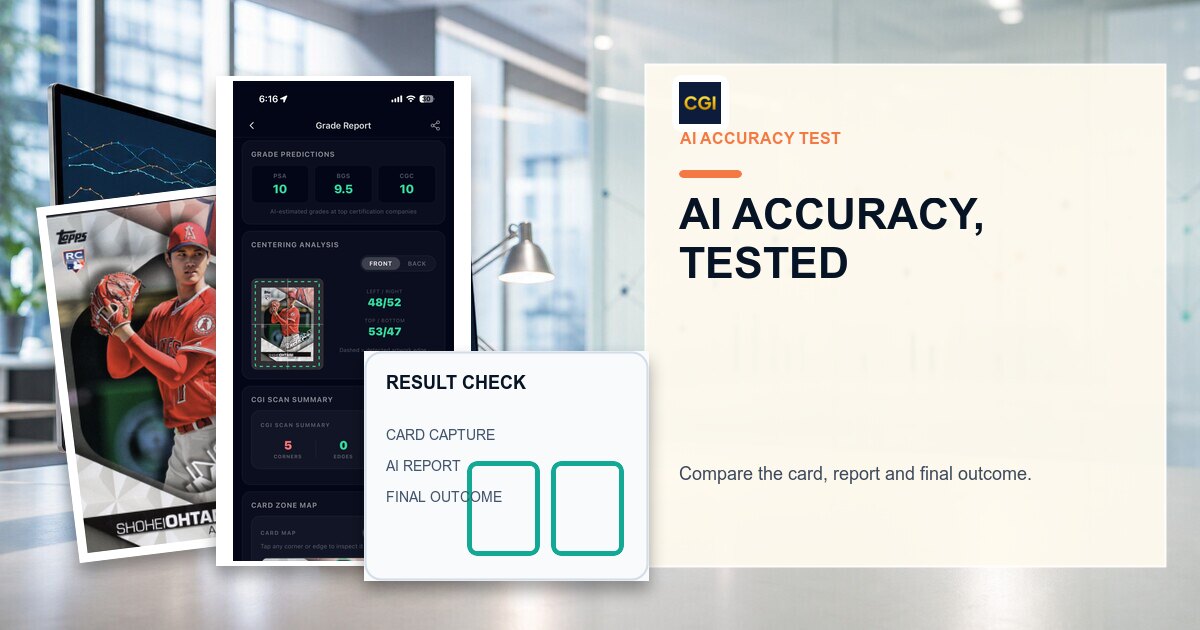
Collectors hear that CardGrade hits 92.8% agreement with professional slabs, but what does that number actually mean? This article opens the hood on our accuracy benchmark, how we compare to PSA/BGS/CGC, and how you should use that data when deciding what to submit.
CardGrade.io Editorial·Published Dec 15, 2025 · Updated Feb 21, 2026·10 min read
Is AI Card Grading Accurate? Inside CardGrade's 92.8% Benchmark Against PSA
Every AI grading tool claims accuracy. Few explain what that number actually means, how it was measured, or where the AI gets it wrong. This article does all three.
CardGrade's AI achieves 92.8% accuracy when compared against PSA grades. That statistic has a specific definition, a specific methodology, and specific limitations. Understanding all of them helps you use AI grading as the decision tool it's designed to be, rather than a black box you blindly trust.
What "92.8% Accuracy" Actually Means
The 92.8% figure means: of all cards graded by CardGrade's AI and subsequently graded by PSA, 92.8% of the AI predictions fell within one grade point of PSA's actual grade.
"Within one grade point" is the key qualifier. If the AI predicted PSA 9 and the card received a PSA 8, PSA 9, or PSA 10 from PSA, that prediction is counted as accurate. If the AI predicted PSA 9 and the card received a PSA 7, that's a miss.
This is not the same as "the AI guesses the exact grade 92.8% of the time." Exact-match accuracy is lower. The one-point window reflects the practical reality that professional grading itself has variance. Two competent human graders examining the same card will disagree on the exact grade more often than most collectors realize.
Why One Grade Point Is the Right Standard
PSA's own grading has inherent variance. Submit the same card twice to PSA and there's a meaningful probability it receives a different grade the second time. This variance is most common at grade boundaries (the 8/9 line, the 9/10 line) where subjective judgment plays the largest role.
Given this reality, expecting an AI to predict exact grades more accurately than human graders agree with each other is an unreasonable standard. The one-point window acknowledges the uncertainty inherent in the entire grading process, including PSA's own process, and asks: does the AI get you in the right neighborhood?
92.8% of the time, the answer is yes.
How the Benchmark Was Conducted
The benchmark followed a straightforward methodology:
Card selection. A diverse sample of cards spanning multiple sports, card types (base, chrome, refractor, holographic), eras (vintage through modern), and condition levels (ranging from apparent PSA 6 to apparent PSA 10) were assembled.
AI grading. Each card was photographed under standardized conditions and processed through CardGrade's AI. The AI returned a predicted grade for each card.
Professional grading. The same cards were submitted to PSA for professional grading. The submission used PSA's standard service, with no special handling or requests.
Comparison. Each AI prediction was compared against the PSA grade received. Predictions within one grade point of the PSA grade were classified as accurate. Predictions outside the one-point window were classified as misses.
Calculation. The accuracy percentage was calculated as: (Number of accurate predictions / Total predictions) x 100 = 92.8%.
Sample Composition
The benchmark included cards from major sports (football, basketball, baseball), Pokemon, and other TCG cards. The sample was intentionally diverse because an accuracy benchmark on only PSA 10-quality cards would inflate the percentage. Including cards across the grading spectrum produces a more honest result.
Chrome cards (Prizm, Optic, Bowman Chrome) and holographic cards (Pokemon holos, refractors) were included because these card types present the greatest challenge for AI analysis due to reflective surfaces.
Where the AI Gets It Right
Centering: Near-Perfect Accuracy
Centering is a mathematical measurement. The AI identifies card borders, measures their widths in pixels, and calculates ratios. This process is deterministic and precise. The AI's centering measurements are more accurate than what most collectors can achieve with a ruler, and this precision is consistent across every scan.
When a card fails centering requirements for a PSA 10 (worse than 55/45 on the front), the AI catches it reliably. This alone prevents a significant number of wasted submissions, since centering problems are the most common reason modern cards miss PSA 10.
Obvious Corner and Edge Damage
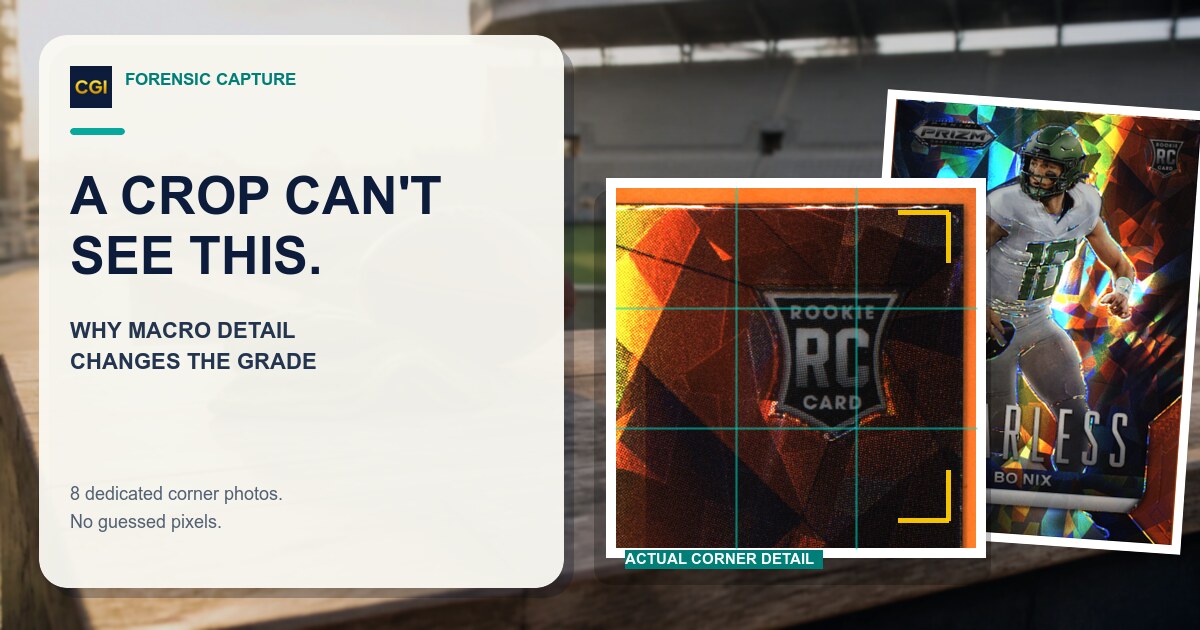
Large corner dings, significant whitening, visible edge chipping, and other major condition issues are well within the AI's detection capabilities. The neural networks were trained on extensive examples of corner and edge damage, and the visual patterns are distinct enough for high-confidence detection.
The AI is particularly effective at catching corner whitening on dark-bordered cards (common on Pokemon card backs) and edge chipping on chrome card stock (common on Prizm and Optic).
Consistent Predictions
One of the AI's underappreciated strengths is consistency. Submit the same card three times and you'll get three identical predictions. Human graders have bad hours, bad days, and unconscious biases. The AI doesn't get tired, doesn't anchor to the previous card's condition, and doesn't care whether it's a Mahomes or a practice squad player.
This consistency makes AI predictions reliable as a decision-making tool. When the AI says a card is a strong PSA 10 candidate, that assessment is based purely on the card's physical characteristics, not on mood or fatigue.
Where the AI Gets It Wrong
The 7.2% miss rate isn't random. It clusters in specific areas:
Surface Defects Invisible in Photos
This is the single largest source of AI grading misses. Certain surface defects, particularly fine scratches, light print lines, and subtle scuffs, are only visible under specific lighting conditions and angles. A standard photograph taken with a phone camera under normal room lighting may not capture these defects.
When the AI analyzes a photo where surface scratches are invisible, it predicts a higher grade than the card will receive from a PSA grader who is handling the card under controlled lighting and examining it at multiple angles.
Practical implication: If the AI predicts PSA 10 and you're not sure about the surface condition, examine the card under a bright, directional light (like a desk lamp or ring light) at multiple tilt angles before submitting. If you see scratches or print lines under angled light that weren't visible in your photos, downgrade your expectations by one point.
Holographic and Refractor Surfaces
Holographic surfaces create complex light refraction patterns that challenge AI analysis in two ways:
Real defects can be masked by holographic patterns, causing the AI to miss damage.
Normal holographic refraction can mimic surface defects, causing the AI to over-penalize.
The AI's accuracy on holographic cards is lower than on non-holographic cards. If you're scanning a holographic Pokemon card or a Prizm Silver refractor, treat the AI's prediction with a wider confidence interval.
Borderline Cards (The 8/9 and 9/10 Lines)
The AI's accuracy drops at grade boundaries where subjective judgment plays the largest role. A card that's solidly a PSA 8 or solidly a PSA 10 is easier to predict than a card that sits right on the 9/10 line. These borderline cards are where human graders disagree with each other most often, and they're where the AI is most likely to be off by one point.
This isn't necessarily a failure of the AI. These are genuinely ambiguous cards where reasonable assessments could go either way. The AI's prediction in borderline cases should be treated as "this card is in the PSA 9 to PSA 10 range" rather than "this card will definitely grade PSA 10."
Unusual Card Stock and Finishes
The AI performs best on card types well-represented in its training data: standard Prizm, Optic, Bowman Chrome, and common Pokemon sets. Cards with unusual finishes, materials, or dimensions (acetate cards, thick patch cards, oversized cards, canvas-finish cards) have fewer training examples and lower prediction accuracy.
How AI Compares to Human Pre-Grading
The relevant comparison isn't AI vs. PSA (since PSA provides the definitive grade). The relevant comparison is AI pre-grading vs. human pre-grading: how accurately can each predict PSA's grade before submission?
Experienced collectors and dealers who pre-screen cards before submission typically achieve accuracy rates in the 75-85% range (within one grade point). They're very good at spotting obvious problems but less consistent at measuring centering precisely and less reliable at catching subtle defects under suboptimal lighting conditions.
The AI's 92.8% accuracy rate compares favorably. The AI doesn't have better "eyes" than an expert, but it has more consistent "eyes" and more precise measurement capabilities, particularly for centering.
Where human pre-grading outperforms AI:
Surface defects under variable lighting. A human rotating a card under a desk lamp will catch scratches that a static photograph misses.
Tactile assessment. Humans can feel creases, warps, and embedded particles that photographs don't capture.
Authentication instincts. Experienced collectors can sense when something is "off" about a card in ways that are difficult to quantify.
The strongest pre-grading approach combines both: use AI for precise centering measurement and systematic evaluation of all four grading categories, then manually verify surface condition under angled light for any card the AI flags as a PSA 9 or 10 candidate.
Using the Accuracy Data to Make Better Decisions
The 92.8% accuracy rate tells you that the AI prediction is highly useful but not infallible. Here's how to calibrate your decisions:
AI predicts PSA 10: There's a strong chance the card grades PSA 9 or PSA 10 from PSA. The main risk is surface defects not visible in photos. Inspect the surface manually before submitting.
AI predicts PSA 9: The card will likely grade PSA 8, 9, or 10. If a PSA 9 justifies the grading cost for this card, submit. If you need a PSA 10 to justify grading, this card is a marginal candidate.
AI predicts PSA 8 or below: The card is unlikely to be a PSA 10 candidate. Don't submit unless you're grading for personal collection purposes or the card is valuable enough that even a PSA 8 justifies the fee.
AI sub-scores disagree dramatically: If the AI gives a PSA 9 overall but one sub-category (like surface) scores much lower than others, that's the category most likely to cause problems. Examine that specific aspect of the card before deciding.
Honest Limitations of the Benchmark
No benchmark is perfect. Here are the limitations of the 92.8% figure:
Sample size. While the benchmark used a meaningful number of cards, it was not a million-card study. The 92.8% figure has a confidence interval around it.
Photo quality dependency. The benchmark used standardized photography conditions. In real-world use, collectors take photos with various phones, in various lighting, at various angles. Real-world accuracy may be lower if photo quality is poor.
PSA grade variance. PSA's own grades have some variance, as mentioned. If the same cards were submitted to PSA a second time, some would receive different grades, which would change the accuracy calculation in both directions.
Evolving grading standards. PSA has adjusted their grading standards over time (the centering requirement for PSA 10 changed from 60/40 to 55/45 in recent years). The AI's training data includes grades from both the old and new standards. As the model is retrained on newer data, this issue diminishes over time.
These limitations don't invalidate the benchmark. They contextualize it. 92.8% accuracy within one grade point, measured against actual PSA grades, is a meaningful and useful performance metric for a pre-screening tool.
The Bottom Line
AI card grading at 92.8% accuracy is accurate enough to be a reliable pre-screening tool and not accurate enough to replace professional grading. That's exactly the role it's designed to fill.
Use it to answer the question that costs you $25-$150 every time you get it wrong: should this card be submitted to PSA?
Get started with 3 free AI grading credits at CardGrade. For more on how the AI technology works under the hood, read our article on AI grading technology. For guidance on which grading company to submit to, check our grading companies comparison.
Share
Ready to grade your cards with AI?
Pre-screen your cards before submitting to PSA, BGS, or CGC. Start with 3 free credits.
The CardGrade.io editorial team writes about card grading, AI technology, and collecting strategy. Our guides are researched against official PSA, BGS, and CGC standards.