AI vs Human Card Grading: Pros, Cons & When to Use Each
Compare AI and human card grading, including authentication, photo limits, slabs, costs, and when collectors should use one approach or both.
Loading...
Compare AI and human card grading, including authentication, photo limits, slabs, costs, and when collectors should use one approach or both.
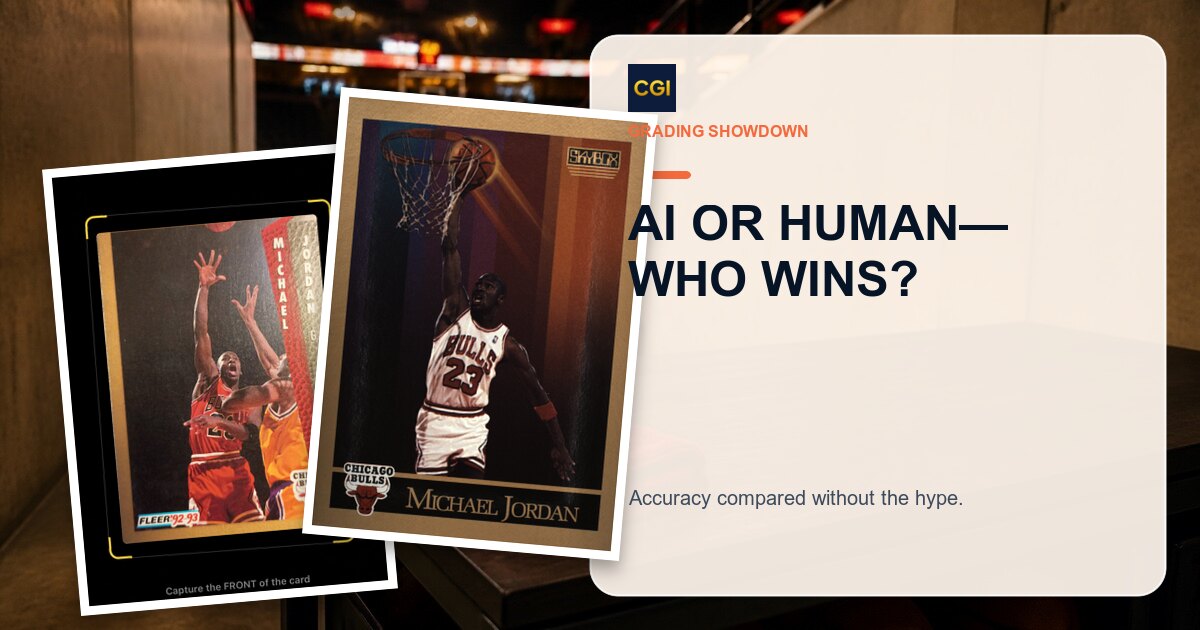
AI and human card grading solve different parts of the collector's decision. CardGrade is a photo-based condition pre-screen: it reviews visible details in the images you provide and helps you decide which cards deserve closer inspection or a paid submission. A professional grading service physically examines the card, evaluates authenticity and alterations under its own procedures, assigns its official grade, and encapsulates accepted cards in a slab.
Use AI first when you need to sort a stack, compare visible condition, or build a submission shortlist. Use a professional grader when you need authentication, a market-recognized grade, physical inspection, or encapsulation. For many valuable cards, a practical workflow is AI pre-screen, personal inspection, then professional grading.
If your main question is how closely a photo-based estimate can line up with a final grade, read our separate guide to AI card grading accuracy, methodology, and limitations. Accuracy is not a single universal percentage: the card, images, lighting, defect type, and professional grading standard all affect the comparison.
| Factor | AI photo pre-screen | Professional human grading |
|---|---|---|
| Primary job | Estimate visible condition from submitted images | Inspect the physical card and assign the company's official grade |
| Authentication | Does not authenticate the physical card | Can evaluate authenticity and alterations under the service's procedures |
| Surface inspection | Limited to defects visible in the photos | Can tilt, magnify, and inspect the card under controlled conditions |
| Output | A screening result for your decision process | An official grade and, for accepted cards, an encapsulated slab |
| Market role | Helps prioritize cards; does not create a professional slab grade | A recognized service outcome that buyers may use when valuing a card |
| Convenience | No mailing step; useful for reviewing many candidates | Requires submission, handling, fees, and turnaround time |
| Best use | Sorting, condition review, and submission planning | Authentication, final grading, resale preparation, and protection |
| Main limitation | Image quality and angle determine what can be seen | Cost, wait time, and a judgment made under one company's standards |
Neither column is “better” in every situation. The right choice depends on whether you need a fast condition screen or a final physical grading service.
CardGrade analyzes photographs of a card and looks for visible condition signals across centering, corners, edges, and surface. That makes it useful before you spend money or place a card in the mail.
An image model can only evaluate what the camera captures. It cannot hold the card, verify the stock, feel thickness, change the lighting angle after the upload, or inspect a hidden edge. It also cannot turn an image estimate into a professional grade.
CardGrade should not be used as proof that a card is authentic, unaltered, or guaranteed to receive a particular grade. Treat the result as one input alongside your physical inspection, the grading company's published standards, current fees, and recent market data.
A professional grading company receives the physical card and applies its own authentication and condition standards. Depending on the company and card, the process can include examination under controlled lighting or magnification, checks for alterations, grade assignment, quality control, and encapsulation.
Collectors generally choose this route because they need an outcome a photo pre-screen cannot provide:
The major services do not use identical scales or policies. Compare the current options in our card grading companies guide, then review the latest official service details before submitting. Our collector guides cover PSA grading, Beckett grading, and CGC card grading.
Use a photo-based AI pre-screen when the next decision is which cards deserve more attention.
Good use cases include:
You can start with the AI card grading tool, then use the dedicated edge analysis and surface analysis pages when one category needs more attention. Our guide to understanding AI grade results explains how to interpret an estimate without treating it as a guaranteed professional result.
Use a professional service when the outcome depends on the physical card, not just visible condition in photos.
Human grading is the stronger choice when:
For an expensive card, do not let a favorable AI estimate replace authentication, insurance, current sold-price research, or professional advice.
Use both when you have more potential cards than you should reasonably submit. The AI step helps organize the decision; the human grading company makes the final physical determination.
For a deeper submission checklist, see how to pre-screen cards before PSA or BGS.
The most important limitation of photo-based grading is simple: the model cannot evaluate a defect that the image does not reveal.
For a useful pre-screen:
Changing the crop, angle, focus, or lighting changes the visual evidence. If two image sets produce different results, inspect the physical card and recapture it under more controlled conditions instead of choosing whichever estimate you prefer.
Reflective cards are harder to assess from a single lighting setup. Glare can look like whitening, conceal a scratch, flatten texture, or create false boundaries around an edge. A card can also look clean straight-on while revealing print lines or dents when tilted.
For foil, holographic, chrome, refractor, and other reflective finishes:
The same caution applies to textured cards, acetate cards, die-cuts, thick stock, vintage cards, and cards photographed through a holder.
AI vs human card grading is not a winner-take-all contest. A photo pre-screen helps answer, “Which cards should I inspect or consider submitting?” A professional grading service answers, “What does this company conclude after examining the physical card?”
Use CardGrade's AI pre-screen to organize visible-condition decisions, then use a professional grader when the card needs authentication, a final company grade, or encapsulation. Keeping those roles separate makes both tools more useful.
If you are deciding whether a specific image-based result deserves confidence, use the seven-check AI card grading trust guide before acting on it.
Not in every use case. AI is useful for fast, photo-based condition screening and submission planning. Human professional grading is necessary when you need physical inspection, authentication procedures, an official company grade, or encapsulation.
No. CardGrade does not authenticate or encapsulate the physical card, and its estimate is not a PSA, BGS, or CGC grade. It can help you decide which cards may be worth submitting to a professional service.
There is no single percentage that applies to every card and photo. Agreement depends on image quality, card type, visible versus hidden defects, and the professional company's standards. Evaluate the methodology and limitations rather than relying on an isolated accuracy claim.
A photo-based condition pre-screen should not be treated as authentication. Counterfeits, trimming, recoloring, stock differences, and other alterations may require physical examination, specialized equipment, and expert knowledge.
No. An AI estimate can support your own condition review, but it is not an official slab grade. Market value depends on the card, buyer demand, authenticity, condition, grading company, and current comparable sales.
Pre-screen your cards before submitting to PSA, BGS, or CGC. Plans from $4.99/mo.
Pre-screen free in 60 secondsAlso available as a Chrome Extension
Grade cards while you browse
Install our free Chrome Extension — right-click any card on eBay, COMC, or TCGPlayer for a grade in ~60 seconds.

Founder, CardGrade
Jamie Budesky is the founder of CardGrade and the engineer behind its AI vision grading pipeline. An Army veteran and IT specialist (DoD, since 2017), he writes about card grading, AI/ML grading technology, and collecting strategy — grounded in CardGrade's own grading data.

Zooming into one photo cannot recover detail the camera never captured. Why per-corner macro capture changes what AI grading can actually see, and when to use it.

Forensic Capture is CardGrade's premium grade: eight per-corner macros, stitched live, for sharper whitening, fraying, and edge-wear detection.
It can help flag visible concerns, but these cards often require extra caution. Vintage stock and alterations may need physical expertise, while reflective finishes can hide or imitate defects depending on the lighting angle.
You can run a preliminary screen, but seller photos may be compressed, cropped, edited, or lit to minimize defects. Do not use an image estimate alone to authenticate the card or make a high-value purchase.
Use clear photos for an initial condition screen, inspect the physical card under controlled light, compare current fees with recent sold prices at several possible grades, and submit only when authentication, an official grade, or a slab justifies the cost and risk.
Use a card grading app to pre-screen visible condition before you pay to submit. CardGrade runs on iPhone, Android, and desktop web—PSA, BGS, and CGC estimates in ~60 seconds.