Does CGC Use AI? How CGI Card Grading Works
Learn how AI card grading reviews visible condition from photos, where image limits begin, and how CGC says AI assists rather than replaces its graders.
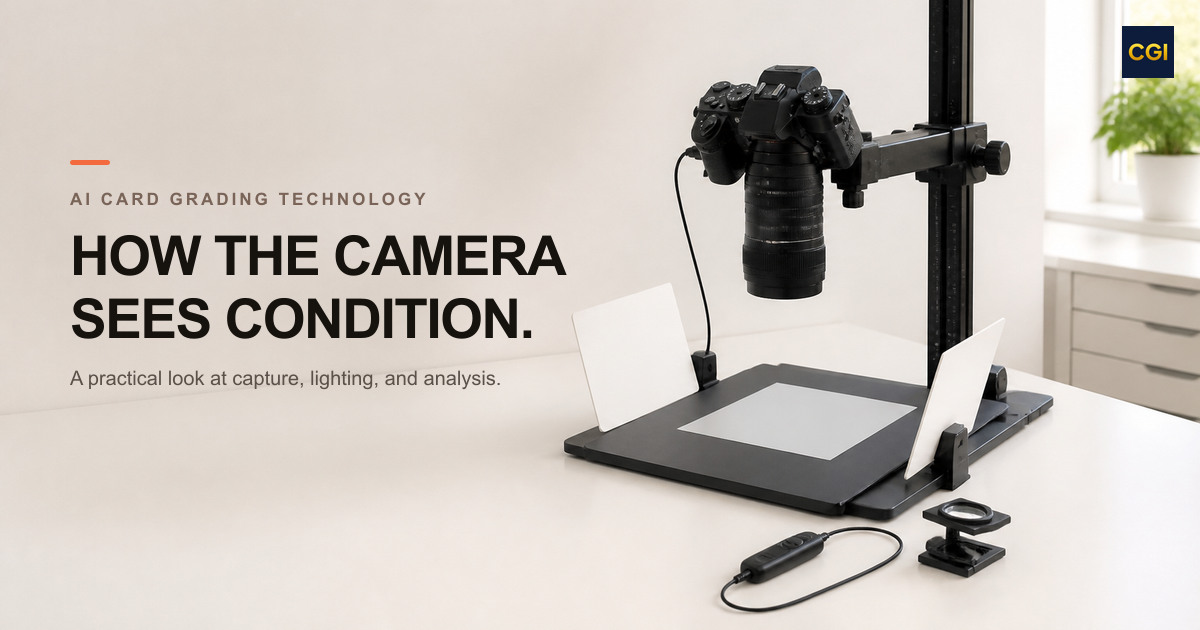
Loading...
Learn how AI card grading reviews visible condition from photos, where image limits begin, and how CGC says AI assists rather than replaces its graders.
AI card grading uses images to estimate the visible condition of a trading card. A photo-based system can organize observations about centering, corners, edges, and surface, then present those observations as a condition estimate or predicted grading-company range.
That estimate is useful for pre-screening a stack of cards before paying submission fees. It is not the same as a professional grade. A photo-based tool cannot hold the card, authenticate it, inspect it under every light and angle, encapsulate it, or guarantee the grade that PSA, BGS, CGC, or another company will assign after a physical examination.
For the complete collector workflow, including capture, interpretation, and submission decisions, use the complete guide to AI card grading. This article focuses on the technology, the difference between CGI and CGC, and the boundary between image assistance and professional grading.
The similar abbreviations answer different search intents:
| Name | What it is | What it does |
|---|---|---|
| CGI | CardGrade Intelligence, CardGrade's photo-analysis system | Estimates visible card condition from supplied images for pre-screening |
| CGC Cards | A professional grading and authentication company | Examines physical cards, authenticates eligible collectibles, assigns official grades, and encapsulates cards |
CardGrade is not affiliated with, endorsed by, or an official representative of CGC, PSA, BGS, or any other grading company. Learn more about the company behind CGI on the About CardGrade page.
Yes, CGC says AI assists parts of its card-grading workflow, but human professionals still examine the physical card and determine the grade.
CGC's official grading FAQ says artificial intelligence assists with attribution and centering. Its published grading process separately explains that multiple CGC professionals examine every card and reach a consensus about the final grade. Those statements describe a human-led professional process with technology assistance, not a fully automated photo-grading service.
That distinction matters. CGC has the physical card and can combine tools with in-hand examination. A consumer photo pre-screen, including CardGrade, only receives the visual evidence captured in the uploaded images.
Sources checked August 9, 2026: CGC Cards grading FAQ and CGC Cards grading process.
If you are deciding whether to mail a card to CGC, review the current CGC grading guide and CGC's own service terms before submitting.
PSA has publicly described technology that assists graders with card diagnostics, measurements, and detection. In its announcement about acquiring Genamint, PSA said the technology was intended to support its grading process and explicitly framed it as assistance for human graders rather than their elimination.
As with CGC, that is different from asking an app to estimate condition from customer photos. PSA controls the physical intake, authentication, imaging, review, and final grade within its own process.
Source checked August 9, 2026: PSA's Genamint acquisition announcement.
For a neutral overview of the services collectors can compare, see the card grading companies guide.
CardGrade's CGI Vision AI is designed for a narrower job: help a collector review visible condition before deciding whether a professional submission deserves more time and money.
See the step-by-step product flow on How CardGrade Works, or try an eligible AI card grading pre-screen.
An AI result can only be as complete as the evidence in the supplied images.
| A clear photo may help review | A photo does not establish |
|---|---|
| Apparent left/right and top/bottom border balance | Authenticity or card-stock composition |
| Visible corner softness, whitening, or damage | Thickness, flexibility, texture, or altered stock |
| Visible edge chips, whitening, and wear | Defects hidden by a sleeve, holder, crop, or angle |
| Scratches, print lines, stains, or dents visible under that light | A market-recognized professional grade |
| Whether a card deserves closer in-hand inspection | The grade a professional company will issue |
Three common examples show why the limitation is practical, not theoretical:
For a focused geometry check, use the card centering tool, then verify the measurement against the physical card.
PSA, BGS, and CGC publish different grading descriptions, scales, and service rules. A multi-company result can therefore present separate prediction heuristics informed by those published criteria.
It does not mean an outside tool knows a grading company's private formula, internal controls, grader discussion, or final decision. Published standards are references, not a complete reproduction of a company's process. Treat each prediction as a planning estimate and let the professional grading company determine its own official grade.
This is also why a prediction should not be used as a sales claim that a raw card “is” a PSA 10, BGS 9.5, or CGC 10. Until the company grades the physical card, it is an estimate.
Photo-based analysis is most useful when the decision is repetitive and reversible:
The grading ROI calculator can help compare fees, shipping, insurance, and expected sale value after the condition review.
Professional graders work with the physical object and control the final service. Human-led examination remains important when a collector needs:
The strongest workflow is not “AI versus humans.” It is a photo-based pre-screen followed by an in-hand review and, when the decision requires it, professional grading. The AI versus human grading guide explains that handoff in more detail.
A model can apply the same logic and still receive different inputs. If one photo is cropped, another is soft, and a third catches a scratch under directional light, each set contains different evidence.
When two results differ:
The AI grading trust checklist gives a decision-by-decision way to judge whether a result is sufficient.
Use the technology as one stage in a broader submission process:
AI card grading is a photo-based condition pre-screen. It can make visible observations easier to review and help prioritize cards for closer inspection, but it cannot turn a photograph into authentication or an official PSA, BGS, or CGC grade.
CGI means CardGrade Intelligence. CGC is a separate professional grading company that says AI assists parts of its human-led physical-card process. Keeping those roles clear makes the technology more useful: use CGI to organize the evidence in your photos, inspect the card yourself, and use the appropriate professional service when the decision requires a certified physical grade.
CGC says it uses AI to assist with attribution and centering. CGC also says multiple professionals examine each physical card and reach a consensus grade, so AI assistance is part of its process rather than a replacement for its graders.
PSA has publicly described technology that provides diagnostics, measurements, and detection capabilities to assist its graders. PSA has not described this as removing human graders from the final physical-card grading decision.
CGI stands for CardGrade Intelligence, the name CardGrade uses for its photo-based pre-screening system. CGI is not CGC, and CardGrade is not affiliated with CGC, PSA, BGS, or another professional grading company.
No. A photo-based AI result is an estimate of visible condition. It does not authenticate, physically inspect, encapsulate, or assign an official professional grade to a card.
No. Authentication may require physical examination, material checks, magnification, ultraviolet light, or comparison with known genuine examples. Use an appropriate professional service when authenticity matters.
Pre-screen your cards before submitting to PSA, BGS, or CGC. Plans from $4.99/mo.
Pre-screen free in 60 secondsAlso available as a Chrome Extension
Grade cards while you browse
Install our free Chrome Extension — right-click any card on eBay, COMC, or TCGPlayer for a grade in ~60 seconds.

Founder, CardGrade
Jamie Budesky is the founder of CardGrade and the engineer behind its AI vision grading pipeline. An Army veteran and IT specialist (DoD, since 2017), he writes about card grading, AI/ML grading technology, and collecting strategy — grounded in CardGrade's own grading data.

Zooming into one photo cannot recover detail the camera never captured. Why per-corner macro capture changes what AI grading can actually see, and when to use it.

Forensic Capture is CardGrade's premium grade: eight per-corner macros, stitched live, for sharper whitening, fraying, and edge-wear detection.
Each photo set contains different visual evidence. Camera angle, crop, glare, focus, background, and lighting can reveal or hide a defect, so a photo-based estimate can change when the evidence changes.
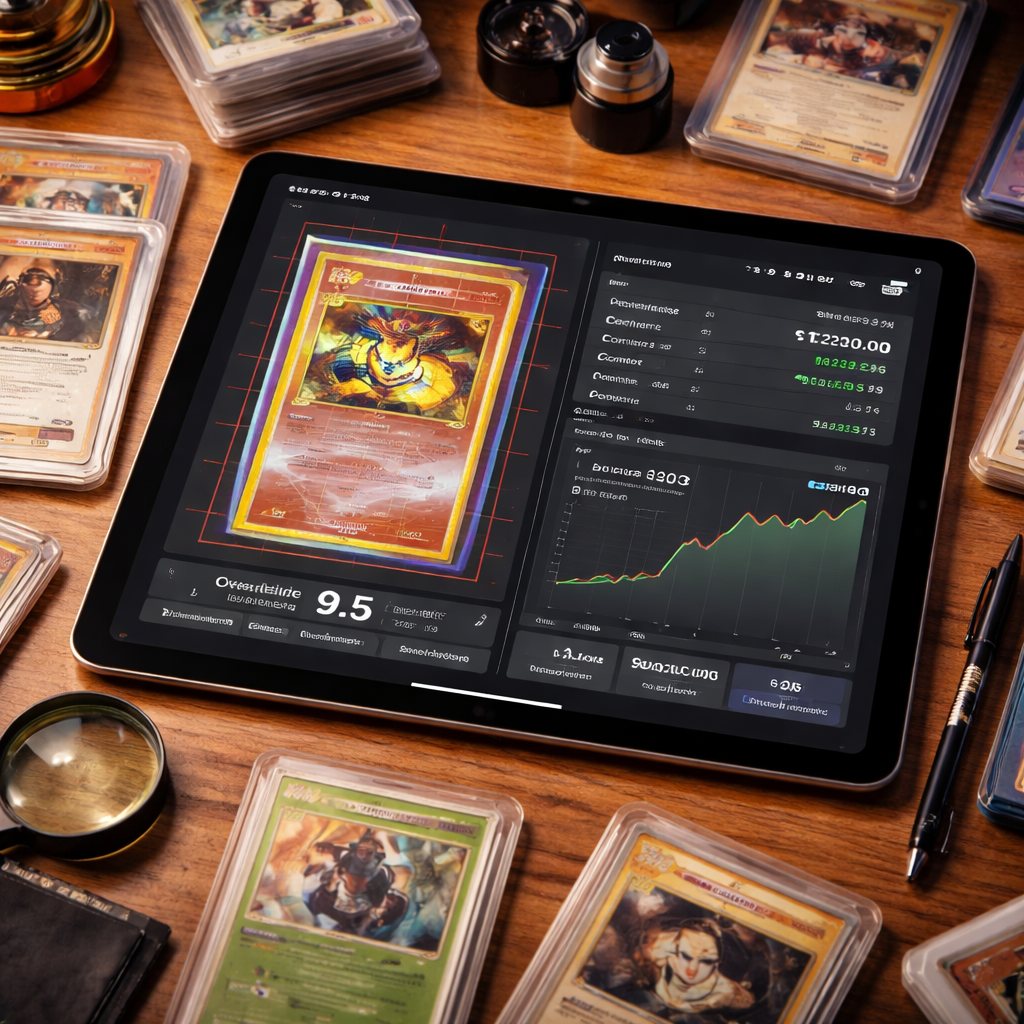
Use a card grading app to pre-screen visible condition before you pay to submit. CardGrade runs on iPhone, Android, and desktop web—PSA, BGS, and CGC estimates in ~60 seconds.