CGC Card Grading: Complete Guide to the Fastest-Growing Grading Company
Guides
CGC Card Grading: Complete Guide to the Fastest-Growing Grading Company
Complete guide to CGC card grading. Learn about pricing, turnaround, strengths for Pokemon/TCG, and how CGC compares to PSA and BGS in 2026.
CardGrade.io Editorial·Published Oct 13, 2025 · Updated Feb 26, 2026·12 min read
What Is CGC (Certified Guaranty Company)?
CGC card grading has rapidly become one of the most popular options for trading card collectors, particularly in the Pokemon and TCG markets. CGC -- the Certified Guaranty Company -- entered the trading card space in 2020, but the company's grading heritage stretches back over two decades through its sister companies that have authenticated millions of collectibles.
If you have been hearing more about CGC grading lately, there is good reason. CGC has carved out a significant market position through competitive pricing, faster turnaround times, and strong appeal among TCG collectors. This guide covers everything you need to know about CGC card grading in 2026 -- from pricing and grading criteria to how it stacks up against PSA and BGS.
CGC's Background: From Comics to Cards
CGC was originally founded in 2000 as the premier grading service for comic books. Under the Certified Collectibles Group umbrella, the organization expanded into coins (NGC), stamps, autographs, and eventually trading cards. This cross-collectible expertise gives CGC a deep foundation in authentication, grading standards, and fraud prevention.
Key Milestones
2000 -- CGC launches as a comic book grading service
2021-2022 -- Rapid growth during the pandemic-era card boom; CGC captures significant market share
2023-2024 -- Establishes strong foothold in Pokemon and TCG markets
2025-2026 -- Continued growth with expanded sports card acceptance and faster turnaround
CGC's advantage as a newer entrant is that they built modern infrastructure from the start. Their technology, processes, and customer experience reflect current expectations rather than legacy systems.
CGC Grading Scale and Criteria
CGC card grading uses a 1 to 10 scale with half-point increments, similar to BGS. The evaluation considers four primary factors: Centering, Corners, Edges, and Surface.
Grade Breakdown
Grade
Label
Description
10
Pristine
Flawless card in every respect
9.5
Gem Mint
Virtually perfect with negligible imperfections
9
Mint
Outstanding condition, one minor flaw
8.5
NM/Mint+
Excellent condition, slight imperfection
8
NM/Mint
Very clean, minor wear allowed
7.5
Near Mint+
Minor wear visible upon inspection
7
Near Mint
Some noticeable wear present
6.5 and below
Lower grades
Progressive levels of wear and damage
CGC Subgrades
CGC offers optional subgrades for an additional fee. Like BGS, these cover Centering, Corners, Edges, and Surface. However, unlike BGS where subgrades are standard, CGC makes them optional -- which keeps base pricing lower for collectors who do not need that level of detail.
Grading Criteria Details
Centering -- CGC measures front and back centering independently. For a 10, centering must be approximately 50/50 on the front and 55/45 or better on the back. Wider tolerances apply at lower grades.
Corners -- All four corners are inspected under magnification for sharpness, dings, and rounding. Corner damage from pack insertion or handling is common and directly impacts grades.
Edges -- CGC examines edges for chips, whitening, nicks, and cutting irregularities. Dark-bordered cards and foil cards are particularly susceptible to visible edge flaws.
Surface -- The front and back surfaces are checked for scratches, print defects, staining, indentations, and coating damage. Chrome and foil cards are held to exacting surface standards.
CGC Pricing and Turnaround Times
One of CGC's strongest selling points is competitive pricing with generally faster turnaround than PSA.
Service Level
Price (approx.)
Turnaround
Max Declared Value
Economy
$15-20/card
75-120 business days
$250
Standard
$30-40/card
30-50 business days
$1,000
Express
$65-80/card
10-15 business days
$5,000
Premium
$150/card
5-7 business days
$10,000
Walk-Through
$250+/card
1-3 business days
Unlimited
Prices are approximate and subject to change. Always verify current pricing on CGC's website.
Cost Advantages
Lower entry price -- CGC's economy tier is typically cheaper than PSA's equivalent
Optional subgrades -- Pay extra only if you want subgrade detail, keeping base cost down
Bulk discounts -- CGC offers pricing incentives for larger submissions
Faster turnaround at comparable prices -- Especially at the Economy and Standard tiers
Additional Fees
Subgrades -- Additional $10-15 per card when requested
Shipping -- Budget $10-25 for shipping to CGC
Return shipping -- Varies by package size and speed
Minimum submission -- Some tiers require minimum card counts
CGC for Pokemon and TCG Cards
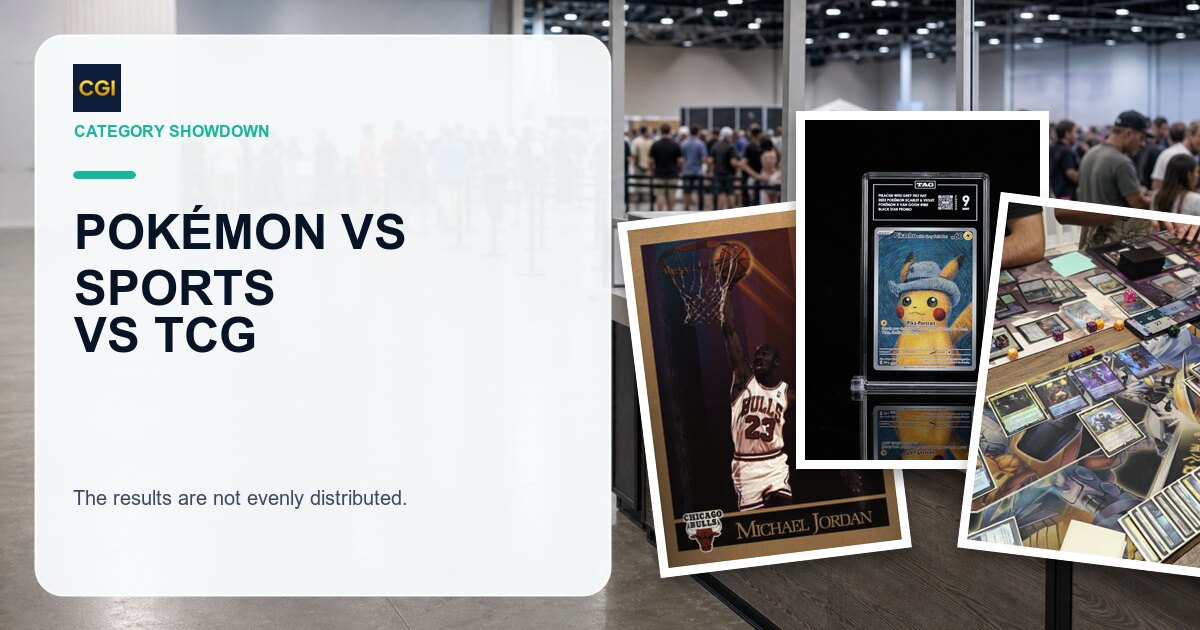
This is where CGC trading cards truly shines. CGC has built its strongest market position in the Pokemon and Japanese TCG segments.
Why Pokemon Collectors Choose CGC
Competitive pricing -- Grading a large Pokemon collection is cheaper through CGC than PSA
Faster turnaround -- Getting cards back sooner matters for active sellers
Growing market acceptance -- CGC-graded Pokemon cards sell well on eBay, TCGPlayer, and marketplace platforms
Quality slab design -- CGC's cases are well-regarded for clarity and protection
Japanese card expertise -- CGC has invested in grading Japanese Pokemon and Yu-Gi-Oh cards
Popular Pokemon Cards for CGC Grading
Card
Era
CGC Appeal
Base Set Charizard
Vintage
Strong demand for CGC-graded vintage
Gold Star cards
Ex era
Rare cards benefit from CGC's growing recognition
Alt Art cards
Modern (Sword & Shield, Scarlet & Violet)
High volume of modern submissions
Japanese Promo cards
Various
CGC's Japanese grading expertise is a differentiator
Illustration Rare
Modern
Popular target for CGC grading
TCG Beyond Pokemon
CGC also grades Yu-Gi-Oh, Magic: The Gathering, Dragon Ball Super, and other trading card games. For TCG collectors outside Pokemon, CGC often provides better value than PSA due to lower fees and faster service. If you collect Pokemon cards, check out our AI Pokemon card grading guide for additional tips on pre-screening.
CGC for Sports Cards
While CGC dominates in TCG grading, its sports card presence is still developing.
Current State
Growing acceptance -- More sports card collectors are considering CGC, especially for mid-value cards where grading fees matter more
Lower resale premiums -- CGC sports cards generally sell for less than PSA or even BGS equivalents
Faster turnaround -- The speed advantage is real and valuable for sellers who need quick flips
Good for personal collections -- If you are not planning to sell, CGC offers solid protection and authentication at a lower cost
Considerations for Sports Card Collectors
The sports card market still heavily favors PSA and BGS for premium cards. If you are grading a high-value rookie card for resale, PSA likely offers better return on investment. But for mid-value sports cards, personal collection building, or situations where turnaround time matters, CGC is a strong option.
For a detailed comparison of all three services, visit our card grading companies page. Here is a summary:
Factor
CGC
PSA
BGS
Founded (cards)
2020
1991
2001
Grading scale
1-10 (half points)
1-10 (whole numbers)
1-10 (half points)
Subgrades
Optional (extra fee)
No
Standard (included)
Economy price
~$15-20
~$20-25
~$20-25
Economy turnaround
75-120 days
120-180 days
90-120 days
Best market (resale)
Pokemon/TCG
Sports cards, Pokemon
Sports (subgrade buyers)
Slab design
Clear, modern
Classic, thin
Thick, protective
Population database
Growing
Largest
Established
Choosing the Right Service
Choose CGC if you primarily collect Pokemon/TCG, want lower pricing, or need faster turnaround
Choose PSA if you want maximum resale value, especially for sports cards
Choose BGS if you want subgrades included by default and value granular condition detail
Pros and Cons of CGC Grading
Pros
Lower pricing -- Economy tier undercuts both PSA and BGS
Faster turnaround -- Consistently faster than PSA at comparable service levels
Strong TCG reputation -- Market-leading position for Pokemon and other trading card games
Modern infrastructure -- Built with current technology from the ground up
Optional subgrades -- Pay only when you want detailed breakdowns
Established parent company -- Decades of authentication experience through the Certified Collectibles Group
Clean slab design -- Well-made cases with clear visibility
Cons
Lower sports card premiums -- CGC sports cards sell for less than PSA equivalents
Newer to cards -- Less than six years of card grading history
Smaller population database -- Fewer graded cards means less population data for rarity assessment
Market perception gap -- Some collectors still view CGC as a secondary option
Crossover risk -- Cards graded by CGC may not cross to higher PSA or BGS grades
Pre-Screening Before CGC with CardGrade.io
Regardless of which grading company you choose, pre-screening your cards saves money and improves hit rates. CardGrade.io predicts grades for PSA, BGS, and CGC, making it the ideal tool for deciding both which cards to grade and which service to use.
Here is how it works for CGC submissions:
Photograph your card -- Front and back, with good lighting
Upload to CardGrade.io -- The CGI Vision AI analyzes 47 inspection points in 29 seconds
Review predicted grades -- See estimated CGC grades alongside PSA and BGS predictions
Make informed decisions -- Submit to CGC when the predicted grade justifies the cost
CardGrade.io's analysis covers the same four areas CGC evaluates:
Centering -- Precise left/right and top/bottom measurement. Try the dedicated centering tool for detailed analysis.
Corners -- All four corners inspected for micro-damage
Edges -- Chipping, whitening, and cutting irregularities detected
Surface -- Scratches, print defects, and coating damage identified
With 92.8% accuracy and 3 free credits (no credit card required), CardGrade.io removes the guesswork from CGC submissions. Over 540+ trusted teams use CardGrade.io to pre-screen before submitting to all major grading companies.
Is CGC a Good Investment? Market Acceptance and Resale Values
Current Market Position
CGC grading has achieved strong market acceptance in specific segments:
Pokemon -- CGC is widely accepted and CGC 10s command strong premiums, approaching PSA 10 values for some cards
Yu-Gi-Oh -- Solid acceptance with growing collector base
Magic: The Gathering -- Good acceptance, especially for casual collectors
Sports cards -- Growing but still behind PSA and BGS in resale premiums
Price Trends
The gap between CGC and PSA pricing has been narrowing for Pokemon and TCG cards. In 2020-2021, a PSA 10 might have sold for 2-3x a CGC 10 equivalent. By 2025-2026, that gap has closed significantly for many popular cards, particularly modern releases.
For sports cards, the gap remains wider. Collectors focused on sports card investment should still consider PSA or BGS for high-value submissions, while using CGC for personal collection protection or mid-value cards.
Long-Term Outlook
Several factors favor CGC's continued growth:
Volume growth -- As more cards enter the CGC ecosystem, population data improves and market familiarity increases
TCG dominance -- The Pokemon and TCG markets are massive and growing
Innovation -- CGC's modern infrastructure allows faster adaptation to market needs
Show presence -- CGC attends major card shows with on-site submission
Investment Considerations
Buy CGC-graded cards when prices reflect a discount -- If a CGC 10 sells for less than a PSA 10 for the same card, it may represent a value opportunity as market acceptance grows
Grade with CGC when cost savings matter -- For mid-value cards where grading fees significantly impact margins, CGC's lower pricing preserves more profit
Use CGC for TCG investments -- In the Pokemon market specifically, CGC 10s have appreciated well and market acceptance is high
CGC card grading has earned its place as a legitimate top-tier grading service, particularly for Pokemon, TCG, and budget-conscious collectors. The combination of competitive pricing, faster turnaround times, and growing market acceptance makes CGC an excellent choice for many submission scenarios.
The key is matching the right grading company to your specific needs. CGC excels for Pokemon and TCG collections, mid-value submissions where fees matter, and situations where turnaround speed is a priority. For high-value sports cards intended for resale, PSA still commands the highest premiums, and BGS remains the choice for subgrade enthusiasts.
Whichever direction you lean, pre-screening your cards with CardGrade.io ensures you are only paying to grade cards worthy of professional encapsulation. See predicted grades for CGC, PSA, and BGS side by side, and make data-driven grading decisions.
Ready to find out which of your cards deserve CGC grading? Try CardGrade.io free today -- 3 free credits, no credit card required, results in 29 seconds.
Share
Ready to grade your cards with AI?
Pre-screen your cards before submitting to PSA, BGS, or CGC. Start with 3 free credits.
The CardGrade.io editorial team writes about card grading, AI technology, and collecting strategy. Our guides are researched against official PSA, BGS, and CGC standards.