Beckett Grading System (BGS): Scale, Subgrades & Black Label
Learn how the Beckett grading system works, how BGS subgrades affect the final grade, and what separates Black Label 10, Gold 10, and Gem Mint 9.5.
Loading...
Learn how the Beckett grading system works, how BGS subgrades affect the final grade, and what separates Black Label 10, Gold 10, and Gem Mint 9.5.
The Beckett grading system is the 1-to-10 condition scale used by Beckett Grading Services, usually shortened to BGS. Beckett physically examines the card, checks it for authenticity or alteration concerns, assigns the official grade, and seals an accepted card in a BGS holder.
BGS is especially known for showing four condition categories on services that include subgrades: Centering, Corners, Edges, and Surface. Those scores help explain the condition assessment, but they do not let a collector calculate or guarantee the final grade before submission.
This article focuses on the BGS scale, subgrades, and label meanings. For current service tiers, intake status, and submission planning, use the Beckett grading services guide. For fee tables, add-ons, shipping, and batch math, use the BGS grading cost guide.
Current service alert, checked August 8, 2026: Beckett says new online Base and Standard submissions are temporarily paused. Existing and in-transit orders continue processing, while Express and Priority remain available. Beckett says it expects to begin reopening paused services on September 15, 2026. Read Beckett's official availability notice immediately before preparing a shipment.
This guide uses Beckett's current public card-grading page, grading scale, and availability notice. Prices, estimates, and availability can change.
BGS uses half-point increments from 1 through 10. Beckett's current label system distinguishes a Black Label Pristine 10, a Gold Pristine 10, a Gem Mint 9.5, and lower grades.
| BGS grade | Published label context | Practical reading |
|---|---|---|
| Black Label 10 | Pristine 10 with four 10 subgrades | Beckett's highest displayed subgrade combination |
| Gold 10 | Pristine 10 | Overall Pristine 10 without four displayed 10 subgrades |
| 9.5 | Gem Mint | Near the top of the BGS scale, but distinct from a 10 |
| 9 | Mint | High-condition card with limited flaws under Beckett's guidance |
| 8 | Near Mint-Mint | More visible condition limitations than a Mint card |
| 7 | Near Mint | Noticeable wear or condition issues are allowed |
| 6 through 1 | Lower condition grades | Progressively greater wear, damage, or defects |
The short labels above are orientation, not a substitute for Beckett's full physical-card standard. Check the official BGS grading scale for the condition guidance that applies to a specific grade.
The overall BGS grade is not a simple average that a collector can reproduce from four predicted numbers. Beckett has explained that the lowest subgrade is heavily weighted, while stronger categories can affect the final result. Beckett still makes the decision from the physical card.
Use subgrades to understand where an already graded card was strongest or weakest. Before submission, treat your own measurements or an image-based estimate as screening evidence—not an official BGS calculation.
Centering compares the printed design with the card's borders on both axes and both sides. Beckett's current card-grading page describes a Black Label Pristine 10 as 50/50 on the front and 55/45 or better on the back, alongside perfect scores in the other categories. That top-grade reference does not make centering the whole grade.
Use the free card-centering tool as a measurement aid, then compare the result with Beckett's current published guidance. A photo or ratio cannot establish the final grade.
Inspect all four corners on the front and reverse under bright, even light. Look for whitening, soft points, fraying, bends, dings, and compression. Magnification can reveal an issue that is hard to see at normal viewing distance.
Check every edge for chipping, whitening, rough cutting, notches, dents, and layer separation. Dark borders can make whitening easier to see, while a light border can require directional light and a closer inspection.
Tilt the card through several angles under one directional light. Look for scratches, print lines, dents, stains, residue, gloss changes, focus or registration issues, and foil defects. A straight-on photo can miss angle-dependent surface flaws, so inspect the physical card as well. The edge and surface inspection guide provides a repeatable checklist.
Beckett's availability notice and grading page answer different questions: a listed service does not necessarily mean that tier is accepting new online orders today.
As checked August 8, 2026:
Confirm both Beckett's grading page and current availability immediately before paying or shipping. For the current price table, add-ons, shipping, and batch math, use the dedicated BGS grading cost guide and grading ROI calculator.
| Decision factor | BGS | PSA |
|---|---|---|
| Grade increments | Half points | Whole numbers plus half-point grades from 1.5 through 8.5 (no 9.5) |
| Displayed condition detail | Four subgrades on included services | One overall numerical grade |
| Top-label structure | Black Label 10, Gold 10, Gem Mint 9.5 | Gem Mint 10 |
| Current entry availability | Base and Standard paused; Express and Priority open as checked | Depends on PSA's live service schedule |
| Best evidence for value | Recent BGS sales for the exact card and grade | Recent PSA sales for the exact card and grade |
Neither column proves which service will produce the better financial outcome. Compare current fees, timing, holder preference, population context, and completed sales for the same card. The PSA vs Beckett comparison and broader card grading companies guide organize those tradeoffs without treating one grader as the universal winner.
A BGS label does not create a fixed premium, and a PSA grade is not automatically worth more for every card. The relevant evidence is recent completed sales for the same year, set, card number, variation, grade, and label type. A Black Label 10, Gold 10, BGS 9.5, and PSA 10 are different search groups and should not be blended into one average.
Population data is supply context, not a price guarantee. A low count matters only when buyers also want that exact card and label. Verify an existing holder through the BGS cert lookup, then compare the item with Beckett's official record before buying.
BGS may fit when:
PSA may fit when its current service, registry, holder, or exact-card sales better match your goal. Personal-collection decisions can reasonably prioritize presentation and documentation; resale decisions should use current, card-specific completed sales.
A BGS Black Label Pristine 10 requires a 10 in Centering, Corners, Edges, and Surface. A Gold Pristine 10 is a different label outcome. Do not compare their populations or sales as if they were the same product.
You can screen for visible issues before submitting, but you cannot confirm a Black Label from photos. A card that looks clean can still have a small surface, edge, stock, alteration, or authenticity issue that changes Beckett's decision.
A practical process is:
CardGrade provides an image-based pre-screen of visible centering, corners, edges, and surface signals. It can help prioritize cards for closer inspection before paying a professional submission fee. It is not Beckett grading, physical authentication, a value appraisal, or a guarantee of any BGS grade.
Eligible new accounts can run one full AI pre-screen free. Review the result against the physical card, Beckett's current standards, and the limits of the photos supplied.
Compare the label and card with Beckett's official certification record. Review each displayed subgrade, document any difference from your pre-submission expectation, and use that evidence to improve your next inspection. Do not assume one outcome proves a universal conversion between BGS and another grader.
The Beckett grading system combines a 1-to-10 half-point scale with Centering, Corners, Edges, and Surface subgrades on included services. Its Black Label 10 is a distinct four-10 outcome, and its current online service availability must be checked separately from its published price table.
Before submitting, verify the active tier, inspect the physical card, calculate the all-in cost, and compare exact-card completed sales. Use an AI pre-screen only as an inspection aid; Beckett makes the final grade and authentication decision.
The Beckett grading system is the 1-to-10 condition scale used by Beckett Grading Services (BGS) when it physically examines, grades, and encapsulates a card. BGS uses half-point increments and evaluates Centering, Corners, Edges, and Surface. Beckett makes the official final grade after physical review.
BGS displays Centering, Corners, Edges, and Surface subgrades on service levels that include them. Beckett also lists a lower-priced Base option without subgrades. Check the selected service before submitting because availability and inclusions can change.
A BGS Black Label Pristine 10 requires a 10 in all four displayed subgrade categories: Centering, Corners, Edges, and Surface. It is different from a Gold Pristine 10. A collector cannot establish or guarantee either result before Beckett physically reviews the card.
Check Beckett’s live grading page for current fees and its availability notice for the services accepting new online submissions. Prices, estimates, inclusions, and intake status can change independently. CardGrade’s separate BGS grading cost guide organizes the current fee table, add-ons, shipping, and batch math.
Beckett’s availability notice says new online Base and Standard submissions are temporarily paused while existing and in-transit orders continue processing. Express and Priority remain available, and Beckett says it expects to begin reopening paused services on September 15, 2026. Check the official notice for changes before shipping.
Pre-screen your cards before submitting to PSA, BGS, or CGC. Plans from $4.99/mo.
Pre-screen free in 60 secondsAlso available as a Chrome Extension
Grade cards while you browse
Install our free Chrome Extension — right-click any card on eBay, COMC, or TCGPlayer for a grade in ~60 seconds.

Founder, CardGrade
Jamie Budesky is the founder of CardGrade and the engineer behind its AI vision grading pipeline. An Army veteran and IT specialist (DoD, since 2017), he writes about card grading, AI/ML grading technology, and collecting strategy — grounded in CardGrade's own grading data.
Pokemon card grading results, sports card grading averages, and TCG grade data compared. See which card categories grade best and why category matters for your submission strategy.
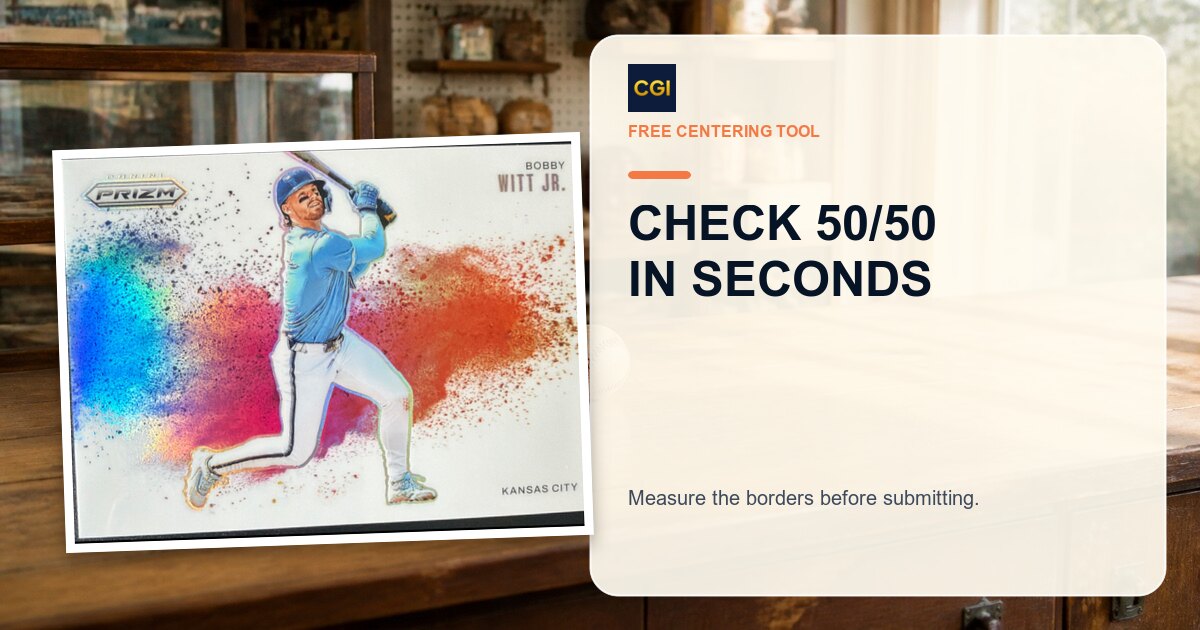
Discover how CardGrade's free online centering tool helps collectors analyze card edges, predict grading outcomes, and maximize card values—all without paying upfront fees. Get instant, professional-grade centering analysis for your trading cards.
Beckett currently publishes estimates of 75 or more business days for Base, 45 business days for Standard, 15 business days for Express, and 5 business days for Priority. These are service estimates, not shipping-inclusive delivery promises, and the selected tier must also be available when you submit.
Choose from the exact card, collecting or resale goal, current service terms, and recent completed sales. BGS can fit collectors who value displayed subgrades or its holder and label system. PSA may fit a card whose comparable sales, registry demand, holder preference, or available service makes it the better option. There is no universal winner.
No. An image-based pre-screen can help you review visible centering, corner, edge, and surface signals in the supplied photos. It cannot authenticate the physical card, determine Beckett’s final grade, or guarantee a Black Label.