Football Card Grading: Complete PSA Submission Guide for 2026
Guides
Football Card Grading: Complete PSA Submission Guide for 2026
Master football card grading with our complete PSA submission guide. Learn which cards to grade, costs, handling tips, and how to pre-screen.
Jamie Budesky·Founder, CardGrade·Published Nov 10, 2025 · Updated Aug 7, 2026·11 min read
Why Football Card Grading Matters
Football card grading transforms raw cardboard into authenticated, encapsulated collectibles with significantly higher market value. Whether you pulled a Patrick Mahomes rookie from a hobby box or inherited a vintage Johnny Unitas collection, professional grading establishes condition, authenticity, and trust for buyers and sellers alike.
The football card market has exploded in recent years. A PSA 10 Mahomes Prizm Silver rookie regularly sells for 10-20x its raw counterpart. Even mid-grade vintage cards command premiums once slabbed. If you are sitting on football cards and wondering whether grading is worthwhile, this guide covers everything you need to know about football card grading in 2026.
Most Valuable Football Cards Worth Grading
Not every football card justifies the cost and wait time of professional grading. Focus your budget on cards with the highest return potential.
Modern Rookies (2015-Present)
Player
Key Cards
PSA 10 Premium
Patrick Mahomes
2017 Prizm Silver, Optic Rated Rookie
15-20x raw value
Josh Allen
2018 Prizm Silver, Select Concourse
10-15x raw value
Justin Herbert
2020 Prizm Base, Mosaic
8-12x raw value
CJ Stroud
2023 Prizm Silver, Optic
10-15x raw value
Caleb Williams
2024 Prizm, Bowman University
8-12x raw value
Vintage Legends
1958 Topps Jim Brown RC - The holy grail of football cards; even a PSA 4 commands thousands
1965 Topps Joe Namath RC - Iconic card with massive demand in any grade
1981 Topps Joe Montana RC - Affordable raw, but PSA 9-10 copies bring serious premiums
1986 Topps Jerry Rice RC - One of the most collected football rookies of all time
1998 Peyton Manning rookies - Pristine copies of Playoff Contenders and SP Authentic remain highly sought after
What Makes a Card Worth Grading?
High raw value - If the card is already worth $50+ raw, grading often makes sense
Condition appears near-mint or better - Visible flaws reduce the chances of a high grade
Strong population demand - Check PSA population reports for the card; low pop high-grade copies command more
Rookie cards - First-year cards almost always justify grading over base or insert cards
PSA Football Card Grading: The Industry Standard
PSA football card grading is the dominant choice for sports card collectors. PSA-graded cards consistently sell for more than their BGS or CGC equivalents on eBay and marketplace platforms, thanks to brand recognition and the largest collector base.
Why Collectors Choose PSA
Highest resale premiums for sports cards specifically
Largest population database for accurate rarity assessment
Most recognized slab among casual and serious collectors
Strong auction house acceptance at Heritage, PWCC, and Goldin
Slight corner or surface wear visible on close inspection
PSA 7
Near Mint
Minor wear on corners and edges; still a clean-looking card
PSA 6
EX-MT
Noticeable wear but no major creases or staining
PSA 1-5
Lower grades
Typically reserved for vintage cards where any graded copy holds value
BGS for Football Cards: The Subgrade Advantage
While PSA dominates football card sales volume, Beckett Grading Services (BGS) appeals to collectors who want detailed condition breakdowns. BGS provides four subgrades: Centering, Corners, Edges, and Surface.
When BGS Makes Sense for Football
You want to showcase a card's specific strengths through subgrades
The card is a candidate for a BGS Black Label (all four 10.0 subgrades)
You are selling to detail-oriented collectors or in niche markets
Modern chrome cards like Prizm and Select that can achieve Pristine grades
Before submitting anything, honestly assess each card's condition. Look at centering, corners, edges, and surface under good lighting. Use a loupe or magnifying glass for surface scratches and print lines.
Step 2: Pre-Screen with CardGrade.io AI
This is where most collectors save significant money. CardGrade.io's AI grading tool uses CGI Vision AI to analyze your football cards across 16 inspection zones in 60 seconds. The system predicts PSA, BGS, and CGC grades with AI-powered accuracy, so you can identify which cards are likely PSA 9-10 candidates before spending on submissions.
You get plans from $4.99/mo with plans start at $4.99/mo. Simply photograph your card's front and back, and CardGrade.io delivers predicted grades with detailed centering, corner, edge, and surface analysis. This eliminates the guesswork and helps you avoid wasting $20-150 per card on submissions that return disappointing grades.
Visit PSA's website and register for an account if you do not have one already. You will need this to create submissions and track your orders.
Step 4: Choose Your Service Level
Service Level
Price (approx.)
Turnaround
Value
$20-25/card
120-180 business days
Regular
$50/card
65 business days
Express
$100/card
20 business days
Super Express
$150/card
10 business days
Walk-Through
$300+/card
3-5 business days
Prices and turnaround times are approximate and subject to change. Always verify current pricing on PSA's website.
Step 5: Prepare Your Submission
Place each card in a clean, new penny sleeve (open end first)
Insert the sleeved card into a semi-rigid card holder (Card Saver I recommended)
Do NOT use toploaders for PSA submissions -- they prefer semi-rigid holders
Fill out the submission form accurately, including declared value
Pack cards snugly in a box with padding to prevent movement
Step 6: Ship and Track
Ship your package with tracking and insurance matching your declared value. USPS Priority Mail or UPS are common choices. PSA provides a shipping label option for some service tiers.
Step 7: Wait and Monitor
Track your submission through PSA's online portal. Grades appear in your account before the cards ship back.
Football Card Handling Tips
Proper handling is critical for maximizing your football card grades. Surface scratches and corner damage are the most common reasons cards receive lower grades than expected.
Before You Touch Your Cards
Wash and dry your hands thoroughly, or wear clean cotton gloves
Work on a clean, soft surface -- a microfiber cloth on a flat table works well
Use good lighting to inspect the card before sleeving
Common Mistakes to Avoid
Sliding cards across surfaces -- This creates hairline scratches invisible to the naked eye but visible under PSA's magnification
Touching the surface -- Fingerprint oils can leave marks that affect surface grades
Overly tight penny sleeves -- Forcing a card into a tight sleeve can bend corners
Stacking unsleeved cards -- Cards rub against each other and develop edge wear
Rubber bands -- Never use rubber bands on cards; they leave indentations and residue
Storage Best Practices
Sleeve every card in a clean penny sleeve immediately
Place sleeved cards in toploaders for rigid protection
Store toploaders upright in card storage boxes
Keep cards in a cool, dry environment away from direct sunlight
Avoid attics, basements, and garages where temperature and humidity fluctuate
Understanding Panini Prizm, Optic, and Mosaic Grading Nuances
Modern Panini football products dominate the hobby, and each line has specific characteristics that affect grading.
Prizm
Prizm is the most collected modern football product. Its chrome finish shows every imperfection, making surface grade the most critical subgrade. Common issues include:
Print lines -- Visible lines in the chrome coating from the printing process; these are manufacturing defects and PSA will grade accordingly
Surface scratches -- Chrome surfaces are highly susceptible to scratches during pack insertion
Edge chipping -- Chrome edges can chip during the cutting process
Optic (Donruss Optic)
Optic uses a similar chrome technology to Prizm but often has slightly different centering tendencies. The rated rookie design with the large border makes centering issues more visible.
Mosaic
Mosaic cards feature a textured pattern that can mask minor surface imperfections but also makes centering more difficult to judge visually. The concentric square design means off-center cuts are immediately noticeable.
Grading Tip for Chrome Cards
Hold the card at an angle under direct light and slowly tilt it. Surface scratches, print lines, and other defects become visible as the light moves across the chrome coating. This technique reveals what PSA's graders will see under their inspection lights.
Pre-Screening Football Cards with CardGrade.io
Submitting football cards without pre-screening is like gambling. At $20-150 per card, a stack of 20 submissions can cost hundreds or thousands of dollars -- and disappointing grades mean you have lost money on grading fees alone.
CardGrade.io changes this equation entirely. The AI-powered platform analyzes your card photos against the same criteria professional graders use:
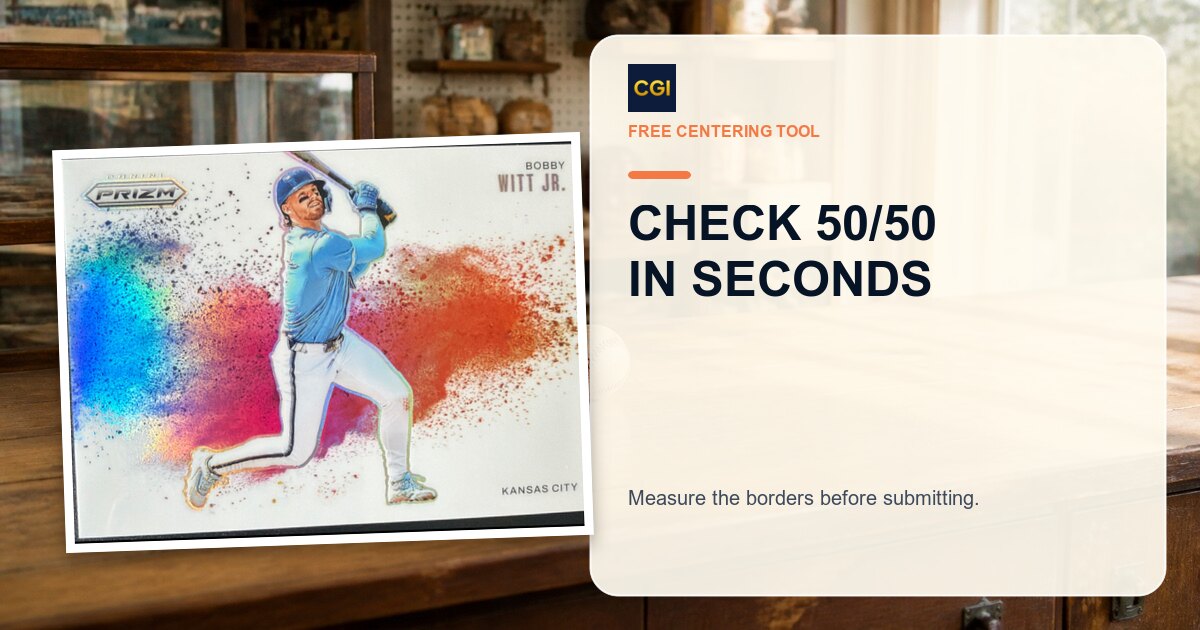
Centering analysis -- Measures left/right and top/bottom ratios, critical for modern Prizm and Optic cards with visible borders. Use our dedicated centering tool for detailed measurements.
Corner inspection -- Detects micro-damage at all four corners
Edge evaluation -- Identifies chipping, whitening, and irregularities along all four edges
Surface assessment -- Spots scratches, print lines, and other surface defects
The process takes 60 seconds per card. Upload a photo, and CardGrade.io's CGI Vision AI returns predicted grades for PSA, BGS, and CGC along with a detailed breakdown of each grading category. This intelligence lets you:
Submit only your strongest cards to maximize PSA 10 hit rates
Choose the right grading company based on each card's strengths
Set accurate declared values based on predicted grades
Save hundreds of dollars on cards that would not grade well
Cost and Turnaround Expectations
Budgeting for Football Card Grading
The total cost of grading includes more than just the service fee:
Cost Component
Typical Range
PSA service fee
$20-300 per card
Shipping to PSA
$10-25 per submission
Return shipping
$10-20 per submission
Insurance
Varies by declared value
Supplies (holders, sleeves)
$0.50-1.00 per card
Maximizing Your Budget
Batch submissions -- Submit multiple cards at once to amortize shipping costs
Pre-screen religiously -- Use CardGrade.io to eliminate cards unlikely to grade well
Choose service levels wisely -- High-value cards may justify Express; lower-value cards should go Value
Declared value matters -- Higher declared values increase insurance costs, but under-declaring risks issues with claims
PSA turnaround times have stabilized since the pandemic-era backlogs, but they still vary. Value tier submissions may take several months. If you need cards back quickly for selling season or a specific event, budget for Express or Super Express service.
Conclusion
Football card grading is one of the most effective ways to increase the value and marketability of your collection. PSA remains the gold standard for sports cards, though BGS offers meaningful advantages for detail-oriented collectors and pristine modern chrome cards.
The key to profitable grading is selectivity. Not every card deserves the investment of professional grading -- but the ones that do can return multiples of their raw value. Pre-screen your cards with CardGrade.io's free AI tool to identify your best candidates, handle your cards with care, and submit strategically based on value and urgency.
Whether you are grading a 2017 Mahomes Prizm Silver or a 1958 Topps Jim Brown, the process rewards preparation, patience, and smart decision-making. Start with your highest-value cards, learn from each submission, and build a graded collection that holds lasting value.
Ready to see which football cards are worth grading? Start grading with CardGrade.io -- plans from $4.99/mo, plans start at $4.99/mo, results in 60 seconds.
Share
Ready to grade your cards with AI?
Pre-screen your cards before submitting to PSA, BGS, or CGC. Plans from $4.99/mo.
Jamie Budesky is the founder of CardGrade and the engineer behind its AI vision grading pipeline. An Army veteran and IT specialist (DoD, since 2017), he writes about card grading, AI/ML grading technology, and collecting strategy — grounded in CardGrade's own grading data.