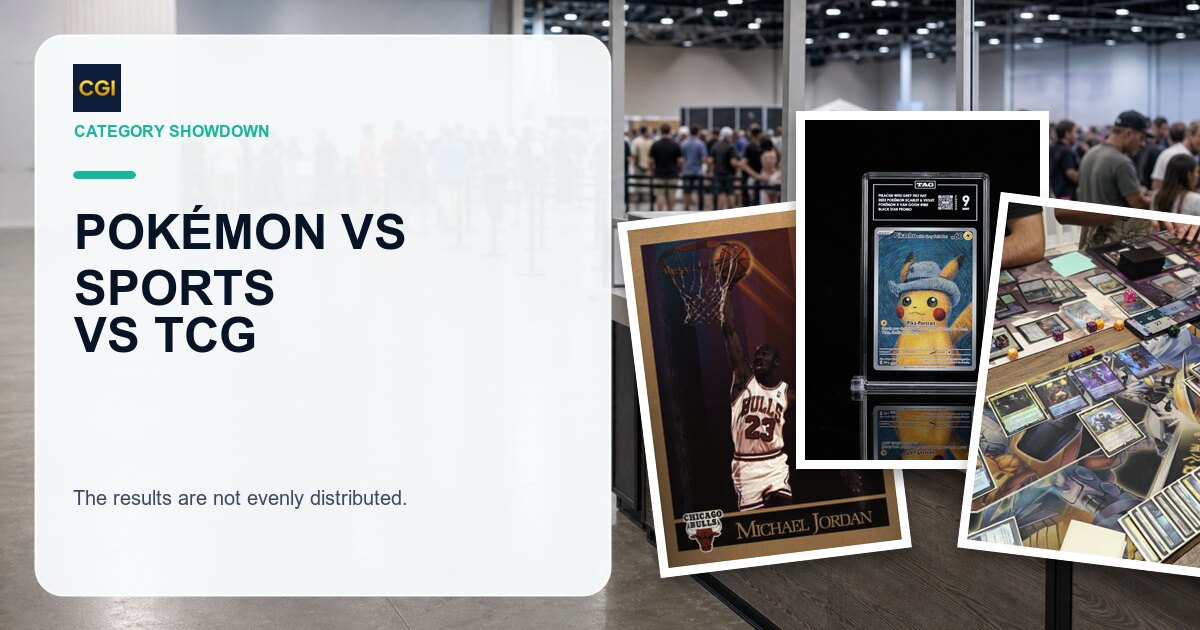
Card Grading Results by Category: Pokemon vs Sports vs TCG
Guides
Card Grading Results by Category: Pokemon vs Sports vs TCG
Pokemon card grading results, sports card grading averages, and TCG grade data compared. See which card categories grade best and why category matters for your submission strategy.
Jamie Budesky·Founder, CardGrade·Published Mar 17, 2026 · Updated Aug 7, 2026·8 min read
Not All Cards Grade Equally
If you have ever wondered why your Pokemon cards seem to grade differently than your sports cards, you are not imagining it. The category of card you submit — Pokemon, sports, or other TCGs like Magic: The Gathering and Yu-Gi-Oh — has a measurable impact on the grades you are likely to receive.
This is not about grading companies playing favorites. It is about the physical realities of how different cards are manufactured, what defects are most common in each category, and how those defects interact with grading standards. After analyzing thousands of cards through CardGrade's AI and cross-referencing with industry data from our State of Card Grading 2026 study, the patterns are clear: category matters, and understanding these differences can save you real money.
Pokemon Card Grading: Modern Quality, Tight Margins
Pokemon cards occupy a unique position in the grading ecosystem. Modern sets from The Pokemon Company International benefit from consistently high print quality — smooth surfaces, sharp corners out of the pack, and clean edges. On paper, this makes them ideal grading candidates.
Where Pokemon Cards Excel
Modern Pokemon cards from sets printed after 2020 tend to score well on corners, edges, and surface condition. The card stock is relatively thick and durable, and factory handling has improved significantly compared to earlier eras. Pull a chase card from a modern booster, and the corners and surface are often near-pristine straight from the pack.
Where Pokemon Cards Struggle
The Achilles' heel for Pokemon cards is centering. The narrow border design that defines most Pokemon cards — especially the Japanese-style layouts — leaves almost no margin for error. A centering shift that would be invisible on a wide-bordered sports card becomes immediately obvious on a Pokemon card where the border might only be 2-3mm wide.
Our State of Card Grading 2026 study confirms what the details: centering is the number-one grade-limiting bottleneck across all categories, but it hits Pokemon cards hardest. A card with perfect corners, edges, and surface can still cap at a PSA 9 because the centering is 55/45 or worse.
If you are grading modern Pokemon, centering should be the first thing you evaluate. Use the CardGrade.io centering tool to measure exact ratios before you decide to submit. A card that looks "good enough" to the naked eye might be outside the 60/40 threshold that PSA requires for a Gem Mint 10.
Sports cards — baseball, football, and basketball — present a different grading profile entirely. The major manufacturers (Topps, Panini, Fanatics) produce cards with wider borders and different card stock than TCGs, which shifts the grading equation.
Where Sports Cards Excel
The wider borders on most sports cards give them a significant centering advantage. A slight shift left or right is less likely to push the centering ratio past the critical thresholds. Cards from flagship sets like Topps Chrome, Donruss, and Prizm typically have enough border room that centering alone rarely kills a grade.
Where Sports Cards Struggle
The challenges for sports cards are more varied and manufacturer-dependent:
Surface issues: Chrome and refractor finishes are more prone to surface scratches and print lines that can be invisible to the naked eye but visible under grading-room lighting
Edge quality: Some print runs produce cards with rough-cut or slightly jagged edges, particularly in lower-end product lines
Corner sensitivity: Thinner card stock in certain products means corners are more susceptible to dings during pack opening and handling
Manufacturer inconsistency: Quality varies significantly between brands and even between print runs of the same set
Differences by Sport
Not all sports cards grade equally either. Key distinctions include:
Baseball cards have the longest grading history, and the market is well-established. Vintage Topps and Bowman cards from the 1950s-1970s have entirely different grading considerations than modern chrome cards. For modern cards, Topps Chrome baseball tends to grade well when surface condition is strong.
Football cards from Panini (and now Fanatics) can be inconsistent in print quality. Some Prizm print runs are notorious for surface imperfections straight from the pack. Read our football card grading guide for sport-specific strategies.
Basketball cards share many of the same manufacturers as football, but certain premium products like National Treasures and Immaculate tend to use thicker card stock that holds up better through the grading process. The basketball market also places an outsized premium on high grades for star rookies, making pre-screening especially valuable.
TCG Cards: Magic, Yu-Gi-Oh, and the Factory Problem
Trading card games beyond Pokemon — particularly Magic: The Gathering and Yu-Gi-Oh — present their own grading challenges. These cards are manufactured at massive scale with quality control that varies significantly by region and print run.
Magic: The Gathering
MTG cards are notorious in the grading world for one specific reason: centering is frequently terrible. Wizards of the Coast prints billions of cards across global facilities, and centering consistency has been a persistent community complaint for years. It is not unusual to open a booster box of Magic cards where a majority of the rares are visibly off-center.
Beyond centering, MTG cards face additional challenges:
Print quality variation by set: Some sets are printed at different facilities with varying quality standards
Foil curling: Foil MTG cards are prone to significant curling, which can affect surface grading
Card stock changes: Wizards has changed card stock multiple times, and some eras are more grading-friendly than others
Yu-Gi-Oh
Yu-Gi-Oh cards share some characteristics with Pokemon — narrow borders that magnify centering issues — but add their own complications:
Foil patterns: Many Yu-Gi-Oh rarities use complex foil patterns that can show surface wear more readily
Card stock thickness: Generally thinner than Pokemon or sports cards, making corners and edges more vulnerable
Regional manufacturing differences: Cards printed for different markets can have noticeably different quality
What the Data Shows for TCGs
The overall picture for non-Pokemon TCGs is that they tend to have lower average grades than both Pokemon and sports cards, driven primarily by manufacturing inconsistency. Centering issues alone disqualify a substantial percentage of MTG and Yu-Gi-Oh cards from top grades before any other factor is considered.
How Category Data Should Inform Your Strategy
Understanding category-level trends is valuable, but it is only the starting point. Here is how to turn this data into actionable decisions:
1. Set Realistic Expectations
If you are submitting a batch of Magic cards, do not expect the same gem rate as a batch of modern Pokemon. The industry-wide data from our State of Card Grading 2026 study shows that among cards submitted to professional graders, approximately 43% achieve a Gem Mint grade — but that rate varies significantly by category. Cards that get submitted are already pre-selected as the best candidates, so the real population rate is much lower.
2. Adjust Your Pre-Screening Threshold
For categories with known weaknesses (Pokemon centering, MTG centering, sports card surfaces), tighten your screening criteria on those specific sub-grades. A Pokemon card needs to clear a higher centering bar than a sports card to justify submission.
3. Choose the Right Grading Company for Your Category
Different companies may be better suited for different card types. PSA's holistic grading approach (no sub-grades) can be more forgiving for cards with one weak attribute. BGS sub-grades expose every weakness but reward perfection. CGC offers a middle ground. Our card grading companies comparison breaks this down in detail.
4. Focus on What You Can Control
You cannot change how a card was printed. But you can control which cards you submit, how you handle them, and how thoroughly you evaluate them before committing $15-$25 per card to a grading company. Given that the industry processes over 12.5 million cards per year at a cost of up to $312 million, the collectors who pre-screen aggressively are the ones who come out ahead.
Stop Guessing, Start Measuring
Category averages tell you about the population. They do not tell you about YOUR card. A Pokemon card from a well-centered print run might be a near-certain PSA 10. A football card with a surface scratch visible only under side lighting might be a PSA 8 at best.
The only way to know is to analyze your specific card. CardGrade.io evaluates every card across 16 inspection zones in 60 seconds — centering, corners, edges, and surface — and gives you predicted grades for PSA, BGS, and CGC. No category assumptions, no guessing. Just data on the card in front of you.
Whether you are grading Pokemon, sports cards, or TCGs, start with the data. Start grading with CardGrade.io and see exactly where your cards stand before you spend a dollar on grading fees.
Share
Ready to grade your cards with AI?
Pre-screen your cards before submitting to PSA, BGS, or CGC. Plans from $4.99/mo.
Jamie Budesky is the founder of CardGrade and the engineer behind its AI vision grading pipeline. An Army veteran and IT specialist (DoD, since 2017), he writes about card grading, AI/ML grading technology, and collecting strategy — grounded in CardGrade's own grading data.