Card Centering Guide: How PSA, BGS, and CGC Measure Centering
Guides
Card Centering Guide: How PSA, BGS, and CGC Measure Centering
Learn how card centering is measured by PSA, BGS, and CGC. Understand centering ratios, tolerances, and use tools to check centering before grading.
CardGrade.io Editorial·Published Sep 15, 2025 · Updated Feb 26, 2026·10 min read
What Is Card Centering and Why Does It Matter?
Card centering refers to how evenly the printed image is positioned within the card's borders. When a card is perfectly centered, the borders on all four sides are equal in width. When centering is off, one side will have a noticeably wider border than the opposite side, and this asymmetry directly impacts your card's grade.
Centering is one of the first things professional graders evaluate. Even a card with flawless corners, pristine edges, and a spotless surface can lose a full grade point or more if the centering is significantly off. For collectors aiming for a PSA 10, BGS 9.5, or CGC 10, understanding card centering tolerances is essential before you submit.
How Card Centering Is Measured
Centering is expressed as a ratio comparing the border widths on opposite sides of the card. The measurement is taken in two directions: left-to-right and top-to-bottom.
Understanding Centering Ratios
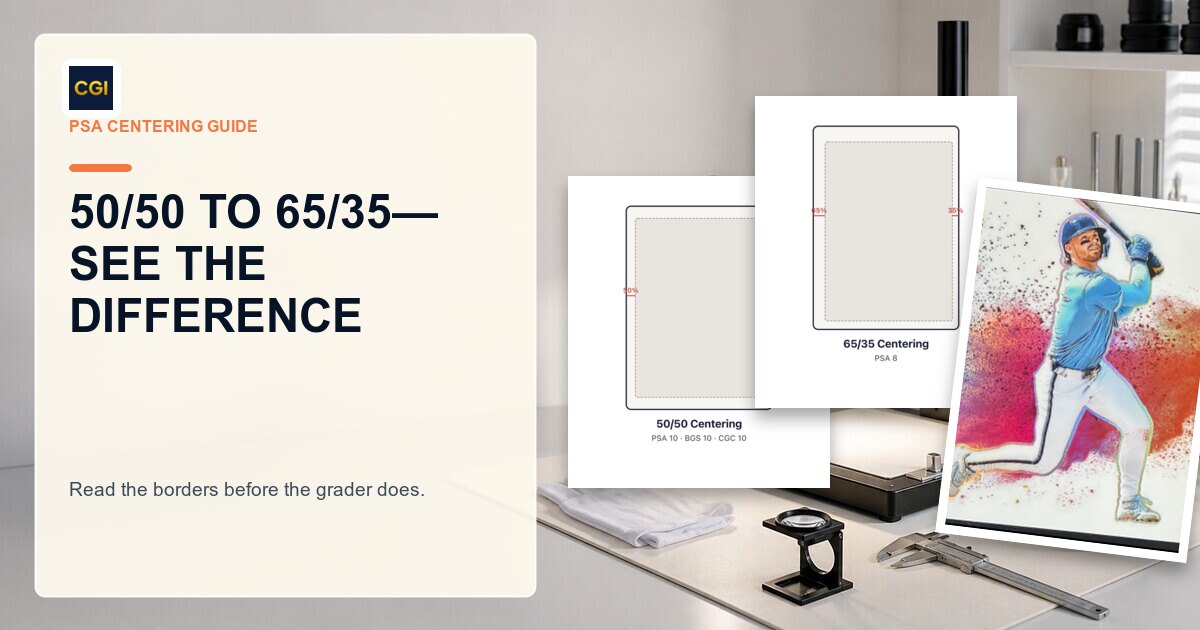
A centering ratio of 50/50 means the borders are perfectly equal. A ratio of 60/40 means the wider border is 60% of the total combined border width, while the narrower border is 40%. The further from 50/50, the worse the centering.
Here is a quick reference for common centering ratios and what they look like:
Centering Ratio
Visual Description
Typical Impact
50/50
Perfectly centered
No impact, ideal
55/45
Slightly off, hard to notice
Generally acceptable for top grades
60/40
Noticeable shift to one side
May reduce grade depending on company
65/35
Clearly off-center
Will reduce grade at all companies
70/30
Significantly off-center
Major grade reduction
75/25 or worse
Heavily miscut
Considered a miscut or error card
Front vs. Back Centering
Both the front and back of a card are evaluated for centering, but grading companies weight them differently. The front centering is always more important because that is the display side collectors see. Back centering typically has more lenient tolerances, which is good news since many cards that look great from the front have slightly off-center backs due to printing registration.
PSA Centering Requirements
PSA evaluates centering as part of its overall grade rather than as a separate sub-grade. Centering is factored into the final 1-to-10 score alongside corners, edges, and surface.
PSA Centering Tolerances by Grade
PSA Grade
Front Centering Tolerance
Back Centering Tolerance
PSA 10 (Gem Mint)
60/40 or better
75/25 or better
PSA 9 (Mint)
65/35 or better
90/10 or better
PSA 8 (NM-MT)
70/30 or better
90/10 or better
PSA 7 (Near Mint)
75/25 or better
95/5 or better
For a PSA 10, your card must have front centering no worse than 60/40 and back centering no worse than 75/25. These are the maximum allowable ratios. Many collectors assume 55/45 is the threshold, but PSA officially allows up to 60/40 on the front for a Gem Mint grade.
The key takeaway with PSA is that centering is just one factor. A card with 58/42 centering might still earn a PSA 10 if everything else is flawless, while a card at exactly 60/40 with a minor surface issue could drop to a PSA 9.
BGS Centering Requirements
Beckett Grading Services (BGS) takes a different approach by assigning centering its own sub-grade on a half-point scale from 1 to 10. This sub-grade is visible on the label alongside corners, edges, and surface scores.
BGS Centering Sub-Grade Scale
BGS Sub-Grade
Front Centering
Back Centering
10 (Pristine)
50/50 to 55/45
55/45 or better
9.5 (Gem Mint)
55/45 or better
60/40 or better
9 (Mint)
60/40 or better
65/35 or better
8.5 (NM-MT+)
65/35 or better
70/30 or better
8 (NM-MT)
70/30 or better
75/25 or better
To achieve a BGS 10 Pristine or BGS Black Label (all four sub-grades at 10), your card needs essentially perfect centering at 50/50 to 55/45 on the front. This is significantly stricter than PSA's 60/40 tolerance for a Gem Mint grade.
The advantage of BGS's sub-grade system is transparency. You can see exactly where your card stands on centering versus other attributes. A BGS 9.5 with a centering sub-grade of 9 tells you the centering was the weakest attribute.
CGC Centering Requirements
CGC (Certified Guaranty Company) entered the card grading market with standards similar to BGS. CGC also provides sub-grades for centering, surface, corners, and edges.
CGC Centering Standards
CGC Grade
Front Centering
Back Centering
CGC 10 (Pristine)
50/50 to 55/45
55/45 or better
CGC 9.5 (Gem Mint)
55/45 or better
60/40 or better
CGC 9 (Mint)
60/40 or better
65/35 or better
CGC 8.5 (NM-MT+)
65/35 or better
70/30 or better
CGC's thresholds closely mirror those of BGS. A CGC Perfect 10 demands near-flawless centering, while a CGC 9.5 offers slightly more room. For collectors debating between PSA, BGS, and CGC, centering standards are one of the differentiating factors.
How Centering Affects Card Value
The financial impact of centering cannot be overstated. A card that grades a PSA 9 instead of a PSA 10 solely due to centering can lose 50% or more of its potential resale value on high-demand cards.
Value Impact Examples
Consider a popular rookie card with these approximate market values:
Grade
Approximate Value
Centering Likely Issue?
PSA 10
$500
No
PSA 9
$200
Possibly centering
PSA 8
$80
Often centering
BGS 9.5 with 9.5 centering
$450
No
BGS 9.5 with 8.5 centering
$350
Yes, visible to buyers
The difference between a PSA 10 and PSA 9 is often just a few millimeters of border width. That small difference can represent hundreds or even thousands of dollars on valuable cards.
How to Check Card Centering Before Submitting
Checking centering before you submit saves both money and disappointment. There are several methods, ranging from simple visual checks to precise digital measurement.
The Eye Test
Hold your card at arm's length and look at the borders. If one side looks obviously wider than the other, the centering is likely outside acceptable tolerances. This method catches severe centering issues but is unreliable for borderline cases.
The Ruler Method
Use a precision ruler or calipers to measure each border in millimeters. Measure the left border and right border, then calculate the ratio. If the left border is 3mm and the right border is 2mm, your left-to-right centering is 60/40 (3 out of 5 total = 60%). Repeat for top and bottom.
This method is more accurate but time-consuming, especially if you are evaluating multiple cards.
CardGrade.io's Centering Tool
The fastest and most accurate way to check card centering is to use CardGrade.io's free centering tool. Simply upload a photo of your card, and CGI Vision AI measures the borders with pixel-level precision. You get exact centering ratios for both the front and back, along with a clear indication of whether the centering meets PSA, BGS, or CGC thresholds.
CardGrade.io's centering tool analyzes your card across 47 inspection points in under 29 seconds, providing not just centering data but a full condition assessment including corners, edges, and surface quality. This eliminates the guesswork and helps you decide whether a card is worth submitting for professional grading.
Tips for Evaluating Centering on Different Card Types
Vintage Cards (Pre-1980)
Vintage cards were printed with less precise technology, so centering is often worse across the board. Grading companies apply the same standards, but the reality is that finding a vintage card with 55/45 or better centering is significantly harder. This scarcity means that well-centered vintage cards command even higher premiums.
Modern Cards (2000+)
Modern printing technology has improved centering considerably, but issues still occur. Factory cutting machines can drift during production runs, resulting in entire sheets being off-center. Cards from the edges of uncut sheets tend to have worse centering than cards from the center.
Full-Art and Borderless Cards
Cards with full-art designs or borderless printing present unique centering challenges. Without visible borders, grading companies measure the distance from the card edge to key design elements like the text box or card name. These cards are harder to evaluate by eye, making a digital card centering tool especially valuable.
Pokemon and Japanese Cards
Pokemon cards, particularly Japanese prints, often have narrower borders than sports cards. This means even small centering shifts become more noticeable. A 2mm difference on a card with 4mm borders is far more impactful than the same 2mm difference on a card with 8mm borders.
Common Centering Myths Debunked
Myth: Centering Does Not Matter Below PSA 9
Reality: Centering affects every grade level. A card with 80/20 centering will grade lower than the same card with 60/40 centering, even at PSA 7 or below. Centering is always part of the evaluation.
Myth: Back Centering Does Not Count
Reality: Both PSA and BGS evaluate back centering. While tolerances are more lenient for the back, a card with 90/10 back centering can absolutely lose grade points. Always check both sides.
Myth: You Can Fix Centering by Trimming
Reality: Trimming a card to improve centering is considered altering the card and will result in the card being flagged as altered or receiving no grade at all. Grading companies check for evidence of trimming using precise measurements of card dimensions.
Myth: All Cards from the Same Pack Have Similar Centering
Reality: Cards from the same pack can have drastically different centering because they come from different positions on the printing sheet. Always evaluate each card individually.
Pre-Screen Your Cards with CardGrade.io
Before spending money on professional grading submissions, use CardGrade.io's AI-powered analysis to pre-screen your cards. CardGrade.io's CGI Vision AI examines 47 inspection points with 92.8% accuracy in just 29 seconds.
The centering tool gives you exact centering measurements that map directly to PSA, BGS, and CGC standards. Combined with corner, edge, and surface analysis, you get a predicted grade before you commit to a submission. With 3 free credits and no credit card required, there is no reason to submit blindly.
Trusted by over 540 teams, CardGrade.io helps collectors and investors make data-driven grading decisions. Check your card's centering today and know exactly what to expect before you send your cards out for grading.
Summary
Card centering is one of the most critical factors in professional grading, and it is also one of the easiest to evaluate before submitting. PSA allows up to 60/40 front centering for a Gem Mint 10, while BGS and CGC require 55/45 or better for their top grades. Back centering is more lenient across all companies but still matters.
Measuring centering does not have to be complicated. CardGrade.io's centering tool provides instant, accurate measurements that tell you exactly where your card stands. Combined with full AI grading analysis, you can confidently decide which cards are worth the investment of professional grading and which ones should stay in your personal collection.
Share
Ready to grade your cards with AI?
Pre-screen your cards before submitting to PSA, BGS, or CGC. Start with 3 free credits.
The CardGrade.io editorial team writes about card grading, AI technology, and collecting strategy. Our guides are researched against official PSA, BGS, and CGC standards.