Pokemon Card Grader Guide: PSA, SGC, CGC & Beckett (2026)
Choosing a Pokemon card grader? Compare PSA, SGC, CGC, and Beckett fees, turnaround times, and grading scales to decide which company fits your cards in 2026.
Loading...
Choosing a Pokemon card grader? Compare PSA, SGC, CGC, and Beckett fees, turnaround times, and grading scales to decide which company fits your cards in 2026.
Pokemon card grading is the process of sending a raw card to a third-party company for physical authentication, condition grading, and encapsulation. The grader evaluates the card under its own standards, assigns a numerical grade if the card qualifies, and seals it in a labeled holder.
The practical decision is not simply, “Could this card get a 10?” It is:
This guide explains how to answer those questions and how PSA, SGC, CGC, and Beckett Pokemon card grading differ in 2026. For a quick pre-submission tool comparison, see the Pokemon card scanner.
Important: CardGrade is an independent image-based condition pre-screen. It does not authenticate a physical card, certify a slab, assign an official PSA, SGC, CGC, or Beckett grade, appraise market value, or guarantee a grading result.
Collectors often use these terms as though they mean the same thing. They do not.
| Step | What it does | What it does not prove |
|---|---|---|
| Manual condition check | Reviews centering, corners, edges, and surface on the card in hand | Does not create an official grade or authenticate the issue |
| AI image pre-screen | Organizes visible condition signals from supplied photos and estimates possible outcomes | Cannot inspect hidden defects, card stock, alterations, or authenticity |
| Professional certification | Physically examines the card under the selected company's authentication and grading process, then encapsulates qualifying cards | Does not guarantee future resale value or eliminate the need to verify a slab when buying |
When buying an already graded Pokemon card, use the grading company's official certification lookup, compare the pictured card and label with the record, inspect the holder for tampering, and evaluate the seller. A copied certification number can appear on a counterfeit label, so a matching number alone is not enough.
There is no fixed dollar threshold and no rule that only perfect cards deserve a slab. Start with the card's identity, condition, and your reason for grading.
Vintage cards are the clearest exception to a “high grade only” rule. A scarce WOTC-era card can be desirable and worth authenticating at a mid or low grade. Compare the exact issue and condition instead of applying modern chase-card economics to every card.
Use recent completed sales, not active asking prices. Match the exact card, variation, language, grading company, and grade whenever possible.
One simple model is:
Modeled graded net = graded sold price × (1 − selling-fee rate) − grading, shipping, insurance, and supply costs
Compare that with the raw sale net using the same selling venue and fee assumption. Also consider the risk that the card grades below your estimate or the market changes while it is away.
The following numbers are illustrative; they are not current prices for a specific card.
| Input | Illustrative amount |
|---|---|
| Recent raw sold-price baseline | $70 |
| Recent PSA 9 sold-price baseline | $95 |
| Recent PSA 10 sold-price baseline | $240 |
| All-in grading and shipping assumption | $95 |
| Selling-fee assumption | 13% |
This submission works only at the top grade. If the card has a visible print line or weak centering, keeping it raw is the more defensible decision. Even a clean-looking card needs a risk margin because a pre-grade cannot promise a PSA 10.
Again, these are illustrative inputs rather than live card prices.
| Input | Illustrative amount |
|---|---|
| Recent raw sold-price baseline | $220 |
| Recent PSA 6 sold-price baseline | $420 |
| All-in grading and shipping assumption | $105 |
| Selling-fee assumption | 13% |
The modeled PSA 6 result is $69 above the comparable raw net. If the physical inspection supports that conservative range and authentication matters, the card may be a reasonable submission without needing a 9 or 10.
Use the grading ROI calculator to replace these assumptions with exact-card sales and your real costs.
No company is best for every card. Service availability, fee, grade label, population data, buyer demand, and your collecting goal all matter.
This snapshot was checked on September 21, 2026. Turnaround figures are company estimates, not shipping-inclusive guarantees, and service terms can change without notice.
| Company | Current entry example | Published estimate | Important current note |
|---|---|---|---|
| PSA | Standard: $59.99 per card | 90–100 business days | PSA Value is paused; Standard is the lowest active direct tier |
| SGC | Standard: $50 (≤$1,500 MDV); $85 (≤$3,500 MDV) | 40+ business days | Direct submissions accepted; Expedited from $150 (2-3 BD) |
| CGC | Bulk: $17 per card; Economy: $20 | 150 working days Bulk; 90 Economy | Bulk requires 25 cards; CGC accepts direct submissions through a free account |
| Beckett | Express: $79.95 per card; Priority: $124.95 | 15 business days Express | Base and Standard remain paused for new online submissions; available via Jotform intake |
Official sources: PSA card-grading services, SGC services and pricing, CGC Cards services and fees, and Beckett grading services.
For fee tables and planning details, use the PSA grading cost guide, SGC grading guide, CGC grading cost guide, and Beckett grading cost guide.
PSA authenticates qualifying cards, grades condition on its 1-to-10 scale, and encapsulates the card with a certification number. Its population report and auction-price tools can make it easier to research how many examples exist at each grade and how exact-card sales differ across grades.
PSA's current grading standards describe a Gem Mint 10 as virtually perfect. The published centering tolerance is approximately 55/45 or better on the front and 75/25 or better on the reverse. PSA also looks for sharp corners, sharp focus, original gloss, and a surface free of staining, while allowing limited discretion for a slight printing imperfection or overall eye appeal.
That ratio is not a promise. A card inside the centering tolerance can still miss a 10 because of corner, edge, surface, print, gloss, focus, or eye-appeal issues. PSA also says it may reject cards showing trimming, recoloring, restoration, cleaning, altered stock, or questionable authenticity.
Before selecting a tier, verify the maximum insured value and current availability on PSA's official page. Estimated turnaround begins under PSA's published processing terms and can change with volume.
SGC (Sportscard Guaranty Company) grades Pokemon cards on a 1-to-10 scale and is known for its distinctive tuxedo-style black slabs. Originally focused on vintage sports cards, SGC has expanded its TCG services and gained popularity among Pokemon collectors who prefer its aesthetic and pricing.
SGC's Standard tier runs 40+ business days: $50 per card for declared values up to $1,500 and $85 for values up to $3,500. For faster turnaround, Expedited starts at $150 (2-3 business days). SGC accepts direct submissions and does not require a membership, though membership programs may offer per-card discounts on larger batches.
SGC's Pokemon population data is smaller than PSA's, which can make exact-card comparisons harder for some issues. Verify the current service menu and insured-value limits on the official SGC page before submitting.
Beckett Grading Services evaluates four condition categories: Centering, Corners, Edges, and Surface. Service levels that include subgrades display those four scores on the label, which can be useful when the condition breakdown matters as much as the overall number.
Beckett's current grading page describes three label groups: Black for a quad-10 Black Label, gold for other Pristine 10s and Gem Mint 9.5, and silver for lower grades. A BGS Black Label Pristine 10 requires four 10 subgrades. A BGS 10 without four perfect subgrades is not a Black Label, and BGS 9.5 is Gem Mint.
Do not submit a card solely because an image pre-screen suggests a Black Label is possible. Beckett makes that decision only after physically evaluating the card, and tiny surface or edge issues can change a subgrade.
As of September 21, 2026, new online Base and Standard submissions remain paused. Beckett's higher tiers—Express ($79.95) and Priority ($124.95)—are available via Jotform intake. Check the official availability notice immediately before shipping because intake status can change independently from the price table.
CGC Cards uses a 10-point scale for TCG, sports, and non-sports cards. Its top labels are Pristine 10 and Gem Mint 10. CGC describes Pristine 10 as virtually flawless with 50/50 centering, while a Gem Mint 10 falls short of the Pristine standard in one criterion.
CGC's grading FAQ says subgrades are no longer offered on new card submissions. This is an important difference from Beckett and corrects older CGC guidance that still appears in some collector articles.
CGC currently lists Bulk at $17 per card with a 25-card minimum and Economy at $20 without that minimum. It says a free account can submit directly, while paid members may receive grading discounts. Current turnaround estimates and value limits appear on the official services page and are not guarantees.
Use the same order every time so a valuable name or exciting pull does not override visible condition evidence.
Record the year, set, card number, language, finish, stamp, rarity, and variation. For early Pokemon cards, distinguish 1st Edition, Shadowless, and Unlimited correctly. For later issues, distinguish standard holo, reverse holo, promo stamps, parallel finishes, and regional variants.
When safe, remove the card from sleeves and top loaders. Plastic can create glare, dust, scratches, and edge distortion that hide or imitate defects. Handle the card by its edges with clean, dry hands over a clean surface.
Compare the visible evidence with the selected company's current standards. Read the PSA grade scale guide if PSA is the likely destination. Use a conservative floor in the value model rather than assuming the highest outcome.
An eligible new account can pre-screen one Pokemon card free. The Pokemon card scanner and AI grader reviews clear front and back photos for visible condition factors; verify every observation against the card in hand. The report is an estimate from the supplied images, not professional certification.
Use recent sold prices for the exact raw card and plausible grades. Include grading, both directions of shipping, insurance, supplies, add-ons, selling costs, and any value-based service requirement. The pre-grade before PSA checklist walks through the complete submit-or-skip decision.
Do not assume all vintage cards are damaged or all pack-fresh modern cards are gem mint. Inspect the card that is actually in front of you.
A manufacturing defect can still affect the grade. “Pack fresh” describes when the card was opened, not its condition score.
After deciding to submit:
Do not polish, press, recolor, trim, erase, or apply cleaning products. PSA's published standards specifically identify evidence of cleaning and alteration as reasons a card may receive no numeric grade or be rejected.
Use the goal, not a blanket ranking:
| Your priority | Company to research first | What to verify |
|---|---|---|
| PSA population data and exact PSA sales comparisons | PSA | Current active tier, insured-value limit, and conservative grade economics |
| Competitive pricing and tuxedo-style slab aesthetic | SGC | Standard $50/$85 by declared value, insured-value limit, and SGC sold comps |
| Four displayed condition subgrades or a Black Label collecting goal | Beckett | Live intake status (Jotform), subgrade inclusion, and exact Beckett sold comps |
| Lower current direct entry pricing or CGC's Pristine/Gem Mint scale | CGC | Minimum card count, current turnaround, value limit, and CGC sold comps |
Do not assume one company always sells for more. Search recent completed sales for the exact Pokemon card, language, variation, company, and grade. Thin sales data should make the decision more conservative, not more certain.
Before shipping, confirm all seven items:
Pokemon card grading works best as a documented decision. Inspect first, model the downside, choose the company whose current service and label fit the goal, and let that company make the official authentication and grade determination.
Pokemon card grading is a professional service that physically examines a card for authenticity, alterations, and condition, assigns a grade under the company's scale, and encapsulates the card with a certification label. An AI or photo-based pre-screen can help assess visible condition before submission, but it is not an official grade or authentication result.
A Pokemon card may be worth grading when the conservative graded sale price, after grading, shipping, insurance, and selling costs, is meaningfully higher than the comparable raw sale price. Rarity, authentication needs, sentimental value, registry goals, and long-term protection can also justify grading even when resale profit is not the goal.
There is no universal winner. PSA offers a widely used 1-to-10 scale, extensive population data, and deep sales-comparison coverage. SGC provides competitive Standard pricing from $50 and tuxedo-style slabs popular with vintage collectors. CGC uses separate Pristine 10 and Gem Mint 10 labels and offers entry pricing from $17 Bulk. Beckett displays centering, corners, edges, and surface subgrades and awards its Black Label to a card with four 10 subgrades. Compare exact-card sold prices and live service terms before choosing.
As of September 21, 2026, PSA Standard is $59.99 with an estimated 90-100 business days. SGC Standard is $50 (up to $1,500 declared value) or $85 (up to $3,500) at 40+ business days. CGC lists Bulk at $17 with a 25-card minimum and Economy at $20 without that minimum. Beckett Base and Standard remain paused for new online submissions; Express is $79.95 and Priority is $124.95 via Jotform intake. Shipping, insurance, supplies, add-ons, and value-based tier rules increase the all-in cost. Verify each official service page before submitting.
Pre-screen your cards before submitting to PSA, BGS, or CGC. Plans from $4.99/mo.
Pre-screen free in 60 secondsAlso available as a Chrome Extension
Grade cards while you browse
Install our free Chrome Extension — right-click any card on eBay, COMC, or TCGPlayer for a grade in ~60 seconds.

Founder, CardGrade
Jamie Budesky is the founder of CardGrade and the engineer behind its AI vision grading pipeline. An Army veteran and IT specialist (DoD, since 2017), he writes about card grading, AI/ML grading technology, and collecting strategy — grounded in CardGrade's own grading data.
Pokemon card grading results, sports card grading averages, and TCG grade data compared. See which card categories grade best and why category matters for your submission strategy.
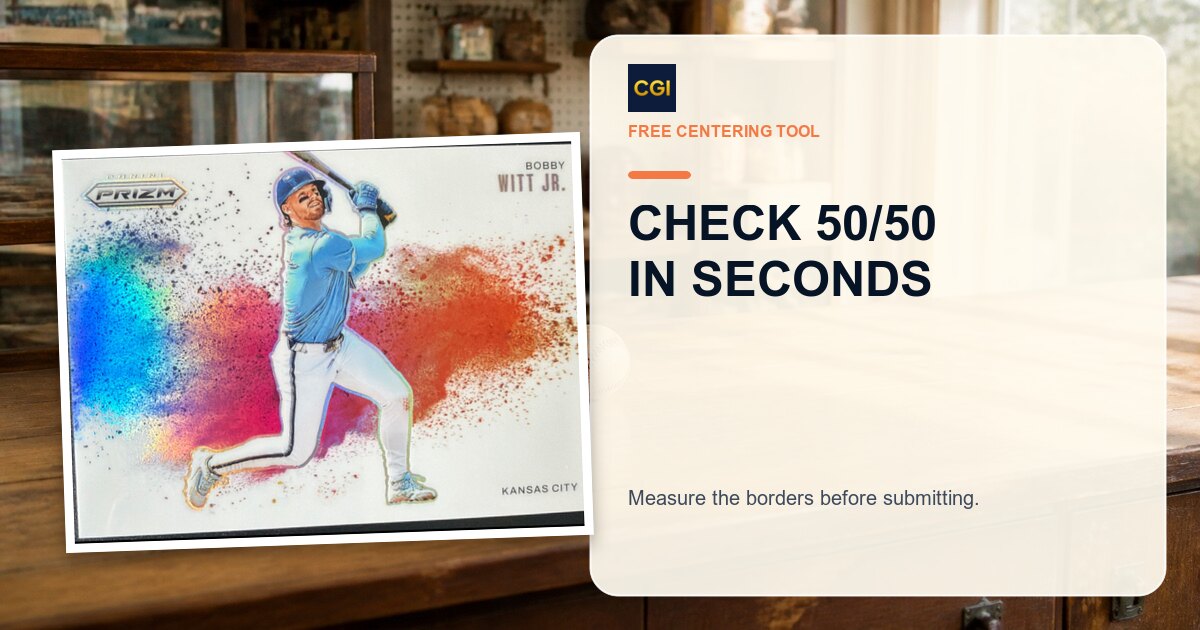
Discover how CardGrade's free online centering tool helps collectors analyze card edges, predict grading outcomes, and maximize card values—all without paying upfront fees. Get instant, professional-grade centering analysis for your trading cards.
PSA's published Gem Mint 10 standard says the image should be centered approximately 55/45 or better on the front and 75/25 or better on the reverse. That is a tolerance, not a grade guarantee. Corners, edges, surface, focus, gloss, staining, print quality, and overall eye appeal also affect the final grade, and PSA notes that graders retain discretion.
No. CGC Cards says subgrades are no longer offered on new card submissions. CGC's current scale includes separate Pristine 10 and Gem Mint 10 grades, but the label does not display four category subgrades like Beckett.
PSA, SGC, CGC, and Beckett perform physical authentication and alteration screening as part of their certification services, subject to their published terms and guarantees. Buyers should still verify the certification on the grading company's official website, compare the card and label with the official record, inspect the holder for tampering, and evaluate the seller. CardGrade does not authenticate cards or certify slabs.
No. Pack-fresh cards can have off-centering, print lines, whitening, corner damage, dents, roller marks, or other manufacturing and handling defects. Inspect the card outside a sleeve under diffuse and angled light before assuming it is a top-grade candidate.
Yes. A scarce vintage card can make sense to authenticate, protect, or sell even at a mid or low grade. The decision should use recent sold prices for the exact card and a realistic condition range rather than a rule that only 9s and 10s are worth grading.
CardGrade provides an image-based condition pre-screen and estimated outcomes from the photos supplied. It can help organize visible centering, corner, edge, and surface observations, but it cannot inspect the physical card, authenticate it, assign an official grade, appraise its value, or guarantee what a grading company will decide.