Submission guide
PSA Value Is Back at $39.99: Value vs Standard vs Priority After the October 28 Changes
PSA announced Value at $39.99 and shorter Standard and Priority estimates. Compare value limits, queue policy, and the full cost before submitting.
By Jamie Budesky ·
In short
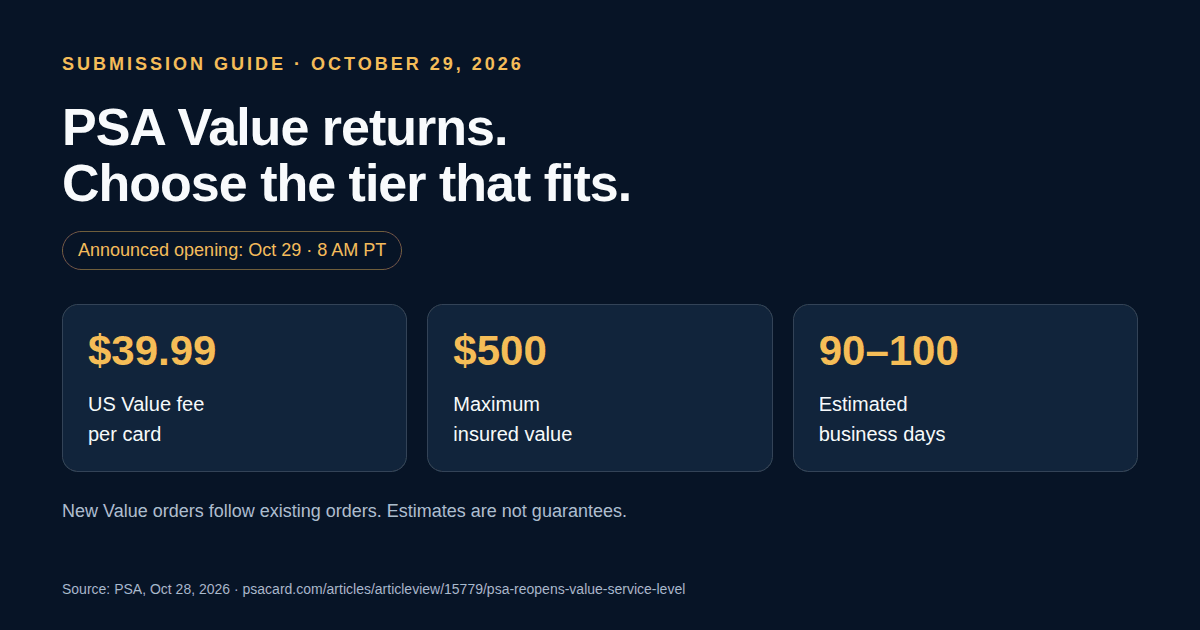
PSA has announced that Value returns at $39.99 per card, with a $500 maximum insured value and a 90–100-business-day estimate. The announced opening is October 29 at 8 AM Pacific. That makes lower-fee submissions possible again, but it does not make every card a Value candidate. Source: PSA's October 28 announcement.
Choose a tier in this order: appropriate insured value, acceptable waiting time, then total cost. Inspect the card before paying a submission fee. A cheaper service can improve the arithmetic; it cannot turn a poor submission into a good one.
Publication note: this guide reports the announced reopening, not a completed checkout test. At our October 29 morning check, PSA's service menu still showed Value as unavailable. Confirm availability in your region before shipping. PSA service menu.
What changed on October 28 and 29?
The table separates the previous terms from the newly announced terms. Prices are US grading fees per card, before shipping and other submission expenses. Standard and Priority retain their prices and insured-value ceilings; their estimates are shorter. September terms · October changes · current prices and limits.
| Tier | Previous price / availability | New price | Maximum insured value | Previous estimate → new estimate |
|---|---|---|---|---|
| Value | $32.99 before the pause; then unavailable | $39.99 | $500 | Paused → 90–100 business days |
| Standard | $59.99 | $59.99 | $1,000 | 90–100 → 70–80 business days |
| Priority | $79.99 | $79.99 | $1,500 | 70–80 → 50–60 business days |
| Value Bulk | $24.99 before the pause | Still paused | Check terms when reopened | No reopening estimate announced |
The historical Value and Bulk prices are reported by Heavy. Bulk's former minimum-card requirement is not presented here as a verified current term. These historical offers are context, not prices to put on a new order.
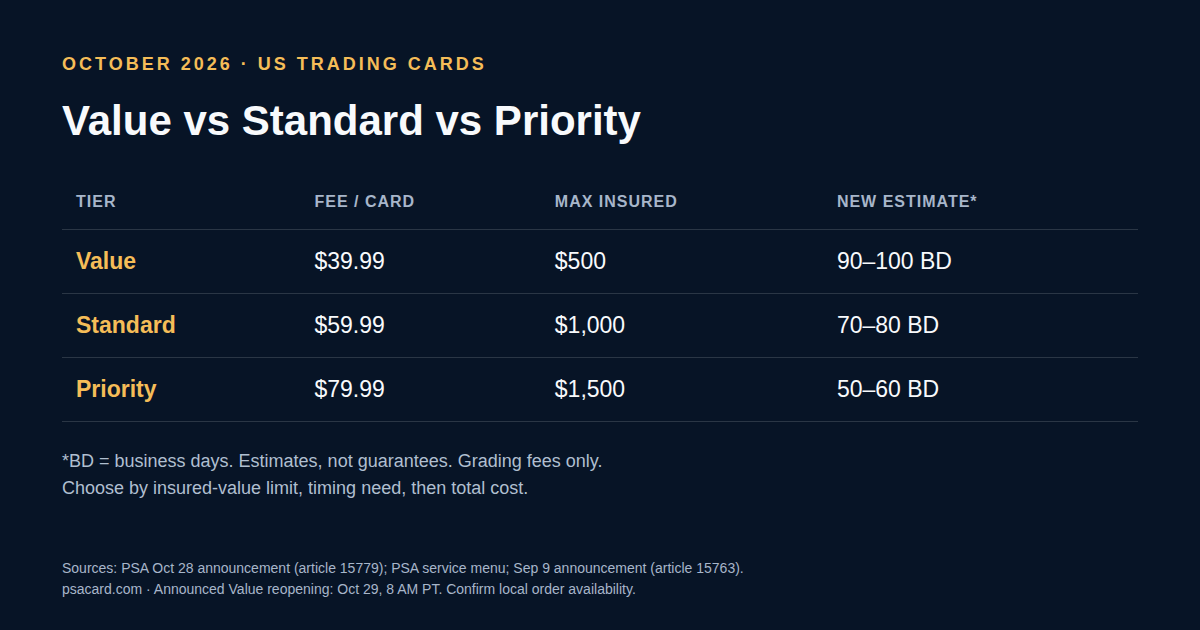
The shorter Standard and Priority estimates apply to submissions from October 28 at 8 AM PT. Existing orders retain their original terms. PSA calls these estimates, not guarantees. October announcement.
For an order already at PSA, keep the original submission confirmation. Do not assume a newly advertised estimate has rewritten your order or that buying a different tier for a new batch will accelerate an old one.
The $500 insured-value trap
The first question is whether a card belongs in the selected value band. PSA lists ceilings of $500 for Value, $1,000 for Standard, and $1,500 for Priority. PSA service limits.
Do not select a band simply because the raw purchase price fits it. Research the exact card, set, variation, and plausible graded outcomes before deciding what value to declare. Follow PSA's current valuation instructions when completing the order; a pre-screen estimate is not a substitute for those instructions.
Consider a hypothetical card bought cheaply that has much stronger completed sales in a high grade. Your receipt tells you what you paid. It does not settle whether Value is the appropriate service. If a reasonable valuation exceeds Value's ceiling, compare the next appropriate band before paying.
Standard can fit a card above Value's limit but within Standard's limit. Priority can fit a card above Standard's limit but within Priority's limit. If neither fits, this three-tier comparison is no longer enough: consult PSA's higher service levels. Do not deliberately understate a card to force it into a cheaper tier.
There is a separate timing decision for cards that fit several bands. Paying more may buy a shorter published estimate, but it does not establish a higher grade or a better resale outcome. Write down why you are paying the difference. “I need a shorter estimated wait” is a reason you can assess; “this is my best card” is not a submission plan.
For a card near a boundary, pause and resolve uncertainty before mailing. Compare several relevant completed sales rather than choosing the lowest result that happens to fit. If the card's identity or authenticity is uncertain, seek the appropriate physical assessment.
New Value orders go behind existing orders
PSA explicitly says new Value submissions will be processed after orders already at PSA. Reopening does not change existing customers' delivery estimates. Queue policy in PSA's announcement.
That caveat belongs beside the headline fee. Treat the published range as a planning input, not a promised date for a sale, convention, birthday, or inventory restock. Allow for shipping and the stages around grading rather than counting from the day you print a label.
Do not add the entire backlog to the estimate as if you knew PSA's internal production schedule. Equally, do not ignore the queue because the fee is attractive. The public information supports caution; it does not support a precise personal return-date forecast.
If you sell cards, ask whether you can leave the cash tied up without needing the proceeds. If you collect for enjoyment, ask whether the wait would make you regret sending the card. A patient collector and a dealer funding the next purchase can reasonably choose different tiers for similar cards.
A deadline that truly cannot move needs a different plan. Paying for Priority still gives you an estimate. Consider whether to keep the card raw, choose another appropriate service after checking its terms, or delay the intended transaction. Do not promise a buyer a slab before you have one.
Why Value is returning while Bulk remains paused
PSA reported a 7.2-million-unit backlog on October 20. Its tracker also records the June pause and Standard's September 14 introduction. PSA Backlog Tracker.
The company says its May target for fully reopening was 5 million units. It also reports April–May submissions at 2.5 times the same months in 2025 and graded-item output up nearly 50% in 2026. These are company-reported figures, not an independent capacity audit. PSA's October explanation.
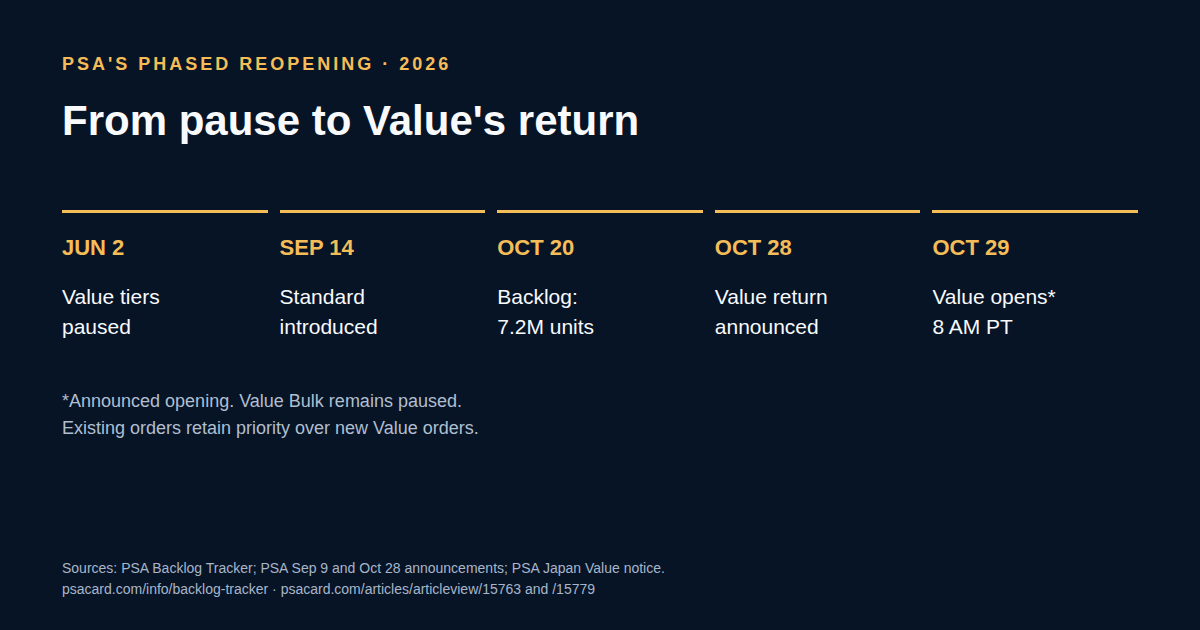
The practical distinction is a phased reopening versus a return of the entire old menu. Value Bulk remains paused; neither its old fee nor an assumed future opening date should anchor a shipment you are preparing now. PSA Japan's explicit Bulk status.
Waiting can still be sensible when your cards only work at a lower fee. Keep that as a choice to hold inventory, not a prediction that Bulk must open next week. Revisit your plan when new terms are published.
Who should choose Value?
Value is the starting comparison for a patient collector whose cards fit the band and whose submission makes sense after every cost. Think collection building, a keeper you want encapsulated, or inventory without a near-term selling requirement.
For a resale submission, first ask whether grading is worthwhile at a conservative outcome. A card that only makes money in the highest hoped-for grade remains a speculative submission. The lower fee narrows your expense; it does not remove condition risk.
Separate sentimental and commercial goals. A favorite card can be worth grading to you even when a resale spreadsheet says no. Record that as a personal collection expense so you do not later interpret the fee as a failed investment.
Avoid filling a box just because a cheaper tier has returned. Make a short list, inspect each card, and remove the ones whose economics depend on optimistic assumptions. An empty slot is cheaper than an unnecessary slab.
When Standard or Priority makes more sense
Choose Standard when its value band is appropriate or when its shorter estimate is worth the additional fee to you. Choose Priority when its value band is necessary or when the shorter estimate has a clear practical use. PSA's current menu.
For a seller, compare the extra fee with a realistic benefit from having inventory back sooner. Do not treat an asking-price spike as proof that an earlier sale will cover the difference. Look at completed sales and ask whether the market opportunity could disappear before even the faster estimate.
For a collector, the benefit may simply be less waiting. That can be a valid use of the budget without dressing it up as investment return. Decide how much that preference is worth before the excitement of checkout.
You do not need to put every card into the same decision category. Sort the candidate list by value eligibility and timing need, then check PSA's order and shipping arrangements for any separate submissions. Splitting a batch may introduce extra expenses, so compare the actual totals.
Twenty cards: the fee difference is only the beginning
Using the published US per-card fees, the arithmetic is:
- 20 × $39.99 = $799.80 at Value.
- 20 × $59.99 = $1,199.80 at Standard.
- Difference: $400 in grading fees alone.
That comparison assumes every card qualifies for its chosen tier. It excludes shipping, insurance, supplies, selling expenses, and any other applicable charges. The fees and the same worked example are documented by Heavy.
Do the next calculation card by card. Start with a conservative expected selling price, subtract selling costs and the card's cost basis, then subtract the full submission expense. Use another column for a weaker grade outcome. If the plan fails there, acknowledge the risk before paying.
For collection cards, replace the resale objective with a budget limit. You can decide that preserving a favorite card is worth an expense without assuming someone else will reimburse it later.
Also compare submitting fewer cards. Removing weak candidates can matter more than choosing a lower fee for the entire pile. Pre-screening is useful when it changes that shortlist, not when it merely adds confidence to a decision you already made.
A pre-submission checklist
- Confirm identity. Match the set, number, parallel, language, and variation. Use that exact identity when researching sales.
- Inspect the physical card. Look at front, back, corners, edges, and surface under changing light. Recheck anything hidden by glare.
- Take useful photos. Capture the full front and back in focus, square to the camera, with even lighting. Retake a blurred image rather than guessing.
- Use a photo pre-screen before fees. CardGrade is a photo-based pre-screen, not an official grade, authentication or appraisal; not affiliated with PSA, BGS, CGC, SGC or TAG. Card photos are the input; pre-screen estimates are the output. Review the pre-screen workflow.
- Investigate the estimate. Compare it with the physical card. A photo can miss a flaw; an estimate cannot settle a disputed condition or authenticity question.
- Research value and select the band. Use relevant completed sales and PSA's instructions. Do not lower a declaration to fit the preferred fee.
- Calculate the whole bill. Include the grading line item, both shipping directions, insurance, supplies, and selling costs where applicable.
- Check the local menu again. Confirm the service is available, its terms suit the card, and any regional restrictions are understood before paying or shipping.
- Save the evidence. Keep photos, the selected service terms, your order confirmation, and shipment records together.
This sequence works best before you have mentally committed the entire batch. Make three piles: ready to submit, needs another look, and keep raw. Treat uncertainty as a reason to inspect again rather than as a reason to round the estimate up.
Use our PSA cost guide for the broader expense checklist and the grading-value calculator to organize your own assumptions. Neither replaces the service provider's submission terms.
Regional details: do not copy US terms blindly
PSA's announcement lists Value fees of CA$56.99, €39.99, and ¥5,980, alongside US pricing. It states a 120-business-day estimate for Japan. Global announcement.
Japan's local notice specifies October 30 at 00:00 JST, corresponding to the global October 29 opening in Pacific time. It also restricts crossover and review to Express and above; Value, Standard, and Priority do not accept those services there. PSA Japan notice.
Use your region's order flow and terms. A US fee comparison does not establish local taxes, shipping charges, insured-value denominations, or service availability. The regional detail matters especially if you are considering a crossover rather than a raw-card submission.
FAQ
Is Value definitely orderable right now?
This guide reports PSA's announced opening. Check the local submission flow before acting; the public menu still showed unavailable at our morning check. PSA service menu.
Are the faster Standard and Priority estimates guaranteed?
No. PSA describes them as estimates and says existing orders keep their submitted terms. October announcement.
Can I send a card over the Value limit and pay later?
Do not plan around an assumed later adjustment. Select an appropriate service using PSA's valuation instructions and current terms. Resolve a borderline card before submitting it.
Should I wait for Bulk?
Wait if the current total cost does not fit your budget or purpose. Bulk remains paused, so there is no confirmed reopening date to build around. PSA Japan's Bulk notice.
Does a photo pre-screen replace PSA?
No. A photo-based pre-screen returns estimates from supplied photos. Official grading and authentication require the appropriate professional service and physical examination.
What should I do with a submission already at PSA?
Keep the original order terms and follow PSA's order updates. The reopening announcement does not replace existing estimates. PSA's statement on existing orders.