Master every aspect of card grading strategy — from centering and corners to edges and surfaces. Learn the AI pre-screening techniques that save money.
Jamie Budesky·Founder, CardGrade·Published Feb 21, 2026 · Updated Aug 7, 2026·11 min read
The Strategic Approach to Card Grading
Card grading is not just about sending cards to PSA, BGS, or CGC and hoping for the best. A complete card grading strategy means evaluating every aspect of your card before committing money to a submission. The collectors who consistently profit from grading are the ones who treat it as a calculated process rather than a gamble.
This guide covers the full grading strategy framework: understanding every sub-grade, learning how to self-evaluate your cards, using AI pre-screening to filter your submissions, and optimizing every step of the process to maximize your return on investment.
Understanding the Four Sub-Grades
Every major grading company evaluates cards across four core categories. Whether you submit to PSA, BGS, or CGC, graders are looking at the same fundamental attributes. BGS and CGC explicitly break these out as sub-scores, while PSA uses a holistic approach informed by the same criteria.
Centering
Centering measures how well the printed image is positioned relative to the card's borders. It is expressed as a ratio (for example, 60/40 left-to-right and 55/45 top-to-bottom). Poor centering is one of the most common reasons cards fail to achieve top grades.
Centering thresholds by company:
Grade Target
PSA Tolerance
BGS Tolerance
CGC Tolerance
Gem Mint (10)
60/40 or better
50/50 to 55/45
55/45 or better
Mint (9)
65/35 or better
55/45 to 60/40
60/40 or better
Near Mint (8)
70/30 or better
60/40 to 65/35
65/35 or better
Centering is the one sub-grade you can measure precisely before submitting. Use the CardGrade.io centering tool to get exact measurements. For a deep dive into centering evaluation, read our centering guide.
Corners
Corner sharpness is evaluated under magnification. Graders look for:
Fraying or fuzzing at the corner tips
Dings and dents from handling or storage
Rounding from wear over time
Whitening on dark-bordered cards where the card stock shows through
Corners are particularly vulnerable on vintage cards and cards that have been stored without sleeves. Even a single soft corner can drop a card from a 10 to an 8.
Corner evaluation tips:
Use a jeweler's loupe (10x magnification minimum) to inspect all four corners
Rotate the card under a bright light to catch subtle whitening
Compare opposite corners since manufacturing defects often affect one side more than the other
Check both the front and back of each corner
Edges
Edge quality encompasses the entire perimeter of the card. Graders assess:
Chipping along the top, bottom, and sides
Whitening or peeling of the card stock layers
Dents or dings from handling
Rough cutting from the manufacturing process
Edges are often overlooked by submitters who focus primarily on centering and corners. However, edge issues can be just as damaging to your final grade. Use the CardGrade.io edge analysis tool to identify problems before submitting. For detailed guidance, see our card edge and surface grading guide.
Surface
Surface quality covers the entire face and back of the card, including:
Scratches visible under direct or angled light
Print defects such as dots, lines, or color inconsistencies
Staining or discoloration from moisture, oils, or age
Indentations from writing pressure, stacking, or rubber bands
Glossiness loss on foil, holo, or glossy-finish cards
Surface is arguably the hardest sub-grade to self-evaluate because many surface defects are only visible under specific lighting conditions. The CardGrade.io surface tool uses AI to detect surface issues that are easy to miss with the naked eye.
Self-Evaluation Framework
Before spending money on professional grading, every card should go through a systematic self-evaluation. Here is the framework experienced graders use:
Step 1: The Quick Scan (30 seconds)
Hold the card at arm's length and look for obvious issues:
Is the centering visually off?
Are there any visible creases, bends, or stains?
Do the corners look sharp or soft?
Is there any obvious surface damage?
If you spot major issues at this stage, the card is likely a 7 or below and may not be worth grading unless it is rare or vintage.
Inspect all four corners at 10x magnification, front and back
Run a finger gently along all edges to feel for chips or rough spots, then inspect visually
Angle the card under a bright light to reveal surface scratches, print lines, or gloss inconsistencies
Check the back for any issues not visible from the front
Step 3: The Honest Assessment
Rate each sub-grade on a 1-10 scale based on your inspection. Your overall grade will typically be limited by your weakest sub-grade. A card with perfect centering, perfect corners, perfect edges, but a surface scratch is not getting a 10.
Common self-evaluation mistakes:
Optimism bias: Most collectors overestimate their cards by 0.5 to 1.0 grade points
Ignoring the back: Graders evaluate both sides equally
Missing surface issues: Always inspect under multiple lighting angles
Forgetting edge chips: Check all four edges, not just the long sides
AI Pre-Screening: The Modern Advantage
Self-evaluation is important, but it has limits. Human eyes miss things, especially under inconsistent lighting. This is where AI pre-screening changes the economics of card grading.
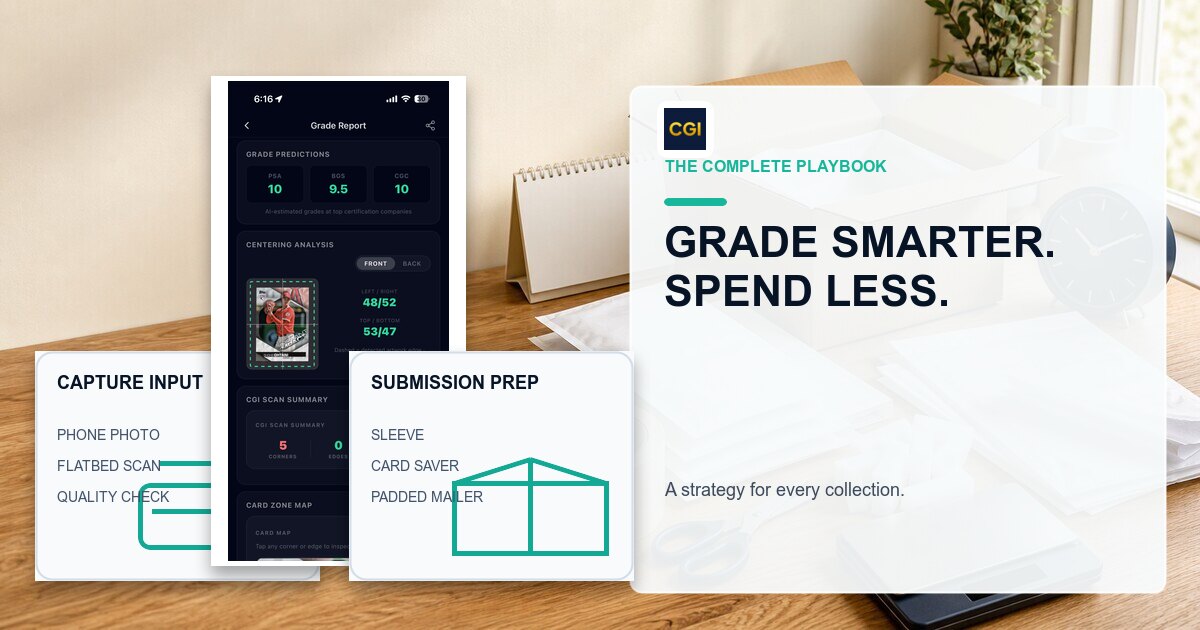
CardGrade.io analyzes your cards across 16 inspection zones in 60 seconds, providing AI-powered grade predictions for PSA, BGS, and CGC that closely match professional grades. This is not a replacement for professional grading. It is a filter that helps you identify which cards are worth the investment.
How AI Pre-Screening Fits Into Your Strategy
The optimal workflow combines self-evaluation with AI analysis:
Quick scan your collection to pull out potential grading candidates
Run candidates through CardGrade.io for AI-predicted grades
Compare AI predictions to your self-assessment. Where they disagree, investigate further
Submit only cards where both you and the AI agree on strong grade potential
Choose the best grading company based on the AI's company-specific predictions
The ROI of Pre-Screening
Consider a collector planning to submit 30 cards at PSA's Value tier:
Approach
Cards Submitted
Total Cost
Average Grade
Profitable Cards
No screening
30
$720
PSA 7.5
12 of 30
Self-evaluation only
22
$528
PSA 8.2
14 of 22
AI pre-screening
16
$384
PSA 9.0
14 of 16
The AI-screened submission costs $336 less while delivering the same number of profitable cards. Over a year of submissions, this adds up to significant savings.
When to Grade vs. When to Sell Raw
Not every card benefits from professional grading. Here is a decision framework:
Grade These Cards
High-value cards in excellent condition: If a card is worth $50+ raw and has a realistic shot at a 9 or 10, the grading premium usually justifies the cost
Vintage cards needing authentication: Even lower grades on vintage cards can add value through authentication
Long-term holds: Cards you plan to keep for years benefit from the protection and liquidity a slab provides
Cards where graded premium is large: Some cards see 3-5x value increases at gem mint grades
Sell Raw Instead
Low-value cards: A $5 card grading PSA 10 at $15 does not justify $24 in grading costs
Cards with obvious flaws: If you know a card will grade 7 or below, the grading premium rarely covers the cost
Bulk commons: Even pristine commons seldom command enough graded premium to be worthwhile
Time-sensitive sales: If you need to sell quickly, the weeks or months of turnaround time for grading work against you
The Break-Even Calculation
For every card, run this formula before submitting:
Expected graded value - Raw value - Total grading cost = Profit (or loss)
If the number is negative or barely positive, sell raw. If the expected profit is substantial, grade it. For help estimating grading costs, see our guides on PSA grading costs, BGS grading costs, and CGC grading costs.
Choosing the Right Grading Company
Your grading strategy should include selecting the best company for each card. Different companies offer different advantages. For a full comparison, read our card grading companies comparison.
Quick Selection Guide
Scenario
Best Choice
Why
Maximum resale value (sports cards)
PSA
Highest market premium for most sports cards
Want sub-grades displayed
BGS
Sub-grades included by default
Budget-conscious submissions
CGC
Lower entry-level pricing
Chasing the ultimate grade
BGS Black Label
10 across all sub-grades is the hobby's pinnacle
Pokemon and TCG cards
PSA or CGC
Both command strong premiums in this market
Company-Specific Strategies
PSA strategy: Focus on cards with a strong chance at PSA 10, as the value jump from PSA 9 to PSA 10 is often dramatic. PSA's holistic grading approach means a card with one slightly weaker area may still achieve a 10 if the overall impression is gem mint.
BGS strategy: Consider BGS when your card has exceptional sub-grades across the board. A BGS 9.5 with strong sub-grades can command premiums close to a PSA 10 for many cards. If all four sub-grades are 10, the BGS Black Label designation carries the highest premium in the hobby.
CGC strategy: CGC is growing in market acceptance and offers competitive pricing. Their grading standards are generally considered strict, so a CGC 10 carries significant weight. This can be advantageous for buyers who value grading accuracy.
Submission Optimization
Once you have identified which cards to grade and where to send them, optimize the submission itself:
Batch by Company
Group your cards by the grading company that gives them the best chance. Do not send every card to the same company out of convenience.
Batch by Value Tier
Within each company, group cards by declared value to use the most cost-effective service tier. See our cost breakdowns for PSA, BGS, and CGC.
Timing Your Submissions
Avoid peak seasons (holiday periods, major set releases) when turnaround times increase
Watch for promotions on grading fees or membership discounts
Consider market timing for cards tied to player performance or set hype cycles
Proper Preparation
Card preparation directly affects your grades. Fingerprints, dust, and improper packaging can cause damage between your evaluation and the grader's desk. Read our guide to preparing cards for grading submission for step-by-step instructions on cleaning, sleeving, and packaging.
Building a Long-Term Grading Strategy
The most successful collectors treat grading as an ongoing process, not a one-time event:
Track your results: Record what you submit, what you predicted, and what you received. This calibrates your self-evaluation over time
Learn from misses: When a card grades lower than expected, figure out what you missed
Adjust your standards: Tighten your submission criteria as you learn. The goal is a higher hit rate, not a higher volume
Use AI as a second opinion: Even experienced graders benefit from AI pre-screening as a check against bias
Try AI Pre-Screening First
Before your next submission, run your candidates through CardGrade.io. The AI analyzes centering, corners, edges, and surface across 16 inspection zones and predicts grades for PSA, BGS, and CGC simultaneously.
Why submit blindly when you can know your expected grades in advance?
Identify which cards are worth the grading investment
Spot hidden flaws you might miss during self-evaluation
Choose the best grading company for each card based on predicted scores
Smart grading is not about submitting more cards. It is about submitting the right cards to the right company at the right time. Sign up for CardGrade.io and start building a data-driven grading strategy today.
Share
Ready to grade your cards with AI?
Pre-screen your cards before submitting to PSA, BGS, or CGC. Plans from $4.99/mo.
Jamie Budesky is the founder of CardGrade and the engineer behind its AI vision grading pipeline. An Army veteran and IT specialist (DoD, since 2017), he writes about card grading, AI/ML grading technology, and collecting strategy — grounded in CardGrade's own grading data.