In short: Centering is the only grading factor you can measure precisely from a photo in seconds. A PSA 10 requires roughly 55/45 front — check your ratios with a free centering tool before paying to submit.
Centering is the single most measurable defect on any trading card. Unlike surface scratches or corner wear, which require a trained eye or magnification, centering can be quantified down to exact pixel ratios. That makes it the easiest grading factor to check before you spend $25-$45 submitting a card to PSA, CGC, or any other grading company.
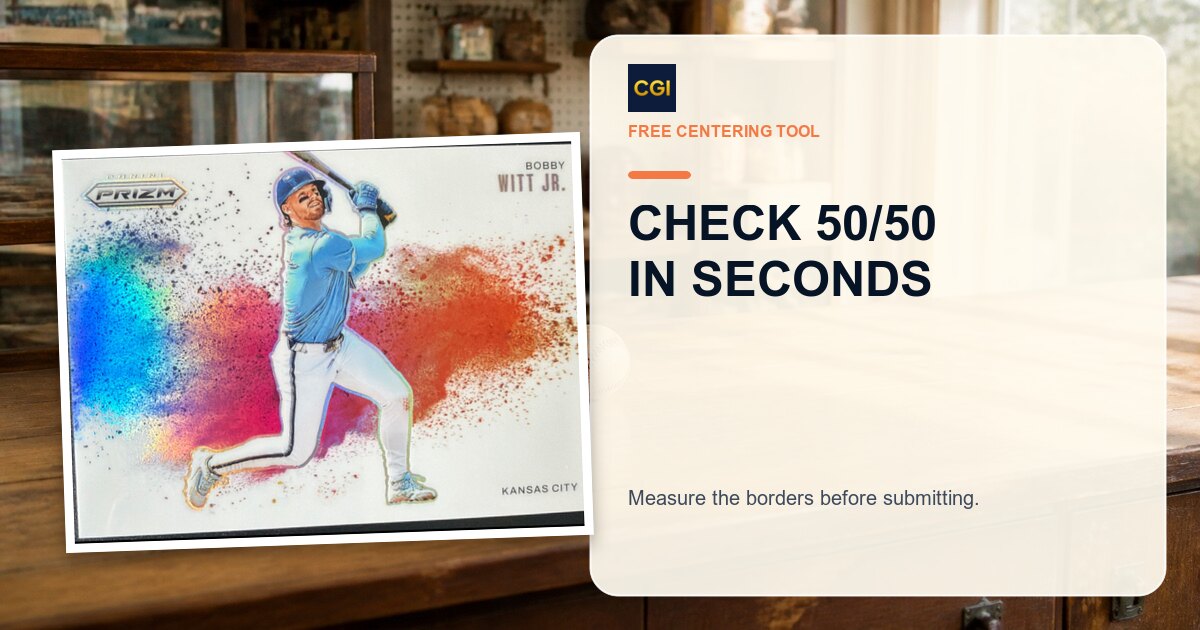
CardGrade offers a free centering tool that analyzes your card's edge-to-edge alignment and gives you a precise left/right and top/bottom centering ratio. No account required. No watermarks. Just upload a photo of your card and get results.
Here's how to use it, what the numbers mean, and why centering checks should be the first step in any pre-submission workflow.
What Centering Actually Measures
Centering refers to how evenly the printed image sits within the card's borders. A perfectly centered card has equal border widths on all four sides. In practice, printing and cutting tolerances mean most cards are slightly off-center.
Grading companies express centering as a ratio. A card with a 2mm left border and a 2mm right border is 50/50 (perfect). A card with a 3mm left border and a 2mm right border is roughly 60/40.
Every major grading company factors centering into the final grade, and each has specific thresholds:
PSA centering requirements (updated January 2025):
- PSA 10 (Gem Mint): 55/45 or better front, 75/25 or better back
- PSA 9 (Mint): 60/40 or better front, 90/10 or better back
- PSA 8 (NM-MT): 65/35 or better front, 90/10 or better back
- PSA 7 (NM): 70/30 or better front, 90/10 or better back
BGS (Beckett) centering subgrade:
- 10 (Pristine): 50/50 to 55/45
- 9.5 (Gem Mint): 55/45 to 60/40
- 9 (Mint): 60/40 to 65/35
CGC centering:
- CGC uses similar thresholds to PSA, though they weight centering as one of four subgrades (centering, corners, edges, surface)
Note that PSA tightened its centering standard in early 2025. Cards that would have received a PSA 10 under the old 60/40 front standard may now cap at PSA 9 under the new 55/45 requirement. This makes pre-checking centering even more important before submitting.

The CardGrade centering tool uses image analysis to measure border widths on all four edges of your card. The process takes about 10 seconds:
Step 1: Take a photo of your card.
Use a flat, well-lit surface. Avoid shadows across the card edges. A phone camera works fine. The card should fill most of the frame, and the background should contrast with the card border (a dark card on a white surface, or vice versa).
Step 2: Upload the image.
Go to cardgrade.io/tools/centering and upload your photo. The tool accepts JPG and PNG files.
Step 3: Review the results.
The tool returns left/right and top/bottom centering ratios for the front of the card. You'll see the exact percentages and a visual overlay showing border measurements.
Step 4: Interpret the grade impact.
The tool maps your centering ratio against grading company thresholds. If your card measures 58/42 left-right, you'll know it passes PSA 10 standards (55/45) but would score a BGS 9.5 centering subgrade rather than a 10.
For best results, photograph just the front of the card straight-on, without any angle. Perspective distortion can skew measurements. If your card is in a sleeve or toploader, remove it first to avoid reflections obscuring the borders.
Why Centering Is the Easiest Pre-Submission Check
Of the four grading factors (centering, corners, edges, surface), centering is the only one you can evaluate with near-professional accuracy from a simple photograph. Corner and edge wear often require magnification and specific lighting angles. Surface defects like print lines or scratches can be invisible in photos.
Centering, by contrast, is a math problem. The borders are either even or they aren't, and a tool can measure them to the pixel.
This is significant because centering is also one of the most common reasons cards fail to achieve top grades. A 2023 survey from Edge Grading found that centering issues account for a substantial share of grade-limiting defects, especially in modern cards where corners and edges are typically sharp out of the pack.
Consider a real scenario: you pull a holographic Charizard from a Scarlet & Violet booster pack. Corners are sharp, surface is clean, edges look good. But the print is shifted noticeably to the left. Without checking, you might submit it expecting a PSA 10 and receive a PSA 9 because the centering measured 62/38. That $33 submission yielded a card worth significantly less than the Gem Mint version.
A 10-second centering check would have flagged this before you paid for the submission.
Several free centering tools exist. Here's how they stack up:
CardGrade Centering Tool (cardgrade.io/tools/centering)
- Automatic edge detection from uploaded photo
- Returns exact ratios for both axes
- Maps results against PSA, BGS, and CGC thresholds
- No account or download required
- Free, no usage limits
CardGrade Centering Tool (open the free calculator)
- Manual measurement tool where you drag borders to match your card
- Relies on user accuracy in placing border markers
- Shows centering ratio and grade compatibility
- Free to use
DIY Method (Ruler)
- Measure each border with a millimeter ruler
- Calculate ratio manually (e.g., 2.5mm left / 2.0mm right = 56/44)
- No software needed but prone to measurement error
- Time-consuming for multiple cards
The advantage of automated tools like CardGrade's is consistency. When you're screening 20+ cards before a submission, manually dragging sliders or measuring with a ruler introduces fatigue and error. Upload, click, read the number. Done.
Using Centering Data in Your Submission Strategy
Centering checks should be the first filter in a multi-step pre-screening process. Here's an efficient workflow:
- Centering check first (free, fast, objective). Eliminate any cards that fail your target grade's centering threshold.
- Visual inspection for corners and edges (loupe or magnifier). Check for dings, whitening, or roller marks.
- Surface check under angled light. Look for print lines, scratches, or surface contamination.
- Full AI pre-grade with CardGrade for remaining candidates. Get an overall grade prediction factoring in all four categories.
This funnel approach saves time and money. Cards with obvious centering issues get eliminated immediately, before you spend time on detailed inspection. For a batch of 30 raw cards, you might eliminate 8-10 on centering alone, then find another 5-7 with corner or surface issues, leaving you with 13-17 strong candidates for submission.
At current PSA Value pricing of $27.99 per card, screening out 12 low-confidence cards saves $335.88 in submission fees. That math gets even more dramatic at higher service tiers.

Common Centering Pitfalls
Borderless and full-art cards. These are harder to center-check because there's no visible border to measure. The centering tool works by detecting the edge of the printed area relative to the card edge. On borderless cards, look for the position of text, logos, or design elements relative to the card edges.
Vintage cards. Older cards from the 1950s-1980s were printed with less precise cutting technology. Centering is frequently poor on vintage cards, and grading companies account for this in their standards. A 1952 Topps card with 65/35 centering might still earn a high grade relative to its era. Modern card centering standards are stricter because modern printing is more precise.
Back centering. Don't forget the reverse. PSA's back centering requirement (75/25 for a PSA 10) is more lenient than the front, but cards with severely off-center backs will lose points. Photograph and check both sides.
Parallax error in photos. If you photograph your card at an angle rather than straight-on, one side of the card appears larger than the other. This creates false centering readings. Always photograph from directly above, perpendicular to the card surface.
The Bottom Line
Centering is the lowest-hanging fruit in pre-submission screening. It costs nothing to check, takes seconds per card, and can save you real money by filtering out cards that won't hit your target grade.
PSA's tightened 55/45 standard for Gem Mint 10 (effective 2025) means cards that previously squeaked by are now getting downgraded. If you aren't checking centering before submitting, you're gambling with every card in your batch.
Use CardGrade's free centering tool to screen your cards, then move the best candidates through a full AI pre-grading analysis for a comprehensive grade prediction. The combination of free centering checks and paid AI grading creates a cost-effective pipeline that maximizes your submission ROI.
Start checking your cards at cardgrade.io/tools/centering.