How to Read Centering Ratios (55/45, 60/40) and Predict PSA Grades
Centering ratios like 55/45 and 60/40 show up on every grading cheat sheet, but most collectors never see the math behind them. This guide explains what those numbers mean, how PSA uses them at each grade level, and how CardGrade''s centering tools help you predict grades before you ship.
CardGrade.io Editorial·Published Dec 8, 2025 · Updated Feb 21, 2026·10 min read
How to Read Centering Ratios (55/45, 60/40) and Predict PSA Grades
Centering ratios are the single most misunderstood element of card grading. Collectors see numbers like 55/45 or 60/40 and either panic unnecessarily or submit cards that were never going to get a PSA 10.
This guide explains centering math in plain language, shows you what different ratios actually look like on a card, and maps each ratio to the PSA grade it produces.
What Centering Ratios Actually Mean
A centering ratio describes how well the printed image is positioned on the card stock. A perfectly centered card has equal borders on all four sides. In the real world, no card is printed with mathematically perfect centering, so grading companies allow a tolerance range.
The ratio is expressed as two numbers that add up to 100. The first number represents the narrower border's percentage of the total border width; the second represents the wider border's percentage.
50/50 means the borders on opposite sides are exactly equal. The image is perfectly centered in that direction.
55/45 means one border is slightly wider than the opposite border. Specifically, the narrow border is 55% of the total width of both borders combined, and the wide border is 45%. Wait, that seems backward. Here's the clarification:
The convention used by PSA describes the ratio as the percentage of the border on each side. A 55/45 card has borders where one side takes up 55% and the other 45% of the total border space. The deviation from perfect (50/50) is 5 percentage points.
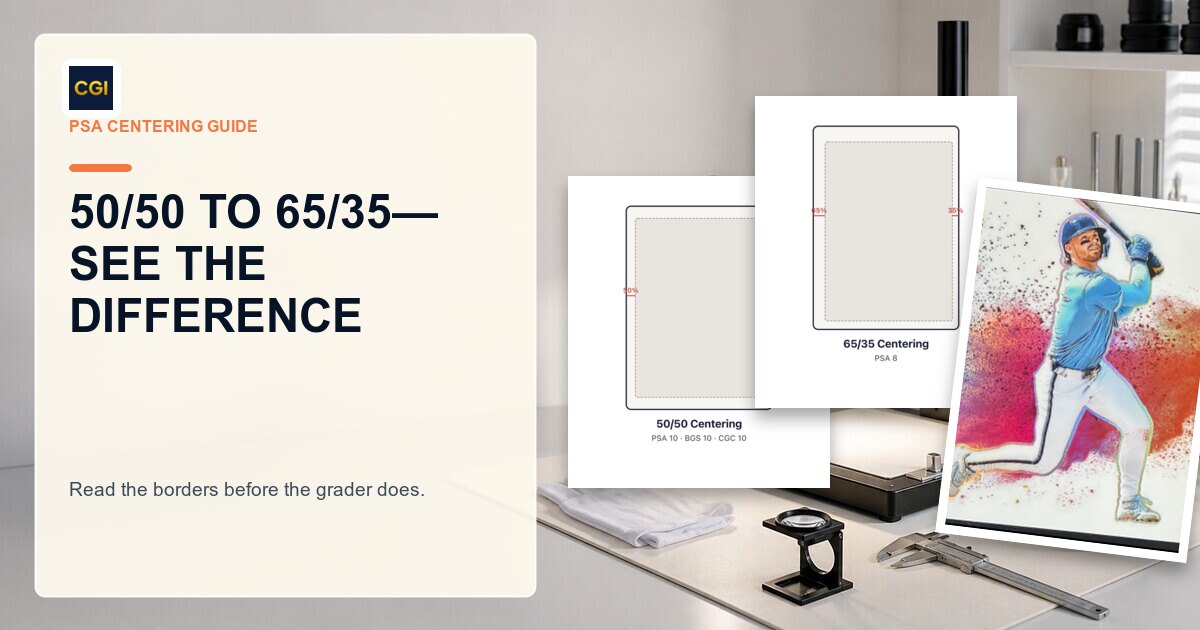
Think of it as a seesaw. At 50/50, the card image sits exactly in the center. At 55/45, the image has shifted slightly toward one side. At 60/40, it's shifted more noticeably. At 70/30, the offset is dramatic and immediately visible.
Visual Examples
50/50 to 52/48: The card looks perfectly centered to the naked eye. You'd need a ruler or digital measurement to detect any offset. Most collectors can't see a difference at this range.
55/45: A trained eye can detect the offset if looking carefully. Place the card on a flat surface and compare the left and right borders (or top and bottom). You'll see that one border is slightly narrower. Most casual observers won't notice.
60/40: The offset is visible without effort. One border is clearly wider than the opposite border. On cards with thin borders (like modern Prizm), this becomes very obvious because even small pixel-level differences are proportionally large.
65/35: Significantly off-center. The image is noticeably shifted. Both casual and experienced collectors will spot this immediately.
70/30 and beyond: Severely miscentered. One border is more than twice the width of the opposite border. These cards are considered error cards in extreme cases and won't grade above PSA 6.
PSA Centering Requirements by Grade Level
PSA evaluates centering on both the front and back of every card. Here are the centering thresholds for each relevant grade:
PSA 10 - Gem Mint
Front: 55/45 or better
Back: 75/25 or better
This means the front centering must be within 5 percentage points of perfect in both the left-right and top-bottom directions. The back is given much more tolerance, requiring only that the centering doesn't exceed 75/25.
A card with 55/45 front centering and 50/50 back centering qualifies for PSA 10 on centering. A card with 56/44 front centering does not.
PSA 9 - Mint
Front: 60/40 or better
Back: 90/10 or better
PSA 9 allows 10 percentage points of deviation from perfect centering on the front. This is noticeably more lenient than PSA 10. Many cards that look "pretty well centered" fall in the 56/44 to 60/40 range, making PSA 9 the highest achievable grade on centering alone.
PSA 8 - NM-MT
Front: 65/35 or better
Back: 90/10 or better
PSA 7 - Near Mint
Front: 70/30 or better
Back: 90/10 or better
PSA 6 - EX-MT
Front: 80/20 or better
Back: 90/10 or better
PSA 5 and Below
Front: 85/15 or better
Back: 90/10 or better
Important Note
Centering is evaluated independently in two directions: left-right and top-bottom. A card could have 52/48 left-right centering but 62/38 top-bottom centering. In that case, the worst ratio (62/38) determines the centering grade contribution. The card would be capped at PSA 9 on centering despite having near-perfect horizontal centering.
How to Measure Centering at Home
The Ruler Method
You need a ruler marked in millimeters and good lighting.
Place the card face-up on a flat, well-lit surface.
Measure the left border width in millimeters. Measure from the edge of the card to where the printed design begins.
Measure the right border width.
Add the two numbers together to get the total border width.
Divide the larger border measurement by the total. That gives you the larger number in the ratio.
Repeat for top and bottom borders.
Flip the card and measure all four borders on the back.
Example: Left border = 2.1mm, Right border = 2.6mm. Total = 4.7mm. Larger side: 2.6 / 4.7 = 0.553, or approximately 55%. The centering ratio is 55/45. This card just barely qualifies for PSA 10 centering on the left-right axis.
Limitations of the ruler method: On modern cards with thin borders (2-3mm total), a measurement error of just 0.2mm shifts the ratio by several percentage points. The ruler method is adequate for rough screening but not precise enough for borderline cases.
Digital Tools
Digital measurement eliminates the precision problem. There are two main approaches:
CardGrade's Centering Tool at cardgrade.io/tools/centering analyzes photos of your card and calculates exact centering ratios. Upload a photo, and the tool identifies the card borders and returns left-right and top-bottom ratios for both front and back. This is faster and more accurate than manual measurement.
Photo editing software. You can use any image editor with a pixel measurement tool. Photograph the card straight on (no angle), then measure the border widths in pixels. The math is the same as the ruler method, but pixel measurements are more precise than millimeter measurements on a physical ruler.
The Penny Sleeve Test (Quick Screen)
For a fast, no-tools check:
Place the card in a standard penny sleeve.
Hold it up to a light source.
The penny sleeve has a consistent width that's slightly larger than the card. By comparing how much the sleeve's edge extends beyond the card's border on each side, you can get a rough sense of whether centering is even or off.
This method only catches severely miscentered cards (65/35 or worse). It won't help you distinguish between 54/46 and 57/43.
Common Centering Issues by Card Brand
Different manufacturers and different card lines have different centering tendencies. Knowing these tendencies helps you evaluate your cards more accurately.
Panini Prizm
Prizm cards are notorious for centering problems. The chrome card stock is printed in large sheets and cut to size. Cards from the center of the sheet tend to be well-centered. Cards from the edges of the sheet often have noticeable offset.
Common pattern: Left-right centering issues are more frequent than top-bottom on Prizm. A typical "bad" Prizm card might be 58/42 left-right but 52/48 top-bottom.
Tip: If you're buying raw Prizm cards specifically to grade, centering should be your first screening criterion. A 2024 Caleb Williams Prizm base with perfect corners, edges, and surface but 58/42 centering is capped at PSA 9 forever.
Panini Optic / Donruss Optic
Similar centering issues to Prizm since they share manufacturing processes. Optic cards tend to have slightly thinner borders than Prizm, which makes centering issues more visually apparent at the same ratio.
Panini Select
Select cards have wider borders than Prizm, which makes centering issues less visually obvious at the same ratio. A 57/43 Select card looks less off-center than a 57/43 Prizm card because the absolute millimeter difference is smaller relative to the wider border.
Topps Chrome / Bowman Chrome
Topps' chrome products (primarily baseball) generally have better centering consistency than Panini products. The cutting process appears more precise, and severe centering issues (60/40 or worse) are less common. However, top-bottom centering problems do occur regularly.
Pokemon (The Pokemon Company / Various Printers)
Pokemon card centering varies dramatically by set, print run, and printing location. Japanese-printed Pokemon cards often have different centering tendencies than US-printed cards. Some sets are notorious for centering issues (certain Sword & Shield era sets) while others are consistently well-centered.
Pokemon-specific note: Pokemon cards often have narrower borders than sports cards, making centering issues proportionally more impactful. A 1mm offset that registers as 55/45 on a wide-bordered sports card might register as 60/40 on a narrow-bordered Pokemon card.
How Centering Interacts With Other Grading Factors
Centering is one of four major grading categories (along with corners, edges, and surface). PSA doesn't publish exact formulas for how these categories combine into a final grade, but the general principle is:
The weakest category limits the final grade.
A card with PSA 10 corners, edges, and surface but 60/40 centering will grade PSA 9 at best. Conversely, a card with 52/48 centering but soft corners will also miss PSA 10.
This means centering is a hard cap. No amount of perfect corners and pristine surface can compensate for centering outside the tolerance. Before evaluating any other aspect of your card, check centering first. If centering fails, nothing else matters for that grade level.
For BGS, centering is even more explicit. BGS assigns a numerical sub-grade (1-10) specifically for centering, which is visible on the slab label. A BGS 9.5 Gem Mint requires a centering sub-grade of 8.5 or higher. A BGS 10 Pristine requires a centering sub-grade of 10.
Practical Decision Framework
Use this framework when evaluating whether to submit a card based on centering:
52/48 or better (both axes, front): Centering will not be the limiting factor. Evaluate corners, edges, and surface. If those pass, submit.
53/47 to 55/45: Centering passes PSA 10 requirements but leaves no margin for measurement variation. Consider AI measurement for a precise reading before deciding.
56/44 to 60/40: Centering caps the card at PSA 9. Submit only if a PSA 9 justifies the grading cost for this specific card.
61/39 to 65/35: Centering caps at PSA 8. Rarely worth grading on modern cards unless the card is very valuable raw.
66/34 or worse: Don't grade unless the card has significant vintage or error value.
For precise centering measurement before you submit, use CardGrade's centering tool or upload the card for a full AI grade prediction that includes centering alongside corners, edges, and surface analysis.
The CardGrade.io editorial team writes about card grading, AI technology, and collecting strategy. Our guides are researched against official PSA, BGS, and CGC standards.