How to Crack a PSA Slab: New Holder Risks & Safer Alternatives
Thinking about breaking a PSA holder? Know what happens to the grade, why newer slabs change the risk, and when PSA Reholder or Review makes more sense.
Loading...
Thinking about breaking a PSA holder? Know what happens to the grade, why newer slabs change the risk, and when PSA Reholder or Review makes more sense.
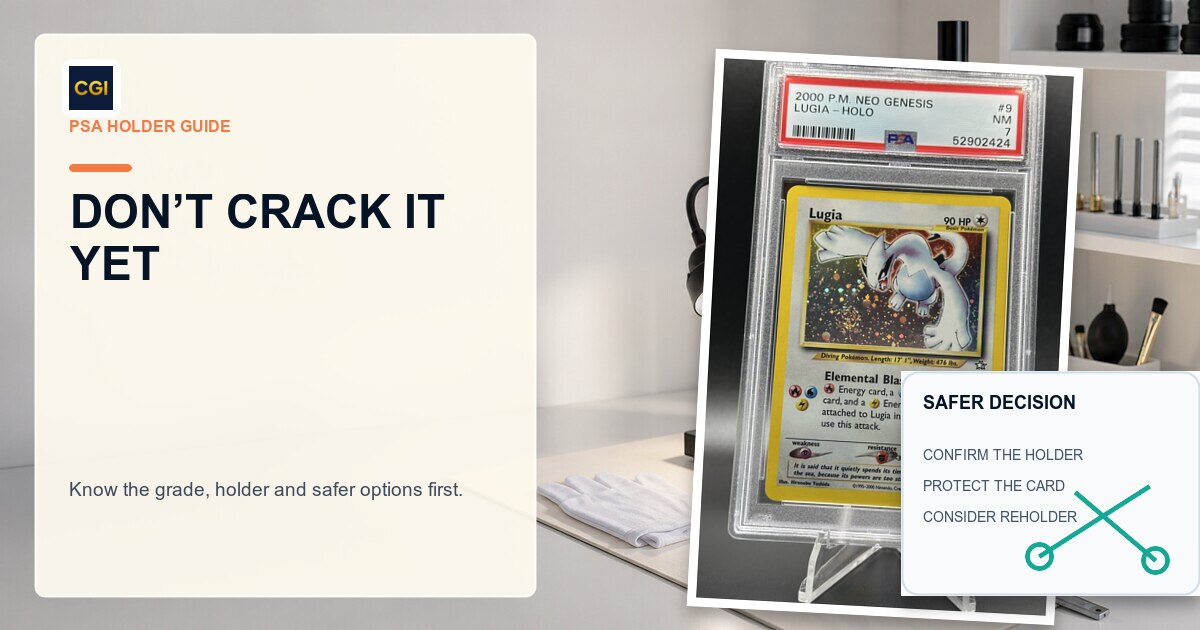
You can remove a card from a PSA holder, but it is not reversible. Once the card is out, do not treat it as a PSA-graded card anymore. PSA's current terms say an item removed intentionally or accidentally from its holder is treated as if it had never been graded by PSA. The prior PSA guarantee no longer applies, and a future submission is not entitled to the same grade.
That matters more than the opening technique. A slab may look like plastic, but it carries the certification, condition decision, and buyer confidence attached to that particular encapsulated item.
PSA also warns that breaking a holder can cause personal injury, including eye injury, and can damage the card. This is a decision guide, not a step-by-step tool tutorial: there is no at-home method that removes those risks.
Sources checked August 5, 2026: PSA's submission terms and PSA's trading-card services.
Recent collector discussion focuses on newer, more flexible PSA holders that can behave differently from older cases when someone tries to remove a card. You may see collectors call a holder variation a “1LR,” but that shorthand is not a reason to assume every recent return uses the same construction or requires the same approach.
PSA's own FAQ says it chooses the holder size it considers safest for each submitted card. It also notes that cards from the same set or parallel can come back in different holder sizes because physical thickness can vary. In other words, a “new slab” is not a universal instruction set.
The practical takeaway is simple: if the slab is merely scuffed, dated, or inconsistent with the rest of a collection, do not equate that with needing to break it. PSA has an official route for that.
Before you decide, separate the card from the status attached to the holder.
| What changes | Why it matters |
|---|---|
| The PSA grade no longer travels with the raw card | A previous label is not a current grade for an unslabbed card. |
| The prior PSA guarantee no longer applies | PSA's terms tie the guarantee to the item while it remains in the PSA holder. |
| Reholder may no longer be available | PSA can decline Reholder when it sees tampering or a fractured case. |
| Card and personal-safety risk become yours | PSA expressly warns about possible injury and damage when a holder is broken. |
| A later submission is a new decision | PSA is not required to return the former grade on a card that is submitted again. |
This does not mean breaking a slab is always irrational. A collector may prefer a raw binder card, or may decide a lower-grade slab is worth less to them than the raw card inside. It does mean the decision should be deliberate and economics-led, not based on a viral clip.
| Your actual goal | Better first option | Why |
|---|---|---|
| The PSA case is scratched, dull, or outdated | PSA Reholder | For eligible cards, PSA moves the card into its current holder while generally keeping the grade, authentication result, and certification number. |
| You think a PSA grade could improve | PSA Review | PSA says Review is submitted in the current holder, and the original label and grade are not at risk if the card does not upgrade. |
| You want a raw card for a binder or personal collection | Decide only after comparing the raw and slabbed values | Treat it as an irreversible collection choice, not a way to preserve a PSA grade outside the slab. |
| You want to use another grading company | Read that company's current crossover rules first | A crossover path may let the next grader evaluate the encapsulated card; opening it first removes that option. |
| You are buying a slab mainly to free the card | Inspect the card and price gap before buying | A low-grade slab can sometimes be a cheaper way to acquire a card, but damage risk and the value of the existing grade still matter. |
A collector with a PSA 10 wants a cleaner-looking case for display. Breaking the slab would turn the card into raw inventory and remove the existing PSA status. Reholder is the more direct first choice because it is designed to refresh an eligible PSA holder without automatically sending the card through a new grade.
The tempting move is to crack and resubmit. But the first question should be whether the card has a realistic upgrade case after close inspection. PSA Review is built for PSA-encapsulated cards and preserves the existing label and grade if there is no upgrade. For a more objective screen before paying a service fee, compare visible centering, corners, edges, and surface with a free CardGrade pre-screen. It is an image-based estimate, not a PSA grade or authentication opinion.
If you genuinely want the raw card, calculate the trade-off rather than relying on a generic rule. Check recent completed sales for the raw card and the same card in its exact PSA grade. Then account for the fact that the raw card will no longer carry the existing PSA grade or guarantee. The grading ROI calculator is useful when comparing the card's value, a possible resubmission fee, shipping, insurance, and marketplace costs.
Before changing an encapsulated card's status:
Newer holder discussions are a useful reminder to stop and ask what outcome you actually want. The issue is not whether someone online found a faster way to separate a case; the issue is whether the result is worth losing the existing PSA status and accepting the risk to the card.
For a worn case, Reholder is the better first conversation. For a potential upgrade, Review is worth considering before a raw resubmission. For a binder card, make the choice openly as a collector who wants a raw card—not as a way to keep a PSA grade after the slab is gone.
For other decisions around grading, compare the current PSA grading options, grading companies, and PSA vs. CGC before choosing a submission path.
PSA says an item intentionally or accidentally removed from its holder is treated as if it had never been graded by PSA. Its prior guarantee no longer applies, and PSA is not required to assign the same grade if the card is submitted again.
Usually, PSA Reholder moves an eligible card into its current holder while retaining the grade, authentication result, and certification number. PSA can decline Reholder when the case has been tampered with or fractured, the card condition has changed, or other exceptions apply.
Not before considering PSA Review. PSA says Review requires the card to stay in its current PSA holder and does not risk the original label and grade if the card does not upgrade. A raw resubmission has a different risk profile and does not preserve the previous grade.
Collectors report that some newer, more flexible holders behave differently from older cases, but PSA does not offer a public at-home opening method. PSA says it selects the safest holder size for the card, and even cards from the same set can be returned in different holder sizes because physical thickness varies.
Do not expect a home opening to preserve the holder or its PSA status. PSA describes its holders as sonically sealed and tamper-evident, and its terms warn that breaking one can injure the collector or damage the card. If the goal is a refreshed PSA holder, use the official Reholder service instead.
Pre-screen your cards before submitting to PSA, BGS, or CGC. Plans from $4.99/mo.
Start gradingAlso available as a Chrome Extension
Grade cards while you browse
Install our free Chrome Extension — right-click any card on eBay, COMC, or TCGPlayer for a grade in ~60 seconds.

Founder, CardGrade
Jamie Budesky is the founder of CardGrade and the engineer behind its AI vision grading pipeline. An Army veteran and IT specialist (DoD, since 2017), he writes about card grading, AI/ML grading technology, and collecting strategy — grounded in CardGrade's own grading data.

Flat light for centering and pre-screen; raking for surface. Re-shoot when the shot fails its criterion — before you trust a tool score or submit/hold.

The widely cited 43% PSA 10 gem rate hides a massive selection bias. Our analysis of thousands of cards reveals the real odds of getting a PSA 10 -- and how pre-screening changes everything.