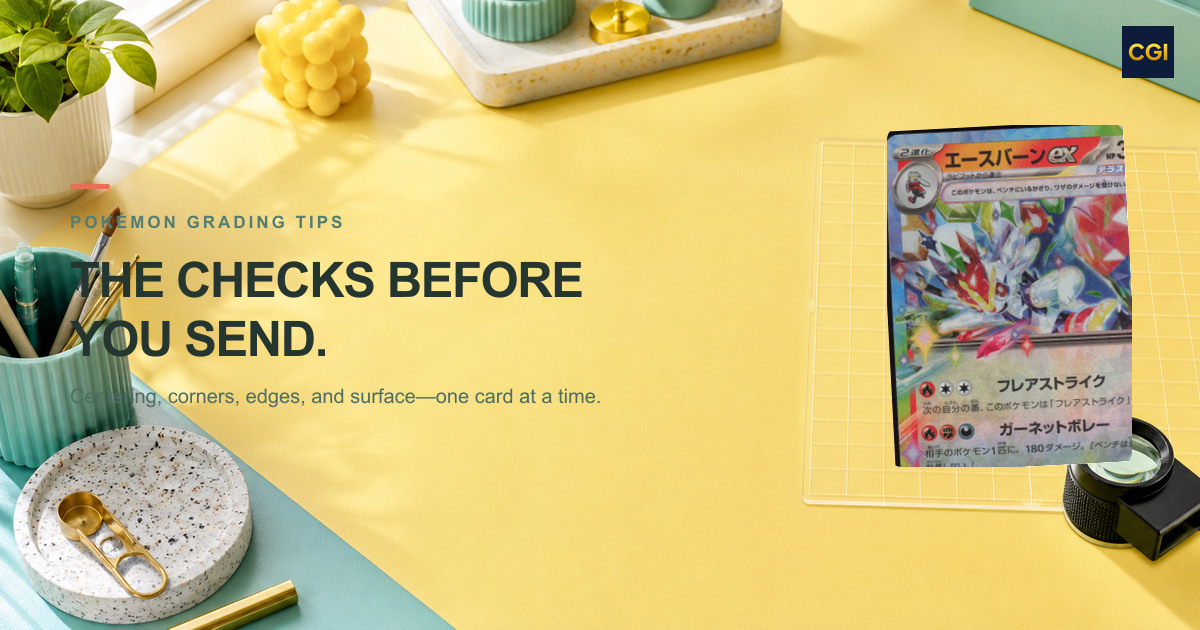
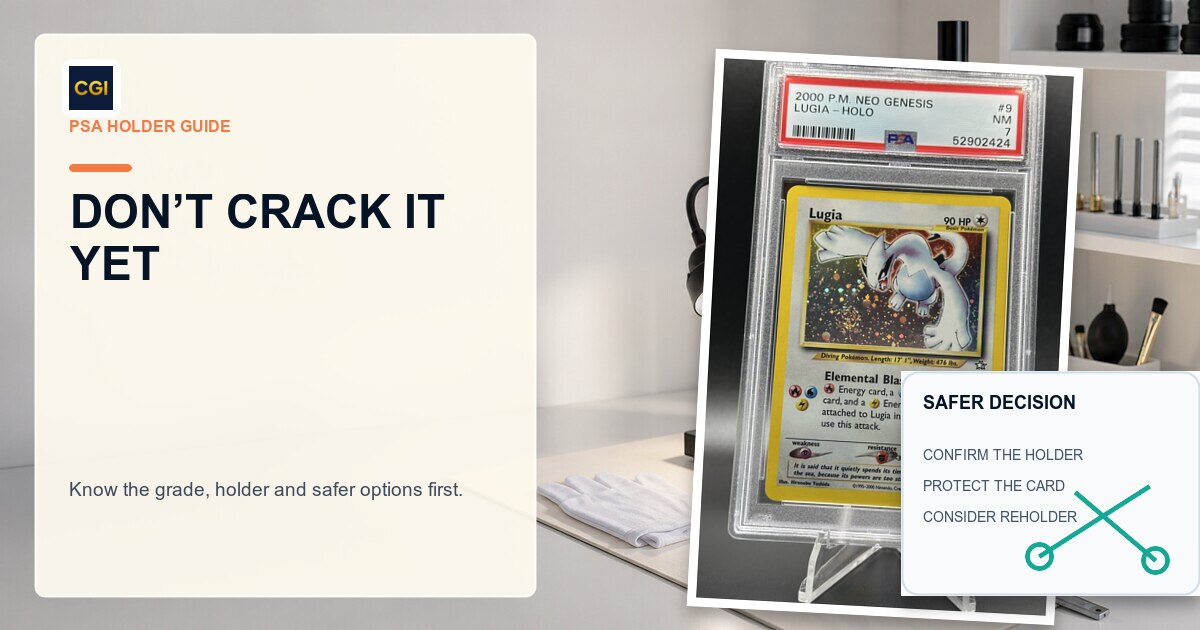
Pokemon Card Grading Tips: Maximize Your PSA and BGS Grades
Tips & Tricks
Pokemon Card Grading Tips: Maximize Your PSA and BGS Grades
Expert Pokemon card grading tips for PSA and BGS submissions. Handle holos, check WOTC quirks, and pre-screen with AI before grading.
Jamie Budesky·Founder, CardGrade·Published Nov 17, 2025 · Updated Aug 7, 2026·11 min read
Getting the Best Grades on Your Pokemon Cards
Pokemon card grading has become essential for serious collectors and investors. Whether you hold vintage Base Set holos or the latest Scarlet and Violet chase cards, a high professional grade can multiply your card's value dramatically. But Pokemon cards have unique characteristics that require specific knowledge to evaluate properly before submitting.
These Pokemon card grading tips cover everything from handling holo cards to understanding WOTC-era quirks, helping you maximize your PSA and BGS grades on every submission.
Understanding Pokemon Card Stock
Vintage vs. Modern Card Stock
One of the most important distinctions in Pokemon card grading is the difference between vintage and modern card stock. This difference affects how cards age, what defects to look for, and how strict grading standards apply.
Vintage WOTC Era (1999-2003):
Thinner card stock that is more susceptible to bending
Card stock tends to yellow over time, especially along edges
More prone to whitening at corners and edges
Surface coating is less durable, scratches more easily
Print quality varied significantly between print runs
Modern Era (2004-Present):
Thicker, more durable card stock
Better surface coating that resists scratching
More consistent print quality
Full-art and textured cards introduce new evaluation challenges
Japanese and English versions have different card stock properties
Japanese vs. English Card Stock
Japanese Pokemon cards use slightly different card stock than their English counterparts. Japanese cards tend to be slightly thinner and have a different texture. The borders on Japanese cards are typically narrower, which means centering issues are more visible. If you collect Japanese Pokemon cards, centering evaluation requires extra attention.
Holo Card Handling and Evaluation
Holo cards are the crown jewels of Pokemon collections, and they require special handling during evaluation and preparation for grading.
Types of Holo Patterns
Holo Type
Era
Key Concerns
Cosmos Holo
Base Set, Jungle, Fossil
Scratches extremely visible
Galaxy Holo
Various modern sets
Surface contamination shows easily
Full Art Holo
Modern sets
Edge whitening on dark borders
Textured Holo
Modern premium cards
Texture damage is irreversible
Reverse Holo
Most modern sets
Print lines and roller marks common
Gold/Silver Foil
Premium cards
Foil peeling and bubbling
Scratch Detection on Holos
Holo surfaces show scratches more readily than non-holo cards. A scratch that is invisible on a standard card becomes immediately apparent when light catches the holographic foil.
How to check for holo scratches:
Hold the card under a bright, direct light source
Slowly tilt the card at various angles (0 to 45 degrees)
Watch for light catching on any linear surface marks
Check both horizontal and vertical orientations
Pay special attention to the center of the holo area, where handling wear concentrates
Even brand-new holo cards can have factory scratches from the packaging process. Cards that were loose in booster packs (not in a protective wrap within the pack) are more susceptible to surface marks.
Silvering on Holo Cards
Silvering is a phenomenon where the holographic foil becomes visible along the edges of the card, appearing as a silver or metallic border. This is a manufacturing issue common in WOTC-era holos and some modern sets.
Impact on grades: Silvering is considered a defect by all grading companies. Light silvering along one edge might drop a card by half a grade at BGS or one full point at PSA. Heavy silvering on multiple edges can drop a card by 2-3 points.
What to look for: Hold the card at a slight angle and examine the edges. If you see a metallic sheen or silver line along any edge, that is silvering. It is most common on the left and right edges of WOTC-era holos.
WOTC Era Quirks (1999-2003)
Wizards of the Coast era Pokemon cards have specific characteristics that affect grading. Understanding these quirks is essential for anyone grading vintage Pokemon cards.
Print Run Variations
WOTC Pokemon cards went through multiple print runs, and quality varied significantly between them.
Base Set:
1st Edition: Generally better print quality and centering
Unlimited: More variable quality, centering issues more common
Shadowless: Intermediate quality, some printing inconsistencies
4th Print (UK): Different card stock, often with texture differences
Jungle and Fossil: These sets had fewer print run variations but still exhibit centering and print quality differences.
Common WOTC Defects
Defect
Frequency
Grade Impact
Off-center printing
Very common (30-40% of cards)
1-3 grade points
Ink dots on surface
Common
0.5-1 grade point
Print lines on holos
Common on unlimited
1-2 grade points
Edge whitening
Very common on older cards
0.5-2 grade points
Yellowing
Common on improperly stored cards
1-3 grade points
The WOTC Centering Problem
WOTC-era Pokemon cards are notorious for poor centering. Industry estimates suggest that fewer than 20% of Base Set Unlimited cards meet PSA 10 centering standards (60/40 or better front centering). This scarcity is one reason well-centered WOTC holos command extreme premiums.
Before submitting any WOTC-era card, centering should be your first evaluation. If the centering is off, no amount of perfect corners and surface will earn a top grade.
Print Line Detection
Print lines are linear marks on the surface of holo cards caused by the printing or lamination process. They run across the holo area and can be subtle or prominent.
How to Identify Print Lines
Place the card on a flat surface under direct light
Tilt the card slowly from side to side
Look for thin, consistent lines running across the holo area
Print lines typically run in one direction (horizontal or vertical)
They may be visible only at specific viewing angles
Print Lines vs. Scratches
Feature
Print Lines
Scratches
Pattern
Parallel, evenly spaced
Random direction and spacing
Depth
Surface level, part of the printing
Can be deeper, displacing material
Consistency
Same on multiple cards from same run
Unique to individual card
Location
Only on holo area
Can be anywhere on card
Grade impact
0.5-1 point typically
0.5-2+ points depending on severity
Print lines are considered manufacturing defects and will reduce a card's grade, but typically less severely than scratches of similar visibility.
Whitening Issues
Whitening occurs when the colored surface layer of a card wears away, exposing the white cardboard core underneath. It is one of the most common defects in Pokemon cards of all eras.
Where Whitening Occurs
Corners: The most common location, caused by contact with other cards or surfaces
Edges: Especially along the top and bottom where cards are shuffled
Back surface: Where cards rub against deck boxes or sleeves
Whitening by Card Color
Dark-bordered cards (like shadowless Base Set) show whitening more prominently than light-bordered cards. A tiny white spot on a card with black borders is far more noticeable than the same defect on a card with yellow borders. Keep this in mind when evaluating:
Yellow borders (Electric type): Whitening least visible
Preventing Whitening
Once whitening exists, it cannot be fixed without altering the card (which will get it flagged as altered). Prevention is key:
Sleeve cards immediately after opening packs
Use inner sleeves plus top loaders for storage
Avoid shuffling valuable cards in decks
Store cards vertically in boxes to minimize pressure contact
Storing Pokemon Cards Before Submission
Proper storage between evaluation and submission is critical. Many collectors damage cards during the waiting period.
Recommended Storage Method
Inner sleeve: Fresh KMC Perfect Fit or equivalent (not a well-used sleeve)
Top loader or Card Saver: Card Saver 1 for submissions, top loaders for long-term storage
Orientation: Store upright, not stacked flat with weight on top
Environment: Cool, dry, stable temperature (avoid attics, basements, garages)
Light exposure: Minimal to prevent fading, especially on older cards
What to Avoid
Binder pages: Ring binders can bend cards; D-ring binders are safer but still risky for high-value cards
Rubber bands: Will create indentations and surface marks
Direct sunlight: Causes fading, especially on Japanese cards and vintage holos
Temperature extremes: Heat warps cards; humidity causes curling and delamination
Magnetic holders: While great for display, inserting and removing cards risks edge and corner contact
Pokemon-Specific Grading Company Recommendations
PSA for Pokemon
Best for: Vintage WOTC holos, high-value chase cards where resale premium matters most
PSA 10 Pokemon cards command strong premiums in the market. For Base Set Charizard and other iconic WOTC holos, PSA remains the most liquid and recognized grade. PSA's slightly more lenient centering standard (60/40) is helpful given the centering challenges of vintage Pokemon cards.
BGS for Pokemon
Best for: Modern chase cards where sub-grades add value, collectors pursuing Black Labels
A BGS Black Label (all four sub-grades at 10) on a desirable modern Pokemon card commands extraordinary premiums. The sub-grade transparency is valued by the Pokemon collecting community, especially for cards in the $100+ range where buyers want to see the condition breakdown.
CGC for Pokemon
Best for: Modern sets, bulk submissions, budget-conscious grading
CGC has gained strong traction in the Pokemon community with competitive pricing and faster turnaround. For modern Pokemon cards where the volume of submissions is high, CGC offers good value.
Pre-Screen with CardGrade.io's Pokemon AI
Before submitting any Pokemon card for professional grading, use CardGrade.io's Pokemon-trained AI to pre-screen your cards. The CGI Vision AI has been trained specifically on Pokemon cards across all eras, understanding the unique characteristics of holo surfaces, WOTC-era card stock, and modern full-art textures.
In 60 seconds, CardGrade.io analyzes your Pokemon card across 16 inspection zones, predicting grades for PSA, BGS, and CGC simultaneously. The system identifies:
Exact centering ratios mapped to each company's tolerances
Corner wear including micro-fraying invisible to the naked eye
Edge whitening and silvering
Surface scratches, print lines, and holo damage
Overall grade prediction with confidence level
Start with plans from $4.99/mo, plans start at $4.99/mo. CardGrade.io is trusted by over 540 teams and has evaluated thousands of Pokemon cards across every era and rarity level.
Quick Reference: Pokemon Grading Checklist
Use this checklist before every Pokemon PSA grading or BGS submission:
Check front centering ratio (need 60/40 or better for PSA 10)
Check back centering ratio (need 75/25 or better for PSA 10)
Examine all four corners under magnification
Check all four edges for whitening and silvering
Inspect holo surface under angled light for scratches
Look for print lines on holo cards
Check for ink dots or surface contamination
Verify card is not warped or curved
Confirm card stock is not yellowed or discolored
Pre-screen with CardGrade.io for AI grade prediction
Summary
Pokemon card grading tips center on understanding the unique characteristics of Pokemon cards across different eras. WOTC-era cards present centering challenges and are prone to silvering and print lines. Modern cards have better consistency but introduce new evaluation challenges with full-art textures and complex holo patterns.
The key to maximizing your Pokemon card grading results is thorough pre-screening. Check centering first (it is the most common reason for grade drops), examine holos under angled light for scratches and print lines, inspect corners and edges under magnification for whitening, and use CardGrade.io's Pokemon-trained AI to get objective grade predictions before committing to professional grading submissions.
Share
Ready to grade your cards with AI?
Pre-screen your cards before submitting to PSA, BGS, or CGC. Plans from $4.99/mo.
Jamie Budesky is the founder of CardGrade and the engineer behind its AI vision grading pipeline. An Army veteran and IT specialist (DoD, since 2017), he writes about card grading, AI/ML grading technology, and collecting strategy — grounded in CardGrade's own grading data.