PSA Orders Stolen From a FedEx Truck: Collector Guide
PSA confirmed graded orders were stolen from a FedEx vehicle. How PSA insurance and Max Insured Value work, how to verify certs, and what to do now.
What Happened to the Stolen PSA Orders
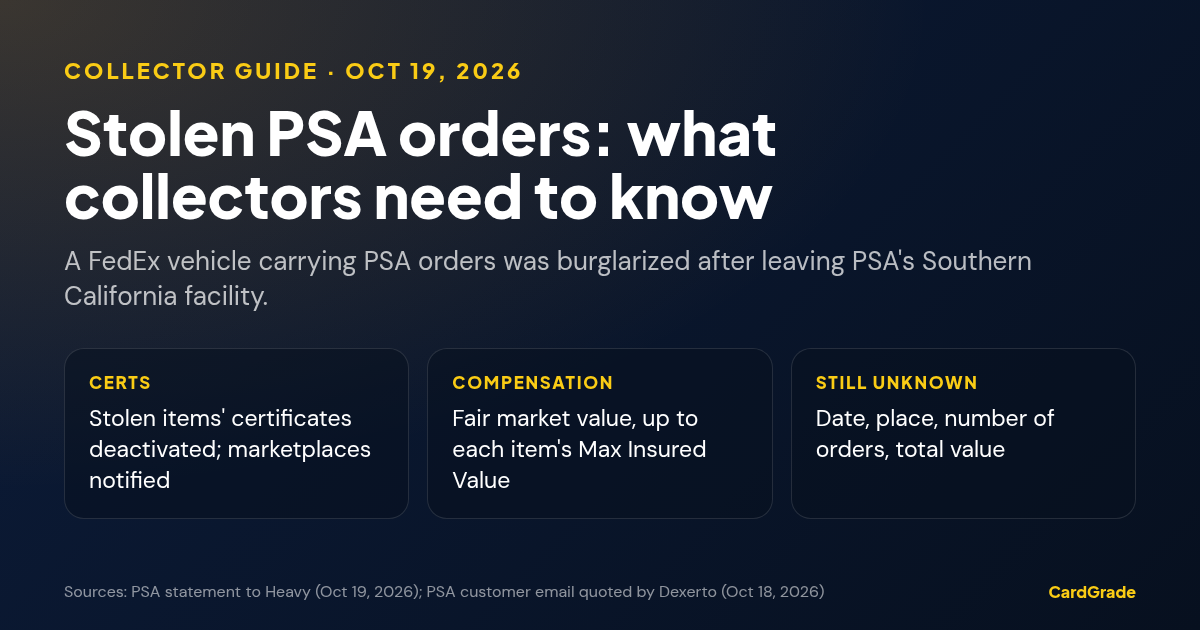
A FedEx vehicle carrying finished PSA orders was burglarized after it left PSA's Southern California facility, and graded cards on their way back to customers were stolen. PSA confirmed the theft in a statement to Heavy on October 19, 2026, after affected collectors began posting the notification emails they received over the weekend.
For anyone with a PSA order in the return pipeline, this is the scenario nobody plans for: the cards were graded, slabbed and shipped, and then disappeared before reaching the mailbox. The good news is that PSA's published coverage rules apply to exactly this stretch of the trip. The harder news is that those rules cap what you can recover, and the cap is a number most submitters picked months ago without much thought.
This guide pulls together what PSA has actually said, how PSA's return shipping and insurance work, what Max Insured Value means in real dollars at each current PSA tier, how certificate deactivation works for buyers, and how to think about ship-back versus picking cards up in person. Everything below is sourced to PSA's own pages or to published reporting, and we flag what is still unknown.
What PSA Has Confirmed So Far
In its statement to Heavy, a PSA spokesperson said:
"We are aware of a theft involving a third-party shipping vehicle carrying PSA-graded items. We are working closely with law enforcement and the carrier as the investigation continues."
The spokesperson added that PSA has "deactivated the certificates for the stolen items and notified marketplace partners so they can be on the lookout for rare and serialized items," and that its "customer service team has contacted affected customers directly and is arranging compensation based on fair market value." PSA also said: "We understand the impact this has on collectors involved, many of whom see these cards as far more than a financial asset."
The emails PSA sent to affected customers, as quoted by Dexerto on October 18, describe it this way: "After leaving our PSA facility in Southern California, a FedEx vehicle transporting PSA orders was burglarized, and items were stolen." The same email says compensation is "based on fair market value up to the Maximum Insured Value ('MIV') you selected for each item" and that customers would receive more information the following week.
Collectors have described losses across Pokémon, Magic: The Gathering and Yu-Gi-Oh! orders, including one collector who said publicly that a 104-card submission worth more than $100,000 was taken. Those are individual accounts, not figures from PSA. PSA has not named suspects, and neither will we.
| Topic | What PSA has said (as of Oct 19, 2026) |
|---|---|
| Investigation | Working with law enforcement and the carrier |
| Certificate numbers | Deactivated for the stolen items; marketplace partners notified |
| Affected customers | Contacted directly by customer service |
| Compensation | Fair market value, up to each item's Max Insured Value; more details promised |
| Turnaround times | Nothing said |
| Date, location, number of orders, total value | Not disclosed |
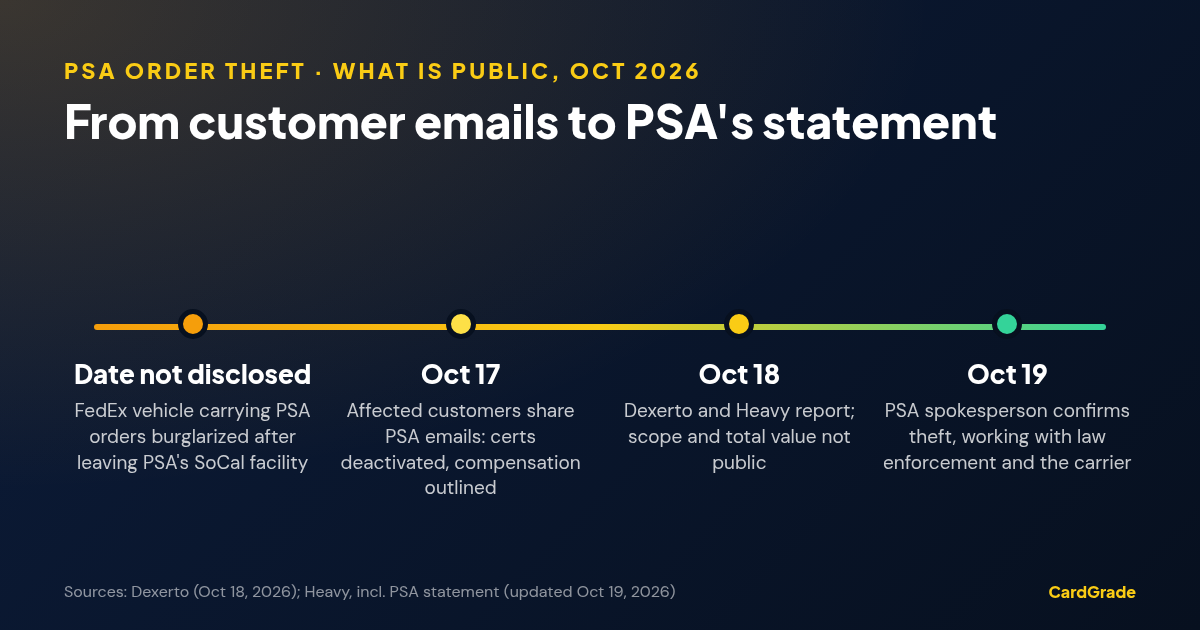
Sources: Dexerto (October 18, 2026); Heavy, including PSA's statement (updated October 19, 2026).
How PSA Return Shipping and Insurance Work
Most collectors think about insurance on the way in. This incident is a reminder that the return leg carries the most value, because the cards are now graded.
Coverage starts when PSA confirms receipt
PSA's coverage page says that once PSA confirms it has received an item, it is covered for loss or damage "up to the lesser of its fair market value or the applicable Max Insured Value," and that the coverage "extends until your item reaches its next destination (e.g., the PSA Vault, back to you, etc.)." That is the window this theft falls into: after grading, before delivery.
Inbound is a different story
The same page says PSA "does not insure inbound packages." If you ship with FedEx through PSA checkout, you can add inbound insurance from a third-party partner, Cabrella, and claims go through that provider. PSA's shipping guide repeats the point in its customer advisory: PSA takes responsibility while items are in its possession but is "not liable for any damage or loss that occurs during the shipping process" to its facilities.
Your return shipping choices
Section 5 of PSA's Submission Services Terms (last updated April 22, 2026) gives three options for the return trip:
- PSA ships and insures the item and charges you for that insurance.
- You obtain your own insurance.
- You ship on your own shipping account, in which case PSA will not insure the outbound package.
If you chose the third option, PSA's Max Insured Value coverage does not follow the package. Check which one your order used before assuming you are covered. Heavy also notes that PSA's published shipping policies list FedEx, UPS and armored transportation providers among the options for domestic shipments.
What Max Insured Value Means in Dollars
Max Insured Value is set by the service level you choose, unless you enter a different value. PSA's terms define it as "the maximum compensation you can receive for actual damage or loss sustained to a collectible while in PSA's possession," and tell submitters to pick a service level whose Max Insured Value is greater than their estimate of each card's post-grading fair market value.
Here is PSA's current trading card menu, checked on PSA's services page on October 19, 2026:
| Price per card | Max Insured Value | Estimated turnaround |
|---|---|---|
| Value Bulk / Value | $500 | Temporarily paused |
| $59.99 (Standard) | $1,000 | 90-100 business days |
| $79.99 | $1,500 | 70-80 business days |
| $199 | $2,500 | 20-30 business days |
| $349 | $5,000 | 10-15 business days |
| $599 | $10,000 | 7-10 business days |
Higher tiers on the same page run up to items with a Max Insured Value of $250,001 or more. PSA notes that turnaround estimates are not guaranteed.
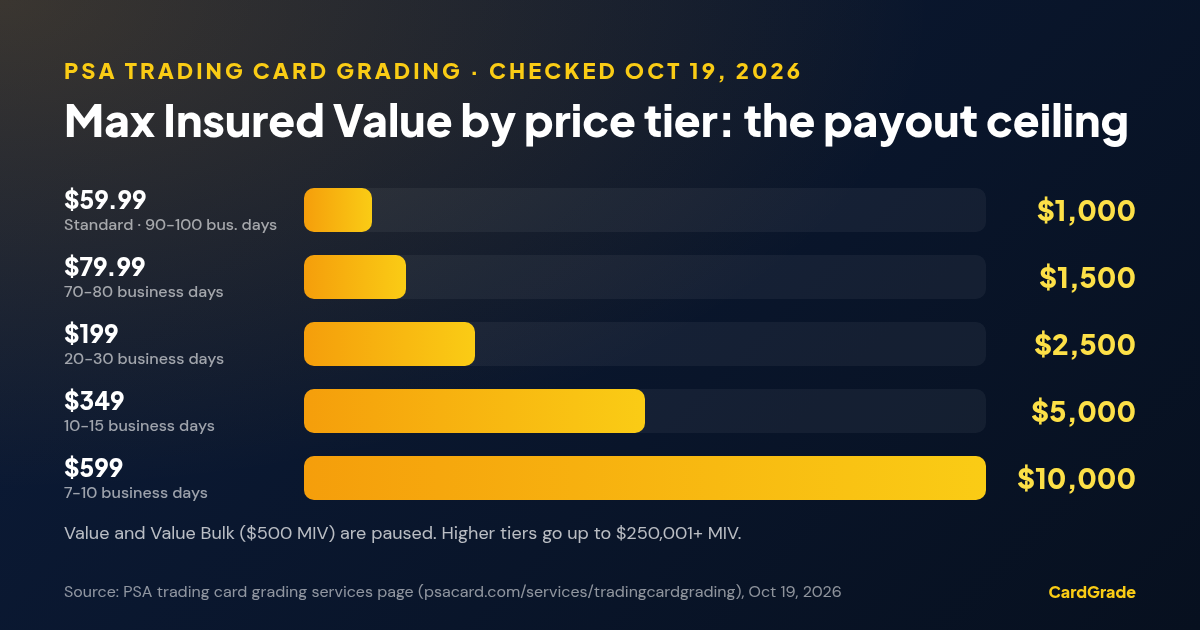
Source: PSA trading card grading services page, checked October 19, 2026.
Two worked examples
These are illustrations of PSA's published formula, not estimates for any real order:
- A card worth $1,800 after grading, submitted at Standard ($1,000 MIV): PSA's maximum compensation is $1,000, the lower of the two numbers.
- A card worth $800, submitted at the $199 tier ($2,500 MIV): the maximum is $800, because fair market value is lower than the cap.
PSA decides fair market value. Section 10 of the terms says PSA may determine it "by any means as we may determine," and that you must sign PSA's standard Release of Claims Agreement as a condition of payment. PSA can also hold back settlements if you owe PSA money.
What if you under-declared?
PSA's coverage page says that if PSA determines after grading that an item's value exceeds the Max Insured Value of your service level, it upgrades that item's service level, notifies you of the extra fee, and covers the item at the higher MIV once the fee is paid. We have not seen PSA say how that applies to orders already in transit. Our post on GameStop's $1,000 PSA insured cap shows how these ceilings can sit below what a card sells for.
How Certificate Deactivation Works and How Buyers Verify
PSA says it has deactivated the certificates for the stolen items. Under Section 10 of its terms, when an item is reported lost or stolen, PSA "may request a police report or carrier claim as proof of loss in order to deactivate the certification numbers displayed on our website." The same section says: "If you possess a deactivated cert, please contact our Customer Care team for direction."
Deactivation has limits. As Heavy points out, it does not stop someone from removing a card from its holder and trying to sell it raw. PSA's terms say a card removed from its holder is treated as if it was never graded by PSA, so a stolen card sold raw loses its PSA grade either way. Serialized cards are easier to trace than base cards.
For buyers, Section 14 of PSA's terms says cert verification "does not eliminate risk" and encourages buying from trustworthy sources. A practical routine for any high-end slab:
- Run the cert number in PSA's cert verification before paying, not after.
- Match the result to the slab in hand: card, year, set, grade and label details.
- Be cautious with serialized cards listed in the days after this theft, and ask for clear photos of the label.
- Walk away if the cert does not verify cleanly. PSA has not said publicly what a deactivated cert displays in the lookup, so treat any missing or mismatched result as a stop sign.
Has This Happened Before?
Large losses of PSA-graded cards in transit are rare in public reporting, but there is at least one well-documented case of slabbed cards being stolen and recovered. In February 2022, The Action Network reported that 285 recently slabbed PSA cards were stolen from the trunk of a car belonging to Nat Turner, who oversees PSA as CEO of Collectors Universe, in a residential garage in Irvine, California. Turner rebuilt the list of cards and values, which came to $1,067,000. Irvine police, helped by a location ping from a stolen device, recovered all 285 cards.
That case was a car break-in, not a carrier theft, and it ended unusually well. But it shows two things that matter now: a fast police report, and a complete record of every cert number and value, make recovery and claims far easier.
7 Things to Do If You Have a PSA Order Out Right Now
1. Check your order status in your PSA account
What to do: Look at each open order and its tracking. PSA says it has contacted affected customers directly.
Why it matters: PSA has not published a list of affected orders, and community-compiled lists on social media are not from PSA. If your order is shipped but stalled, contact PSA through its support page with your order number.
2. Note the reporting deadline
What to do: Put the date on your calendar. Section 7 of PSA's terms asks you to report missing return items within 17 calendar days of the original estimated delivery date, or within 30 days of the ship date if no estimate was given.
Why it matters: The terms say claims not reported on time can be waived.
3. Pull the Max Insured Value for every card
What to do: Write down the service level and MIV for each line item.
Why it matters: It is the ceiling on any payout. Use the table above to translate tiers into dollars.
4. Build your value file
What to do: Collect cert numbers, grades, purchase receipts, photos taken before submission and recent sold listings for the same card in the same grade.
Why it matters: PSA sets fair market value, but organized evidence makes any conversation about it easier.
5. Confirm how the return was insured
What to do: Check whether PSA shipped and insured the package, you added your own insurance, or you used your own shipping account.
Why it matters: PSA's terms say it does not insure outbound packages sent on your own account.
6. Deal only through PSA's own channels
What to do: Use your PSA account and psacard.com for anything related to a claim.
Why it matters: High-profile incidents attract unsolicited messages. Treat anyone offering to "recover" your cards with caution.
7. Keep buying discipline
What to do: Verify every cert before you buy, especially serialized cards.
Why it matters: You are less likely to end up holding a deactivated slab.
Ship-Back vs Pickup, Drop-Off and the Vault
PSA's terms describe more than one way for graded cards to come home, and each changes who carries the risk on the final leg.
| Option | What PSA's terms and coverage page say |
|---|---|
| Ship back to you | Covered up to the lower of fair market value or MIV until the item reaches you, if PSA ships and insures it |
| Ship on your own account | PSA will not insure the outbound package |
| Pickup (for example at a show) | Offered at PSA's option; in-person submissions are not guaranteed to be ready by the end of the event; items not collected are shipped at your expense unless PSA's delay was the only reason |
| PSA Vault | Listed by PSA as a "next destination"; separate Vault terms apply |
Dropping cards off in person does not remove return-shipping risk unless you also pick them up. Dexerto reported that one affected collector had submitted a card in person at a convention in Miami specifically to avoid the mail, and it was still in the stolen shipment on the way back. If you have high-value cards, the return method is worth as much thought as the inbound one. For queue context on any new order, see our October 6 PSA backlog update. PSA has not said whether the theft affects turnaround.
What We Could Not Confirm
- The date and exact location of the burglary. PSA's email and statement give neither.
- How many orders or cards were taken, or their total value.
- Any police agency's account, case number or arrests. We found no public police release as of October 19, 2026.
- Whether community-compiled lists of stolen cards are accurate. They are not from PSA.
- When and how PSA will set fair market values for affected items.
Pre-Screen Before You Set Your Max Insured Value
The MIV decision depends on what a card is likely to be worth after grading, which depends on its likely grade. CardGrade takes photos of a raw card and returns notes on visible centering, corners, edges and surface, so you can sort strong candidates from the rest before you choose a tier. It is a photo-based pre-screen, not an official grade, authentication or appraisal, and CardGrade is not affiliated with PSA, BGS, CGC, SGC or TAG. For how tier choice plays out once you know which cards are contenders, see our PSA Standard vs Priority guide.
Summary
- PSA confirmed the theft on October 19, 2026 and says it is working with law enforcement and the carrier.
- Stolen items' certs are deactivated, and marketplace partners have been notified.
- Compensation is fair market value, capped at each item's Max Insured Value, with details still to come.
- Check your orders now and report anything missing within PSA's 17-day window.
- Know your MIV in dollars: $1,000 at Standard, up to $10,000 at the $599 tier.
- Buyers should verify every cert before paying, especially serialized cards.
- Choose your return method deliberately; in-person drop-off does not cover the trip home.
Sources
- Heavy: PSA Grading Customers Hit by Massive Card Theft After FedEx Truck Burglary (includes PSA statement; updated October 19, 2026)
- Dexerto: TCG collector says $100K PSA card order stolen in FedEx truck burglary (October 18, 2026)
- PSA Coverage (checked October 19, 2026)
- PSA Submission Services Terms and Conditions (last updated April 22, 2026; Sections 2, 3, 5, 7, 9, 10 and 14)
- PSA trading card grading services and pricing (checked October 19, 2026)
- PSA Shipping Guide (checked October 19, 2026)
- The Action Network: Police Help Noted Collector Recover Over $1 Million in Stolen Trading Cards (February 15, 2022)
Frequently asked questions
Did PSA confirm the FedEx truck theft?
Yes. In a statement to Heavy on October 19, 2026, a PSA spokesperson said PSA is aware of a theft involving a third-party shipping vehicle carrying PSA-graded items and is working closely with law enforcement and the carrier. Customer emails quoted by Dexerto say the FedEx vehicle was burglarized after leaving PSA’s Southern California facility.
How do I know if my PSA order was stolen?
PSA says its customer service team has contacted affected customers directly. If you have an order in return transit and have not heard from PSA, check the order and tracking in your PSA account and contact PSA through its official support page with your order number. PSA has not published a list of affected orders.
Will PSA pay for stolen cards?
PSA says it is arranging compensation based on fair market value. The customer email quoted by Dexerto says that is capped at the Maximum Insured Value selected for each item, which matches PSA’s published terms: the payout is the lower of fair market value or Max Insured Value, and PSA determines fair market value.
What is the Max Insured Value for PSA Standard?
PSA’s services page, checked October 19, 2026, lists Standard at $59.99 per card with a $1,000 Max Insured Value. The $79.99 tier carries $1,500, $199 carries $2,500, $349 carries $5,000 and $599 carries $10,000. Value and Value Bulk ($500) are paused.
What happens to the cert numbers of stolen PSA cards?
PSA says it deactivated the certificates for the stolen items and notified marketplace partners. PSA’s terms say anyone who possesses a card with a deactivated cert should contact PSA Customer Care for direction.
Does dropping cards off in person avoid shipping risk?
Only for the inbound trip. Unless you also pick the cards up, they come back by carrier. Dexerto reported that one affected collector had submitted a card in person at a Miami convention and it was still in the stolen return shipment. PSA’s terms also say in-person submissions are not guaranteed to be ready for pickup by the end of an event.
Will the theft delay PSA turnaround times?
PSA has not said anything publicly about turnaround in connection with the theft. Its statement covers the investigation, certificate deactivation and compensation only.
Pre-screen raw cards before you submit
A photo-based pre-screen of centering, corners, edges and surface. Not an official grade, authentication or appraisal. CardGrade is not affiliated with PSA, BGS, CGC, SGC or TAG.
Try a pre-screen
Related articles
GameStop Cuts PSA Insured Cap to $1,000 per Card
GameStop’s updated terms cap insured value at $1,000 per card for PSA submissions created on or after September 9, down from $1,500.
PSA Standard vs Priority: Which Tier After You Pre-Screen?
Choosing between PSA Standard ($59.99) and Priority ($79.99) once you know which cards are gem candidates.
PSA Backlog Falls to 8.2M: October 6, 2026 Update
PSA active grading backlog is 8.2M as of Oct 6, down from ~9M Sept 22. Value still paused; Standard $59.99 is the cheapest open tier.