Avoid Junk Slabs With AI Pre-Screening | CardGrade
Market Insights
How AI Pre-Screening Helps Collectors Avoid Junk Slabs in the 2026 Grading Boom
Learn how AI pre-screening helps collectors avoid weak grading submissions, wasted fees, and low-value slabs before paying PSA, CGC, SGC, or Beckett.
Jamie Budesky·Founder, CardGrade·Published Jun 5, 2026 · Updated Aug 6, 2026·7 min read
Cardboard Connection's article, "The 2026 Grading Boom: Why You Can No Longer Afford to Guess", gets at the exact problem modern collectors are facing: grading demand is high, submission fees are real, and the market is full of cards that only make sense if they land near the top of the scale. The old habit of sending anything that "looks clean" is expensive now.
That matters because the biggest grading mistake is not missing a once-in-a-lifetime card. It is submitting too many borderline cards that come back as PSA 7, PSA 8, or weak PSA 9 slabs with no resale spread. A pre-screening workflow cannot guarantee a professional grade, but it can stop the obvious fee traps before they leave your desk.
Why the 2026 grading boom changed the submission decision
The grading market has moved from a collector habit to a margin decision. When raw supply is high and graded populations keep climbing, a slab only helps if the final grade creates enough value above the raw card, shipping, grading fee, and time cost. For many modern cards, that means the submission has to be a credible PSA 10 candidate or a high-demand PSA 9 with a proven market.
Cardboard Connection frames this as the rise of "precision collectors." That is the right lens. The best submitters are not guessing from a quick front scan. They are measuring centering, inspecting corners under light, checking edges slowly, and looking for surface problems that photographs often hide.
The important shift is that pre-screening is not a replacement for PSA, BGS, or CGC. It is a filter before paid grading. If a card cannot survive a basic centering and surface review at home, the odds are poor that a professional grader will save it.
Pre-screen factor
What to check before submitting
Why it matters
Submit signal
Centering
Left/right and top/bottom border ratios
A visible miss can cap the grade even when the card is otherwise clean
Submit only if the card is near the expected gem range
Corners
Whitening, dings, lift, compression
Corners are easy to miss in sleeve photos
Any touched corner should lower the expected grade
Edges
Chipping, rough cuts, whitening, foil damage
Edge wear is common on dark borders and chrome stock
Submit only if flaws are minor and market spread supports it
Surface
Scratches, print lines, dents, residue
Surface defects can turn a gem-looking card into a mid-grade slab
Use angled light before making the final call
The specific numbers and thresholds collectors should use
The source article highlights the simplest version of the math: if grading costs $25 or more per card and a raw card is worth $8, a low-grade slab can be a losing trade. Even when the exact fee changes by service level, the principle stays the same. The card has to clear the fee, shipping, insurance, opportunity cost, and resale risk.
For centering, the practical threshold collectors often discuss is 60/40 as a major boundary for many gem-mint conversations. That does not mean every card at 60/40 earns a top grade, and it does not mean every grader treats every issue identically. It means a collector should not rely on eyesight when a phone photo or centering tool can show whether the card is drifting toward the danger zone.
The other useful threshold is not a grading-company rule at all. It is your personal auto-reject line. If your pre-screening tool or manual review says a card is likely below a PSA 8 or PSA 9, and the market only rewards PSA 10, the answer is usually to keep it raw.
The junk slab problem
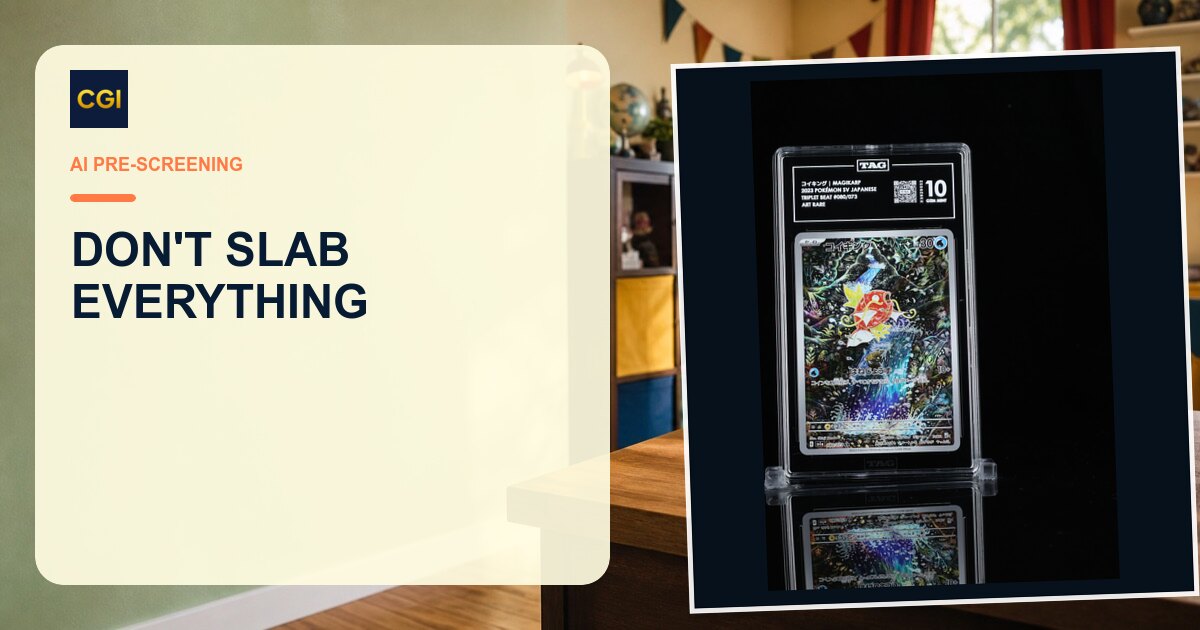
A "junk slab" is not a bad card. It is a card where the slab adds less value than the grading process costs. This is why modern base cards, overproduced parallels, and lightly flawed recent pulls can be dangerous submissions. The collector sees a possible gem; the market sees another low-pop-value slab.
The fix is to separate emotional appeal from submission value. A card can be worth keeping, displaying, or selling raw while still being a poor grading candidate. That distinction is where pre-screening earns its keep.
What this means for a collector deciding whether to submit
Start with the spread, not the grade dream. Look up recent raw sales and recent sales at likely grades. If the card needs a PSA 10 to make sense, treat every small flaw as a serious decision point. If the card is profitable at PSA 9, you have more room to submit.
Then inspect in the order graders punish most consistently: centering, corners, edges, surface. Centering is measurable, so there is little reason to guess. Corners and edges need magnification or sharp close-up photos. Surface needs angled light because flat overhead lighting hides scratches, dents, print lines, and residue.
Finally, be honest about the card type. Chrome cards, dark borders, thick stock, foil surfaces, and vintage paper all fail in different ways. A one-size-fits-all glance is how collectors end up paying professional fees on cards that were never strong candidates.
How to use pre-screening here
A good pre-screening workflow should answer three questions before you submit: What grade range is realistic, what defects are visible, and what grade does the market require for profit? CardGrade's /free-ai-card-grading tool is useful for the first pass because it gives collectors a fast condition read before they spend money on a grading order.
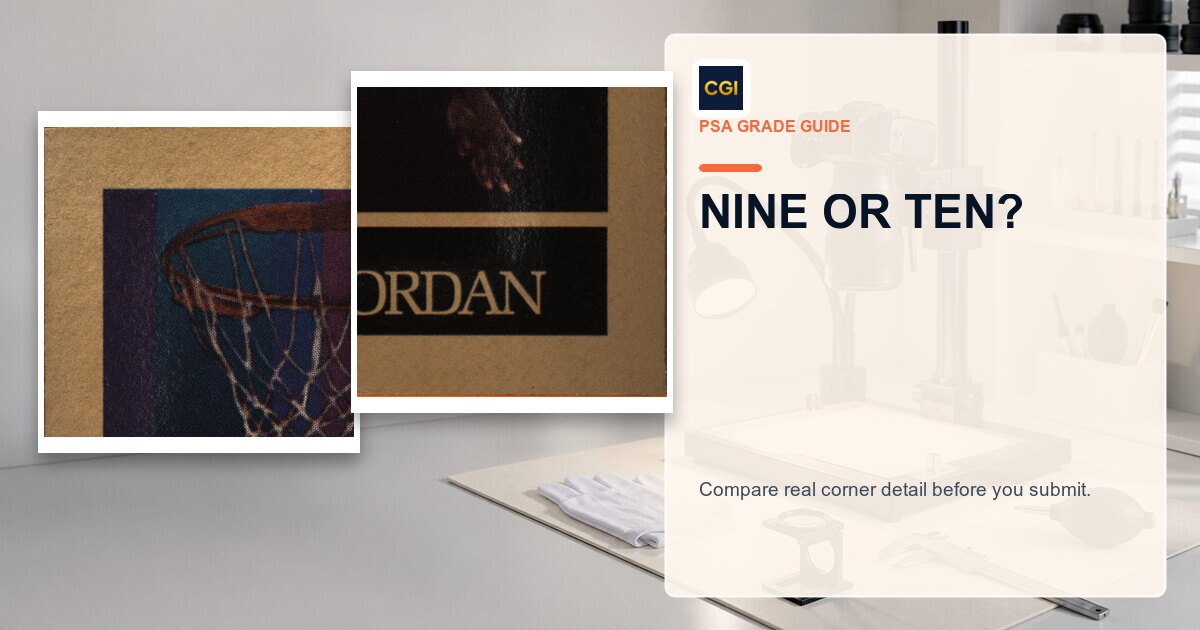
From there, pair the AI result with deeper manual checks. The PSA 9 vs PSA 10 guide is the right next read when a card looks close but not perfect, because the financial difference between 9 and 10 is often the whole submission decision. If you are still deciding where to send the card, compare costs and turnaround expectations with the CGC grading cost guide or the PSA grading cost breakdown.
The best use of AI is not blind trust. Use it as a triage layer: reject obvious non-candidates, flag borderline cards for closer inspection, and reserve paid submissions for cards where the condition read and market math agree.
Additional context: AI tools still need human inspection
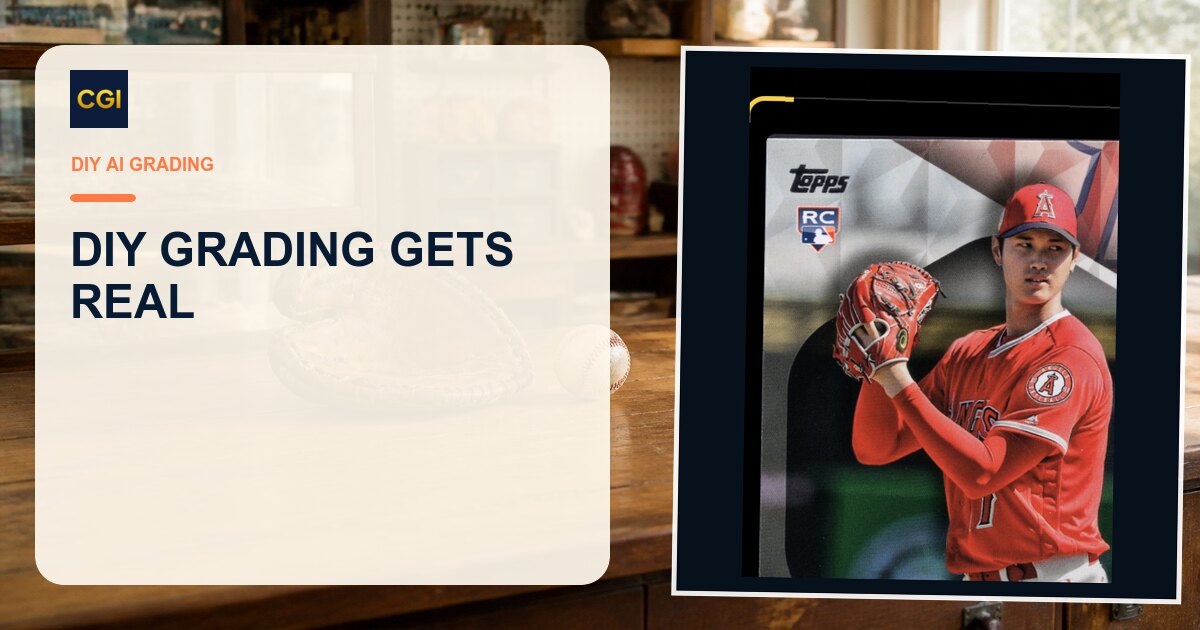
The source article correctly points out that phone-based tools can help with centering, surface review, and batch processing. That does not make them magic. AI can struggle with lighting, foil glare, transparent sleeves, factory print texture, and subtle surface issues that only appear when the card is tilted.
This is why the strongest workflow is hybrid. Use AI for consistency and speed, then use human inspection for the flaws that cameras miss. A desk lamp at a low angle, a microfiber-safe handling routine, and a loupe can catch problems that a straight-on image will flatten.
Collectors should also be careful with app grade estimates that sound too certain. A predicted PSA 10 is not a professional grade. Treat it as a reason to inspect more carefully, not as a reason to submit without checking the card yourself.
The bottom line
The 2026 grading boom rewards discipline. The winning move is not submitting more cards. It is submitting fewer cards with better evidence behind each decision. If the card needs a perfect outcome and your pre-screen finds centering drift, a soft corner, or a suspicious surface mark, keeping it raw may be the profitable choice.
Pre-screening gives collectors a way to slow down before the fee is gone. Measure what can be measured, inspect what AI may miss, and only submit when the expected grade and market spread both support the risk.
FAQ
Frequently asked questions
Is AI card grading accurate enough to decide whether to submit to PSA?
AI card grading is useful for pre-screening, but it should not be treated as a guaranteed **PSA** result. It is best used to identify obvious rejects, likely candidates, and cards that need closer manual inspection. The final submission decision should still include centering measurements, angled-light surface review, and current market comps.
What grade should I use as my auto-reject threshold?
For many modern cards, anything likely below **PSA 9** should be questioned unless the card is rare, vintage, autographed, or valuable in lower grades. If the market only pays a premium for **PSA 10**, your threshold should be even stricter. The right cutoff depends on raw value, grading cost, and the price spread between likely grades.
What is the fastest way to avoid junk slabs?
Check the resale spread before checking the card. If a **PSA 8** or **PSA 9** would not cover the grading cost, the card needs to be an unusually strong gem candidate. Then measure centering, inspect corners and edges, and use angled light for surface problems before submitting. Before you spend another grading fee, run the card through CardGrade's [/free-ai-card-grading](/free-ai-card-grading) pre-screen and make the submission decision with better evidence.
Share
Ready to grade your cards with AI?
Pre-screen your cards before submitting to PSA, BGS, or CGC. Plans from $4.99/mo.
Jamie Budesky is the founder of CardGrade and the engineer behind its AI vision grading pipeline. An Army veteran and IT specialist (DoD, since 2017), he writes about card grading, AI/ML grading technology, and collecting strategy — grounded in CardGrade's own grading data.