PSA 9 vs PSA 10: What the Official Standards Say
Compare PSA Mint 9 and Gem Mint 10 standards, centering, permitted imperfections, value research, and what a photo cannot determine before you submit.
Loading...
Compare PSA Mint 9 and Gem Mint 10 standards, centering, permitted imperfections, value research, and what a photo cannot determine before you submit.
The official difference is narrower—and more nuanced—than “one flaw versus no flaws.” PSA describes a Mint 9 as a superb-condition card with one minor flaw, such as a very slight reverse wax stain, a minor printing imperfection, or slightly off-white borders. PSA describes a Gem Mint 10 as virtually perfect, with four sharp corners, sharp focus, full original gloss, and no staining. PSA can still allow a slight printing imperfection on a 10 when it does not impair overall appeal.
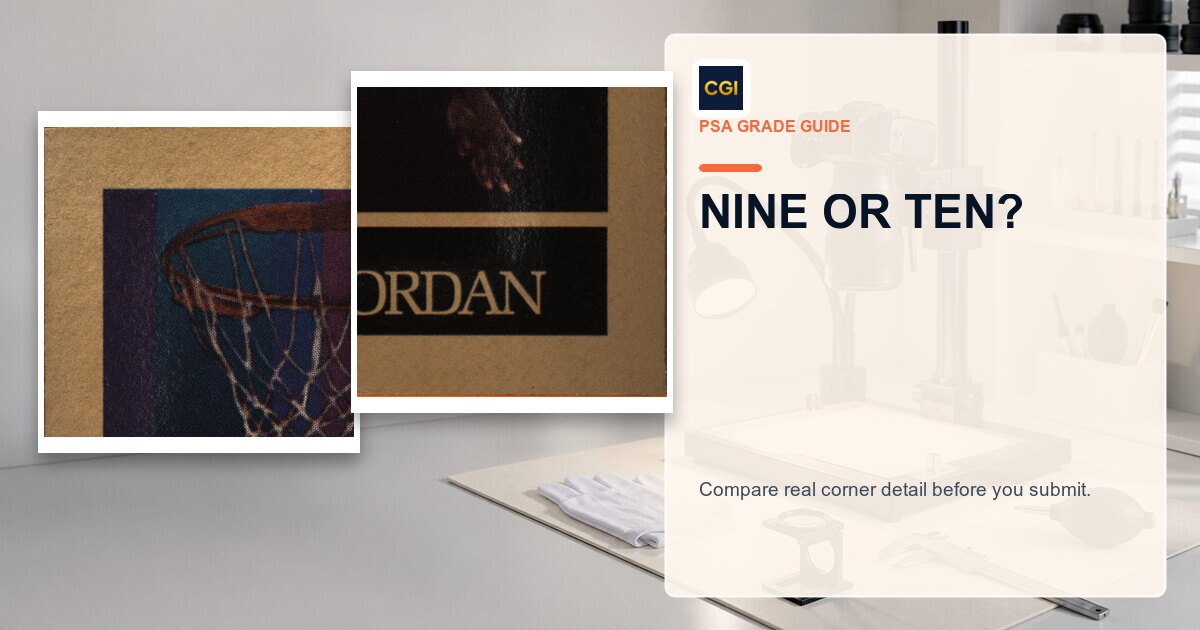
PSA publishes approximate centering of 60/40 or better on the front and 90/10 or better on the reverse for PSA 9, compared with 55/45 or better on the front and 75/25 or better on the reverse for PSA 10. Those figures are useful inspection references, not a formula or promise. PSA physically inspects the card and reserves judgment for its overall eye appeal.
Primary source checked August 8, 2026: PSA grading standards.
| Factor | PSA 9 Mint | PSA 10 Gem Mint |
|---|---|---|
| PSA description | Superb condition with one minor flaw | Virtually perfect |
| Front centering | Approximately 60/40 or better | Approximately 55/45 or better |
| Reverse centering | Approximately 90/10 or better | Approximately 75/25 or better |
| Corners and focus | Must support the overall Mint judgment | Four sharp corners and sharp focus |
| Surface and print | A very slight reverse wax stain, minor printing imperfection, or slightly off-white borders may be present | Full original gloss and no staining; a slight printing imperfection may be allowed when overall appeal is not impaired |
| What determines the result | PSA's inspection of the physical card and overall eye appeal | PSA's inspection of the physical card and overall eye appeal |
PSA does not publish a four-subgrade averaging formula for these grades, and it does not say that one measured factor automatically determines the final number. Treat centering, corners, edges, surface, focus, print quality, and eye appeal as parts of a physical-card review—not as points in a homemade equation.
For grade-by-grade definitions, see the dedicated PSA 9 Mint guide, PSA 10 Gem Mint guide, and complete PSA grading scale.
A PSA 9 can look exceptionally clean at normal viewing distance. The grade-limiting issue may be subtle: a small printing imperfection, slightly off-white border, very slight reverse wax stain, or centering that fits PSA's published Mint range but not its tighter Gem Mint reference.
That does not mean every PSA 9 must show one obvious defect, or that finding one minor issue proves a raw card is a 9. PSA examines the actual card under its own process. Image compression, glare, a sleeve, and a single lighting angle can all hide or exaggerate a concern.
When reviewing a candidate, check:
The card centering tool can help calculate border ratios. It cannot determine the final grade or inspect flaws that are not visible in the image.
PSA's Gem Mint 10 standard calls for a virtually perfect card with four sharp corners, sharp focus, full original gloss, no staining, and centering within its published approximate limits. The important nuance is that “virtually perfect” is not the same as “mechanically flawless”: PSA says a slight printing imperfection may be acceptable when it does not impair overall appeal.
That exception should not be turned into a checklist loophole. A visible scratch, stain, damaged corner, or other issue is not automatically acceptable because PSA mentions a limited printing imperfection. PSA decides whether the physical card meets the Gem Mint standard.
If you are evaluating a raw card, use the PSA grade predictor as a photo-based pre-screen only. CardGrade does not authenticate the card, issue a PSA grade, or guarantee a submission outcome.
These examples show how to reason about evidence before a submission. They are not predictions of what PSA will do.
Suppose a modern card measures near 50/50 on both axes and looks sharp at the corners, but a print line appears when the foil surface is tilted under directional light. The centering alone does not settle the grade. Document the line, inspect it from multiple angles, and compare the physical card with PSA's published definitions. A straight-on photo may miss the issue entirely.
Suppose the front measures approximately 60/40 while the reverse and visible condition look clean. That front measurement matches PSA's published Mint 9 reference, not its tighter published Gem Mint 10 front reference. It still does not guarantee PSA 9: PSA evaluates the complete physical card, and a photo cannot reveal every surface, stock, alteration, or authenticity concern.
Before paying a submission fee, follow the pre-grade-before-PSA checklist and inspect the raw card outside a reflective holder when it is safe to do so.
PSA publishes approximately 60/40 or better front centering for Mint 9. It also notes limited discretion based on eye appeal. That discretion should not be advertised as a standard 65/35 allowance or a reliable exception.
For submission planning, use 60/40 as the published PSA 9 front reference. A card outside that reference may receive a different result, and only PSA can determine the final grade after physical inspection.
There is no defensible universal PSA 10-to-PSA 9 price multiplier. The difference can be small, large, or unstable depending on the exact card and market.
Build a comparison with:
PSA's Auction Prices Realized can support card-specific research. The card value research guide and grading ROI calculator explain how to compare outcomes without assuming that every 10 commands the same premium.
Cracking a holder is not a shortcut to PSA 10. Opening a slab can damage the card, and a new submission can receive the same grade, a lower grade, or another outcome. A favorable photo estimate does not remove those risks.
Before considering it:
Never treat a predicted grade or border measurement as proof that a slab is undergraded.
No. A card can leave the pack with off-centering, a print line, rough cut, corner issue, edge chipping, surface mark, or other manufacturing defect. “Pack-fresh” describes when the card was removed; it is not a professional condition grade.
Use clean hands, good light, and careful handling. Inspect both sides and several surface angles, then compare the card with PSA's current standards. If the economics only work at PSA 10, calculate the downside of PSA 9 or a lower result before submitting.
CardGrade is an image-based condition pre-screen. It can help organize visible observations across centering, corners, edges, and surface, but its result depends on the photos supplied. It does not authenticate the physical card, identify every hidden issue, issue an official PSA grade, appraise value, or guarantee a submission result.
A practical sequence is:
PSA describes a Mint 9 as a superb-condition card with one minor flaw, while a Gem Mint 10 is virtually perfect with four sharp corners, sharp focus, full original gloss, and no staining. PSA can still allow a slight printing imperfection on a 10 when it does not impair overall appeal. PSA makes the final decision after inspecting the physical card.
PSA publishes approximate centering of 60/40 or better on the front and 90/10 or better on the reverse for Mint 9. For Gem Mint 10, PSA publishes approximately 55/45 or better on the front and 75/25 or better on the reverse. These are reference points, not grade guarantees.
Yes. PSA says a Gem Mint 10 may have a slight printing imperfection when it does not impair the card's overall appeal. That does not mean every flaw is acceptable; PSA still expects a virtually perfect card and makes the final judgment from the physical card.
PSA publishes approximately 60/40 or better front centering for Mint 9. PSA also reserves limited eye-appeal discretion, but collectors should not treat 65/35 as the normal PSA 9 standard or a promised exception. Use 60/40 as the published front reference and let PSA determine the final grade.
There is no universal multiplier. Compare recent completed sales for the exact year, set, card number, variation, qualifier, grade, and selling venue. Then account for population, demand, eye appeal, grading, shipping, insurance, and selling fees.
Pre-screen your cards before submitting to PSA, BGS, or CGC. Plans from $4.99/mo.
Pre-screen free in 60 secondsAlso available as a Chrome Extension
Grade cards while you browse
Install our free Chrome Extension — right-click any card on eBay, COMC, or TCGPlayer for a grade in ~60 seconds.

Founder, CardGrade
Jamie Budesky is the founder of CardGrade and the engineer behind its AI vision grading pipeline. An Army veteran and IT specialist (DoD, since 2017), he writes about card grading, AI/ML grading technology, and collecting strategy — grounded in CardGrade's own grading data.
Learn how AI pre-screening helps collectors avoid weak grading submissions, wasted fees, and low-value slabs before paying PSA, CGC, SGC, or Beckett.

GemRate's May 2026 grading recap shows that grading demand is still running near the 3 million card-per-month level, even after a month-over-month dip
No. CardGrade is an image-based condition pre-screen. It can help organize a review of visible centering, corners, edges, and surface details in the supplied photos, but it cannot authenticate the physical card, detect every hidden issue, or determine PSA's final grade.
No. A pack-fresh card can have factory centering, printing, corner, edge, or surface issues before it is handled. Inspect both sides under suitable light and compare the physical card with PSA's standards before deciding whether to submit.
Only after weighing the downside carefully. Removing a card from a holder can damage it, and a new submission can receive the same grade, a lower grade, or another outcome. Verify the certification, inspect the card, compare exact PSA 9 and PSA 10 sales, include all costs, and consider PSA's current Review service before opening a PSA holder. PSA Crossover applies to cards graded by other companies.