In short: PSA's new Standard tier at $59.99 gives collectors a cheaper option than Priority ($79.99), but it comes with a longer wait (90–100 business days) and a lower insured-value cap ($1,000). If your card could be worth more than $1k slabbed, the $20 savings may cost you in coverage. Pre-screen first to know what you're betting on.
PSA Restructures Pricing: Standard Arrives, Express Jumps to $199
On September 9, 2026, PSA announced a restructured service lineup that adds a new tier and renames two existing ones. Collectors now have more options below $80 for the first time since Value tiers were paused — but the fine print matters.
Here's what changed:
- Standard — NEW. $59.99 per card, 90–100 business day turnaround, $1,000 maximum insured value. Opens September 14, 2026.
- Priority — Renamed from Regular. $79.99 per card, 70–80 business days, $1,500 MIV. Priority keeps the same $79.99 fee and 70–80 business-day estimate that Regular carried immediately before the rename (confirm live at checkout).
- Express — Price increased from $149 to $199 effective September 9. 20–30 business days, $2,500 MIV.
- Premier — Renamed from Walk-Through. $599 per card, 7–10 business days, $10,000 MIV.
- Value tiers — Still paused. Value Bulk, Value, Value Plus, and Value Max remain unavailable.
PSA made clear: Standard is not a Value replacement. It's a new tier positioned between the paused Values and Priority.
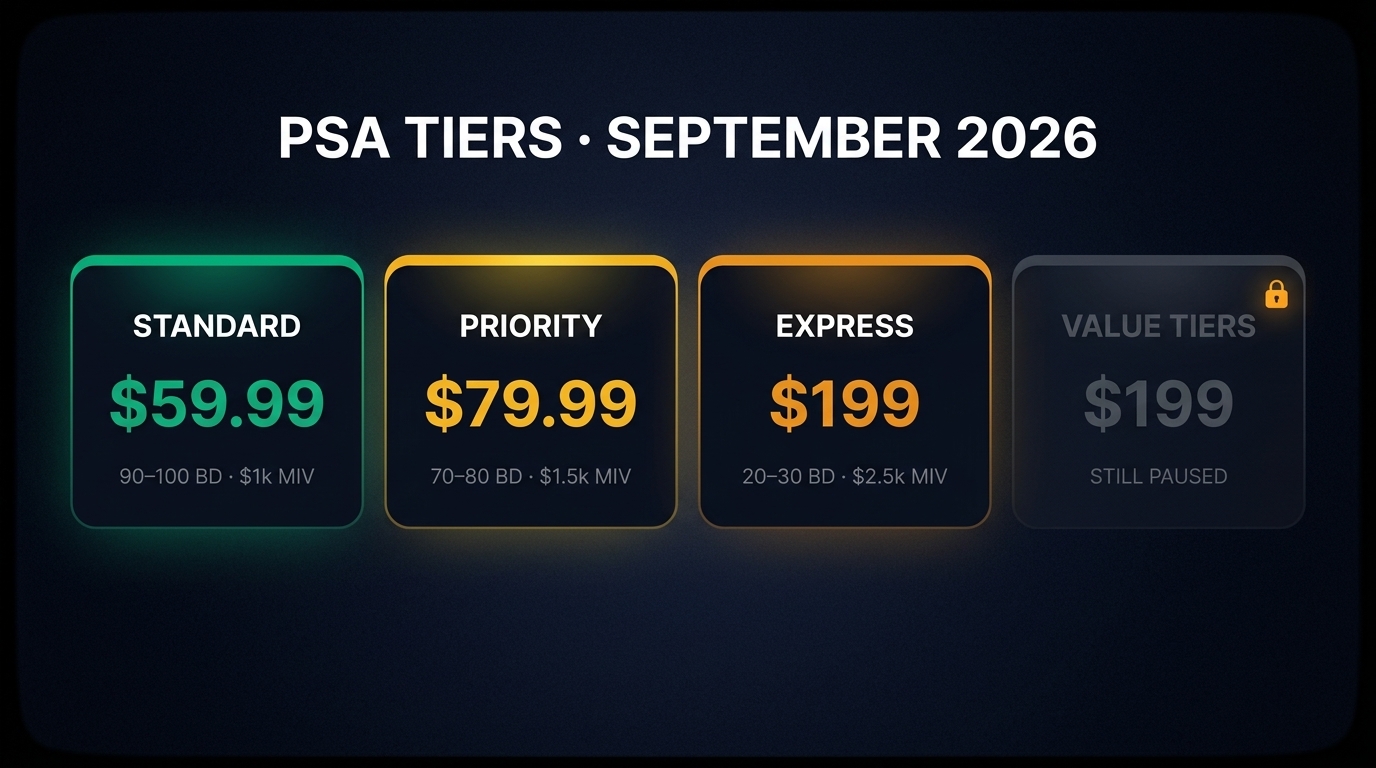
Complete PSA Pricing — September 2026
| Tier | Price | Turnaround | Max Insured Value | Notes |
|---|
| Standard | $59.99 | 90–100 BD | $1,000 | Opens Sept 14; no Collectors Club required |
| Priority | $79.99 | 70–80 BD | $1,500 | Formerly "Regular" |
| Express | $199 | 20–30 BD | $2,500 | Price increased Sept 9 (was $149) |
| Premier | $599 | 7–10 BD | $10,000 | Formerly "Walk-Through" |
| Value Bulk–Max | $24.99–$64.99 | N/A | — | Still paused |
PSA is also opening Frankfurt, Germany submissions on September 15, 2026 at 12:01 a.m. CET — a significant move for EU collectors tired of transatlantic shipping costs and customs friction.
The active backlog remains around 9.9 million cards as of September 8, 2026. That context matters when you're picking a tier: these turnaround estimates are not promises.
Don't Confuse Standard with Value Max
One comparison that's circulating in collector discussions on r/psagrading is worth addressing head-on: Standard is not the old Value Max.
| Old Value Max | New Standard |
|---|
| Price | $64.99 | $59.99 |
| Turnaround | 40–50 BD | 90–100 BD |
| Max Insured Value | $1,000 | $1,000 |
| Status | Paused (June 2026) | Opens Sept 14, 2026 |
Yes, Standard is $5 cheaper than Value Max was. But the turnaround is roughly double — 90–100 business days vs. 40–50. Same insurance cap, longer wait, slightly lower fee.
PSA explicitly positioned Standard as a new tier, not a reopening or rebranding of Value Max. The Value tiers (Bulk, Value, Value Plus, Value Max) remain paused with no announced return date.
The takeaway: If you were budgeting for Value Max's 40–50 day turnaround at $65, don't assume Standard at $60 is the same deal. You're saving $5 but potentially waiting an extra 6–8 weeks.
What Collectors Are Saying
The announcement sparked immediate debate in the hobby community. In a September 9 thread on r/psagrading, collectors weighed in on what Standard actually means for them:
The wait-for-Value crowd is still waiting. Multiple commenters noted they're holding off until Value Bulk ($24.99) or Value ($32.99) reopen. At $59.99, Standard is nearly double what they were paying before the June pause — and for many low-to-mid value cards, the math doesn't work at that price point.
The 100-day turnaround is the sticking point. Several collectors pointed out that $60 isn't terrible in isolation, but $60 plus 90–100 business days — effectively 4–5 calendar months — changes the calculation. Cards tied to seasonal markets, player performance, or set hype may lose their window.
Express at $199 drew criticism. The $50 price jump (from $149 to $199) without a corresponding bump in the $2,500 MIV cap frustrated collectors who saw it as a pure price increase. If you're submitting cards that need Express-level insurance coverage, you're now paying more for the same protection.
These are collector observations, not PSA-verified statistics. Anecdotal reports about turnaround times running past estimates reflect individual experiences, not official PSA data. Your mileage may vary — literally.
The CardGrade angle: This is exactly when pre-screening matters most. If you're debating whether to pay $60 and wait 4 months, you want to know the card's grade potential before you commit. A card that pre-screens at PSA 8 probably isn't worth Standard's fee and wait. A card that pre-screens at 9.5–10 might be — if the PSA 10 value justifies the cost and timeline.
The Decision: Standard ($59.99) vs. Priority ($79.99)
The $20 difference looks small. The implications aren't.
Choose Standard when:
- Your card's slabbed value would stay under $1,000 (the insurance cap)
- You're submitting volume and can wait 90–100 business days
- You're building a graded personal collection, not flipping
- The card pre-screens at 9.5+ with AI, confirming gem-mint potential
Choose Priority when:
- Your card could be worth $1,000–$1,500 slabbed (you need the coverage)
- Turnaround matters — 70–80 BD vs. 90–100 BD is 2–4 weeks faster
- You're uncertain about value and want a buffer on the insurance cap
- You're submitting a small number of high-confidence cards, not bulk
Consider Express ($199) when:
- The card is worth $1,500–$2,500 slabbed and you need the higher MIV
- You're selling into a time-sensitive market window (set release, player moment)
- 20–30 business days fits a specific deadline
For most hobby collectors sending modern cards with moderate upside, Standard will be the right call. For vintage, chase hits, or anything with real pop potential, don't let $20 in savings underinsure you.
The Insured-Value Trap
Every PSA tier caps what you can declare as the card's value — and what PSA will cover if something goes wrong.
Example scenario:
You pull a modern chase card from a new set. Raw, it's selling for $200. You submit it at Standard ($59.99, $1,000 MIV) expecting a PSA 9 that might fetch $400 slabbed.
It comes back PSA 10. Comps show PSA 10 copies selling for $2,500.
You shipped a $2,500 card with $1,000 of coverage. If PSA loses or damages it in transit, you're $1,500 short.
This isn't hypothetical. The PSA 10 premium on desirable modern cards is often 4–6× the PSA 9 value. If your card has gem-mint upside, the tier's MIV ceiling is part of the bet.
The fix: Pre-screen the card before you choose a tier. If it's borderline (AI grades it 8–9), Standard is fine — you're not expecting a PSA 10. If it's a strong 10 candidate and the 10 comps are over $1,000, bump to Priority or Express.
When Standard Doesn't Make Sense
Standard is the cheapest open tier. That doesn't mean it's always the right tier.
Skip Standard if:
- The card's PSA 10 value exceeds $1,000. You're underinsuring the upside.
- You need it faster. 90–100 business days is 4–5 calendar months. If the card is tied to a seasonal market (football rookies, Pokémon set hype), that window may close.
- You're submitting cards that won't gem. At $59.99 per card, a PSA 8 still costs you the same fee as a PSA 10. The tier is cheaper than Priority — but it's not cheap enough to absorb misses. Pre-screen first.
- You were waiting for Value tiers. Standard is not Value. If you were planning to submit at $32.99 (Value) or $24.99 (Value Bulk), Standard at $59.99 is still nearly double the cost.
A Pre-Screen Strategy for the New Tiers
With three open tiers at three different price/insurance levels, the question isn't just "should I submit?" — it's "which tier matches this card?"
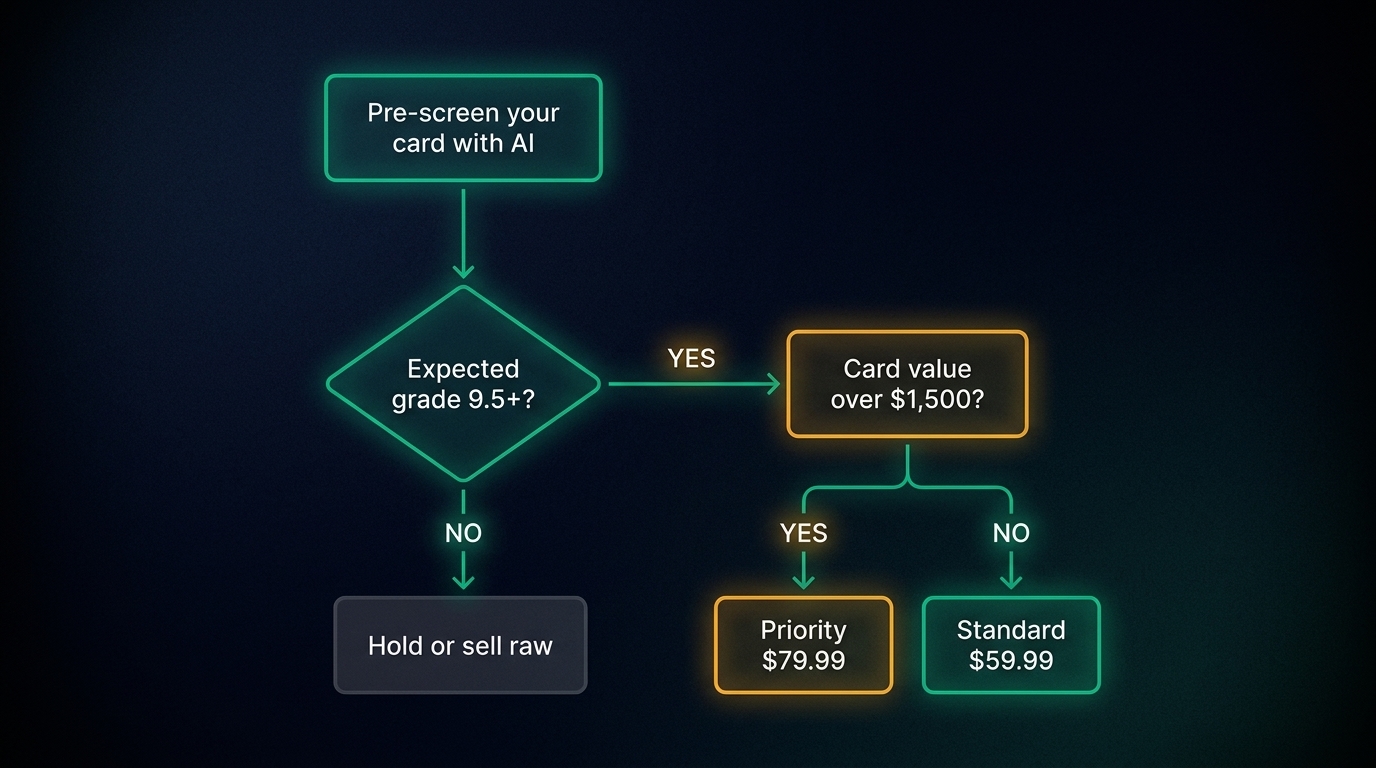
Here's the workflow that makes sense now:
-
Pre-screen the card with AI. CardGrade.io analyzes centering, corners, edges, and surface in under 60 seconds and predicts PSA, BGS, and CGC grades. It costs less than $1 per card to check. It tells you whether you're betting on a 10, a 9, or something lower.
-
If the AI grades it 9.5–10: Look up the PSA 10 comps for that specific card.
- PSA 10 value under $1,000 → Standard ($59.99)
- PSA 10 value $1,000–$1,500 → Priority ($79.99)
- PSA 10 value $1,500–$2,500 → Express ($199)
-
If the AI grades it 8–9: Consider whether the PSA 9 value justifies the fee. At $59.99, your break-even is a card where the slabbed 9 sells for meaningfully more than the raw card + grading cost. For most modern cards, that's a narrow window.
-
If the AI grades it below 8: Hold it raw. No tier makes economic sense.
This isn't about trusting AI over PSA's graders. It's about not spending $60–$200 to find out what you could have learned for $1.
We've covered this decision math in depth in our guides on whether card grading is worth it and pre-screening before PSA.
What Hasn't Changed
A few things to keep in mind:
- Value tiers are still paused. Standard is a new tier, not the return of Value. If you were waiting for $24.99–$49.99 pricing, you're still waiting.
- The backlog is still massive. ~9.9 million cards as of September 8. Turnaround estimates are estimates, not guarantees.
- AI pre-screening isn't going anywhere. In an environment where the cheapest tier is $59.99 and the wait is 4+ months, knowing what your card will grade before you pay has never mattered more.
The Bottom Line
PSA's Standard tier gives collectors a real option below $80 for the first time since Value tiers closed. At $59.99 with a $1,000 insured cap, it's the right tier for everyday cards with moderate upside and no time pressure.
But it's not Value. And it's not the right tier for every card.
Match the tier to the card: its expected grade, its slabbed value, and your willingness to wait. Pre-screen first. The $59.99 Standard fee is cheaper than Priority — but it's still expensive enough that you want to spend it on the right cards.
Pre-screen your cards before you submit →
Source: PSA — New Standard Service Level, September 9, 2026. Prices, turnarounds, and tier availability can change — confirm current terms on PSA's site before submitting. Card values are market estimates and fluctuate.