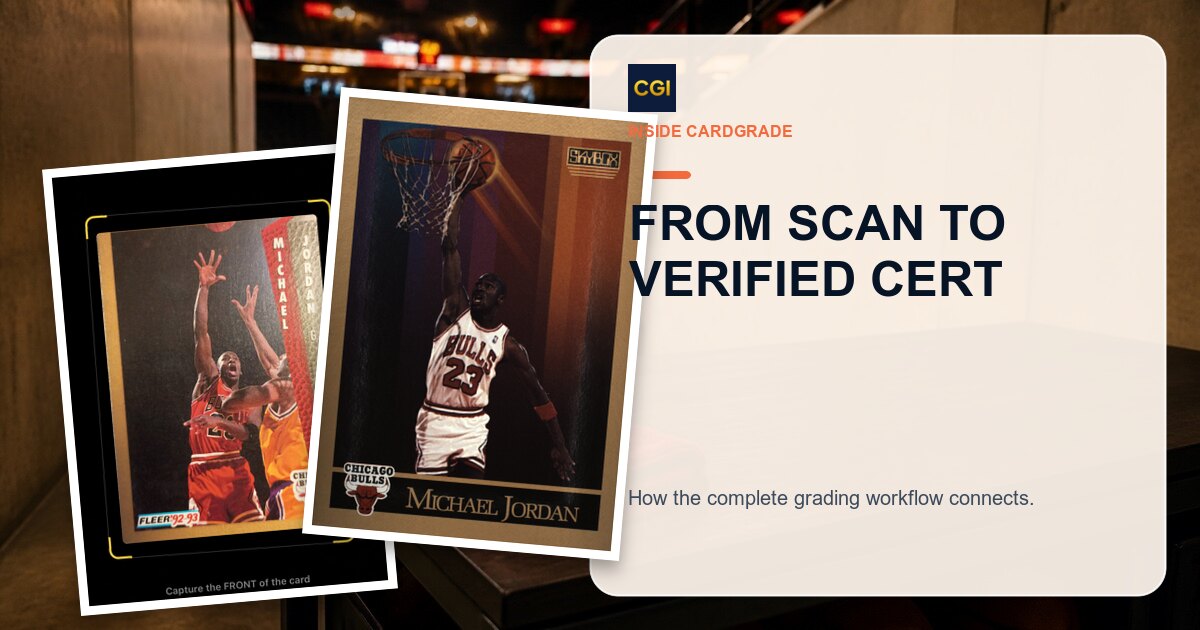
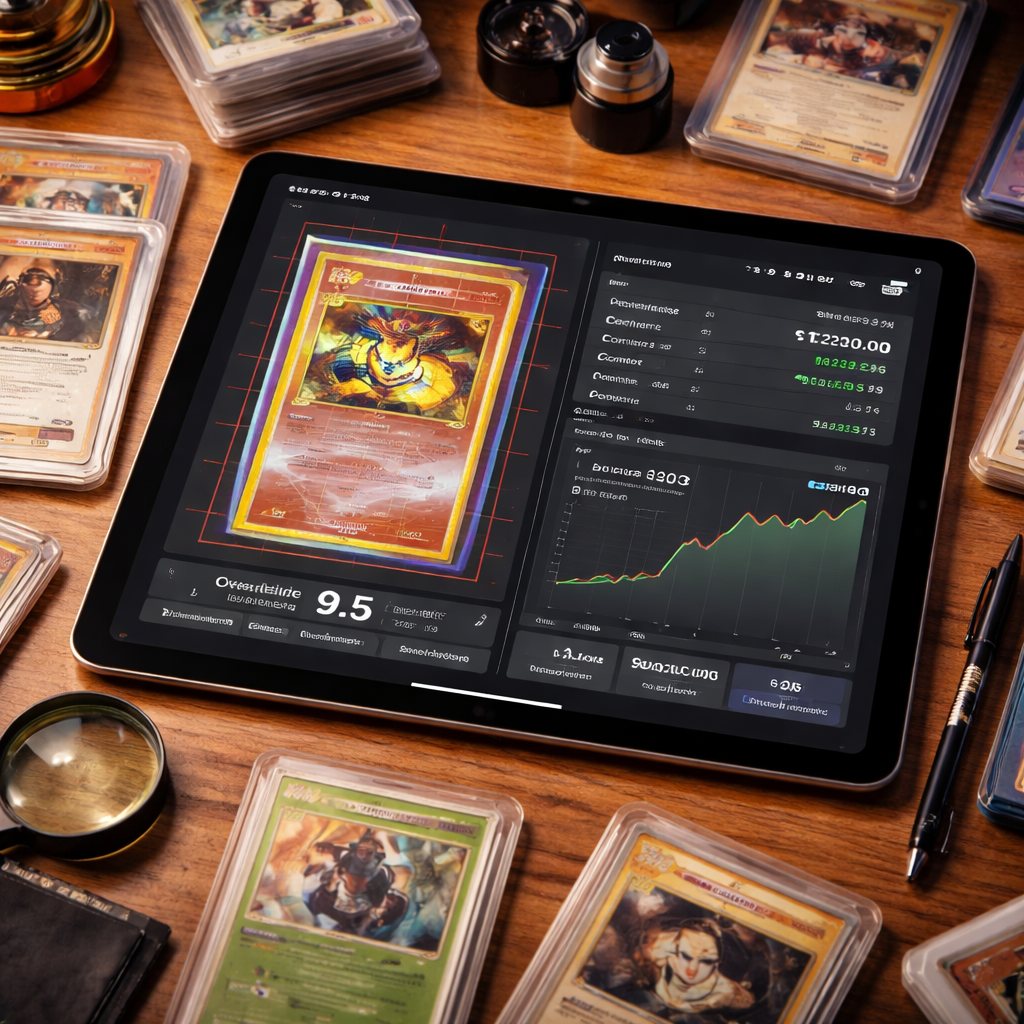
In short: Every CardGrade scan produces a digital certificate with exact centering ratios, per-corner and per-edge condition notes, surface defect markers, a confidence score, and predicted grades for PSA, BGS, and CGC — all in one permanent record you can share with buyers or reference before submitting. Understanding what each score means is the key to acting on it correctly.
Inside CardGrade: How Our AI Grading Workflow and Digital Certificates Work Together
CardGrade exists to answer one question before you spend money on professional grading: what grade is this card likely to receive?
The process starts with a photo and ends with a digital certificate that breaks down your card's condition across every factor that grading companies evaluate. This article walks through the complete workflow, explains what the certificate includes, and covers how to use it when buying, selling, or submitting cards for professional grading.
The Problem CardGrade Solves
Professional grading from PSA costs $22-$28 per card at entry-level tiers. CGC starts at $17. TAG at $15-$25. Across all companies, submission fees add up fast, and the outcome is uncertain until your card returns weeks or months later.
The industry-wide PSA 10 rate for modern cards hovers around 30-40%. That means 60-70% of submitted cards come back at PSA 9 or lower, many of them barely breaking even or losing money relative to their raw value plus fees.
CardGrade's AI pre-grading reduces that uncertainty. By analyzing your card's condition before you submit, you can make informed decisions about which cards are worth the grading fee and which should be sold raw, traded, or held.

The Workflow: Photo to Certificate
Step 1: Upload Your Card Photo
Go to cardgrade.io and upload a high-resolution photo of your card's front. The AI works best with:
- Well-lit images without harsh shadows across the card
- Flat orientation (card photographed from directly above)
- Card filling most of the frame
- Contrasting background (light card on dark surface, or dark card on light surface)
- Card removed from sleeves or toploaders to avoid reflections
You can upload from your phone camera, desktop, or any device with a browser. Supported formats include JPG and PNG.
Step 2: AI Analysis
Once uploaded, CardGrade's AI evaluates four grading factors:
Centering
The AI measures border widths on all four edges and calculates left/right and top/bottom centering ratios. These ratios are compared against grading company thresholds. For PSA, the current Gem Mint 10 standard is 55/45 front centering. The AI flags whether your card passes or fails this threshold and provides the exact measured ratio.
Corners
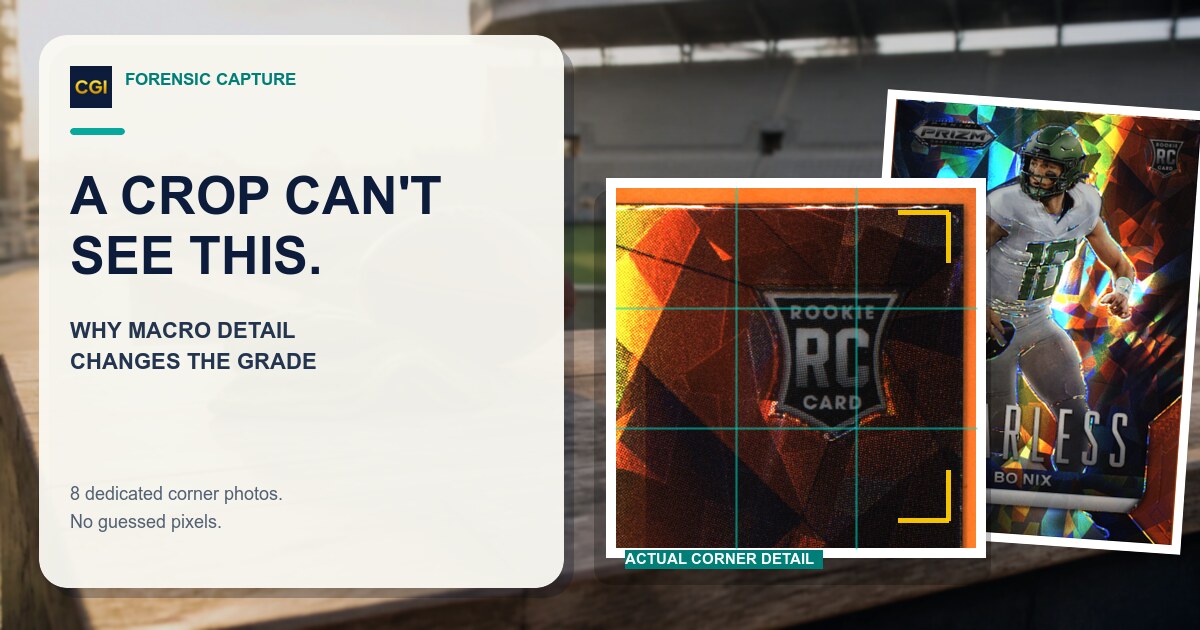
Corner analysis looks for whitening, dings, rounding, and impact damage at all four corners. Modern cards from packs typically have sharp corners, but even slight whitening from handling or pack friction can limit a card to PSA 9. The AI identifies corner issues and their severity.
Edges
Edge analysis evaluates the full perimeter of the card for chipping, whitening, rough cuts, and denting. Edge damage often occurs during pack opening or improper storage. The AI scans each edge and notes any defects.
Surface
Surface analysis is the most complex factor. The AI looks for scratches, print lines, surface contamination, ink spots, roller marks, and other surface defects. Some surface issues (like factory print lines) are common on modern cards and may or may not affect the grade depending on severity and grading company standards.
Step 3: Grade Prediction
After analyzing all four factors, the AI produces:
- Predicted grade range: A likely grade (e.g., "PSA 9-10") based on the combined assessment
- Confidence level: How certain the AI is in its prediction, accounting for factors like image quality and defect ambiguity
- Grade-limiting factors: The specific issue(s) most likely to prevent a higher grade (e.g., "centering: 58/42 limits PSA 10 potential")
- Factor-by-factor breakdown: Individual scores or assessments for centering, corners, edges, and surface
Step 4: Digital Certificate Generation
The analysis results are packaged into a digital certificate, a permanent record of your card's pre-grade assessment.
What the Digital Certificate Includes
The CardGrade digital certificate is a comprehensive document that captures everything the AI found during analysis:
Card Identification
- Card name, set, year, and number (when identifiable)
- Photo of the analyzed card
Grade Assessment
- Overall predicted grade range
- Confidence percentage
- Primary grade-limiting factor
Factor Breakdown
- Centering: exact ratios (left/right and top/bottom) with pass/fail against PSA 10, PSA 9, BGS 9.5, and CGC 10 thresholds
- Corners: condition assessment for each corner
- Edges: condition assessment for each edge
- Surface: identified defects with severity ratings
Visual Overlays
- Centering measurement overlay showing border widths
- Defect markers highlighting specific issues on the card image
Metadata
- Date and time of analysis
- Unique certificate ID for reference
The certificate is designed to be useful both for your own records and for communicating card condition to potential buyers.
Using the Certificate When Selling Cards
Digital certificates add credibility when selling raw cards. Buyers on eBay, Facebook groups, Discord servers, or any marketplace face the same problem: they can't inspect a raw card's condition from a listing photo alone. A CardGrade certificate provides objective, AI-generated condition data that goes beyond "looks mint to me."
In eBay listings:
Include the certificate or its key findings in your listing description. A centering measurement of 52/48 (near-perfect) backed by AI analysis carries more weight than a seller claiming "great centering" with no data. Buyers looking for gradable raw cards will find this information valuable.
In Facebook marketplace or Discord sales:
Share the certificate link or screenshot alongside your card photos. Serious buyers will appreciate the transparency, and it can justify higher asking prices for cards that show strong PSA 10 potential.
In trade negotiations:
When trading raw cards, the certificate provides a shared reference point for condition. Instead of arguing about whether a card is "mint" or "near-mint," both parties can reference the AI assessment and centering measurements.
The certificate does not replace professional grading. It's a pre-grade assessment, not an authenticated grade. But in raw card transactions, it's the closest thing to objective condition data that exists outside of a grading company's slab.
Using the Certificate for Submission Decisions
The most common use of the certificate is deciding whether to submit a card for professional grading. The workflow is:
- Upload card to CardGrade
- Review the certificate
- If the predicted grade meets your submission threshold, submit to your chosen grading company
- If the predicted grade falls below your threshold, sell raw or hold
This creates a data-driven submission pipeline that replaces gut-feeling decisions. Over time, tracking your certificates against actual grading results lets you calibrate your submission criteria.
For a detailed breakdown of how pre-screening math works, see our guide on how AI pre-grading boosts PSA submission success.
Privacy and Data Handling
CardGrade takes data handling seriously. Here's what happens with your uploads:
Your card images:
Photos you upload are used for AI analysis. They're stored securely to generate and maintain your certificates. CardGrade does not sell, share, or distribute your card images to third parties.
Your certificates:
Certificates are accessible to you through your account. You control whether to share them publicly (e.g., in a sale listing) or keep them private.
Account data:
Standard account information (email, username) is stored with industry-standard encryption. CardGrade does not require or store financial information beyond what's necessary for payment processing.
No third-party card data sharing:
CardGrade does not share information about what cards you own, what grades they received, or your submission patterns with grading companies, marketplaces, or any other parties.
How AI Grading Compares to Human Grading
AI grading and human grading serve different purposes, and understanding the distinction matters.
What AI pre-grading does well:
- Centering measurement (more precise than the human eye)
- Consistent evaluation (no grader fatigue, no mood variability, no subjective drift)
- Speed (seconds vs. weeks)
- Cost (fraction of professional grading fees)
- Accessibility (anyone with a phone can pre-grade)
What human grading still does better:
- Tactile assessment (feeling for surface texture, card stock quality)
- Context judgment (distinguishing factory defects from post-production damage)
- Authentication (verifying a card is genuine, not counterfeit)
- Final authority (the market values professional grading company labels, not AI predictions)
CardGrade's AI is not a replacement for PSA, CGC, or any professional grading service. It's a filter that helps you decide which cards deserve the investment of professional grading. Think of it as a metal detector on the beach: it tells you where to dig, but you still need to dig.
Getting Started
The workflow is designed to be minimal-friction:
- Visit cardgrade.io
- Upload a card photo
- Receive your AI analysis and digital certificate
- Use the results to inform your grading, selling, or collecting decisions
For centering-only checks, the free centering tool provides instant centering ratios for free, no account required.
For full condition analysis across all four grading factors with digital certificate generation, sign up for CardGrade and start screening your cards before your next submission.
The goal is simple: spend your grading budget on cards that will return value, and keep your money in your pocket for the ones that won't.