What Your AI Card Grade Means: Understanding Your Results | CardGrade
Guides
What Your AI Card Grade Means: Understanding Your Results
Just got your AI card grade from CardGrade.io? Here's exactly what each score means, how sub-grades work, and what to do next.
Jamie Budesky·Founder, CardGrade·Published Feb 21, 2026 · Updated Aug 7, 2026·11 min read
Your First AI Grade: Now What?
You just uploaded a card to CardGrade.io, and 60 seconds later you are looking at a screen full of numbers, sub-grades, and detailed notes. If you are new to AI card grading — or even new to card grading in general — this can be overwhelming.
This guide walks you through every component of your AI grade report, explains what each score means in practical terms, and helps you make smart decisions based on your results.
The Overall Grade
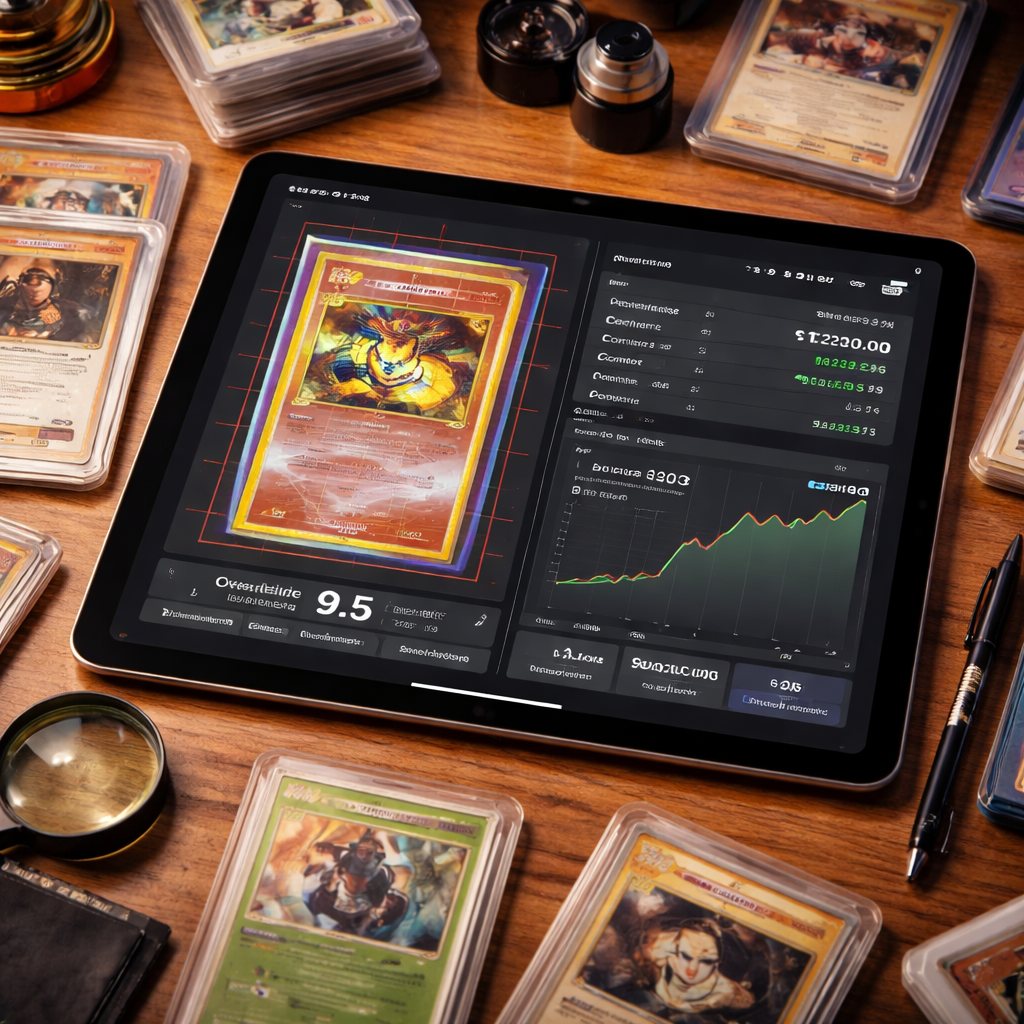
The most prominent number on your results page is the overall predicted grade. CardGrade.io displays predicted grades on three scales simultaneously:
PSA Scale (1-10)
PSA uses whole-number grades from 1 to 10. Your AI prediction maps to the same scale:
Beckett Grading Services uses a more granular scale that includes half-point grades (9.5, 9, 8.5, etc.) and displays individual sub-grades on the slab. Key BGS grades:
CGC Trading Cards uses a scale similar to BGS with half-point increments. Their standards align closely with PSA for most grade levels. See our CGC card grading guide for more information.
Why Three Scales?
Different grading companies have different standards and tolerances. A card that earns a PSA 10 might receive a BGS 9.5 because BGS has tighter centering requirements. By showing all three predictions, CardGrade.io helps you choose the right company for each card. For a full comparison of grading companies, see our card grading companies comparison.
Understanding Sub-Grades
Below your overall grade, you will see individual sub-grades for four categories. These are where the real insight lives.
Centering Sub-Grade
Your centering sub-grade reflects how well the card's printed image is positioned within its borders. The report includes:
Centering ratio (Left/Right): Displayed as a ratio like 50/50, 52/48, or 55/45
Centering ratio (Top/Bottom): Same format, measuring vertical centering
Grade impact: How centering affects your overall grade
How to read it:
50/50: Perfect centering. Maximum score in this category.
52/48 to 55/45: Good centering. Still eligible for top grades at most companies.
55/45 to 60/40: Acceptable for PSA 10 on the front, but will lower BGS centering sub-grade.
Beyond 60/40: Will impact the grade at all companies.
If your centering is the weakest sub-grade, you might want to verify it independently with CardGrade.io's centering tool. Our centering guide explains centering standards in full detail.
What you can do about poor centering: Unfortunately, centering is a factory defect and cannot be fixed. If centering is your card's weakest attribute, consider whether the card is still worth grading. Some collectors specifically seek out well-centered copies of popular cards for grading.
Corners Sub-Grade
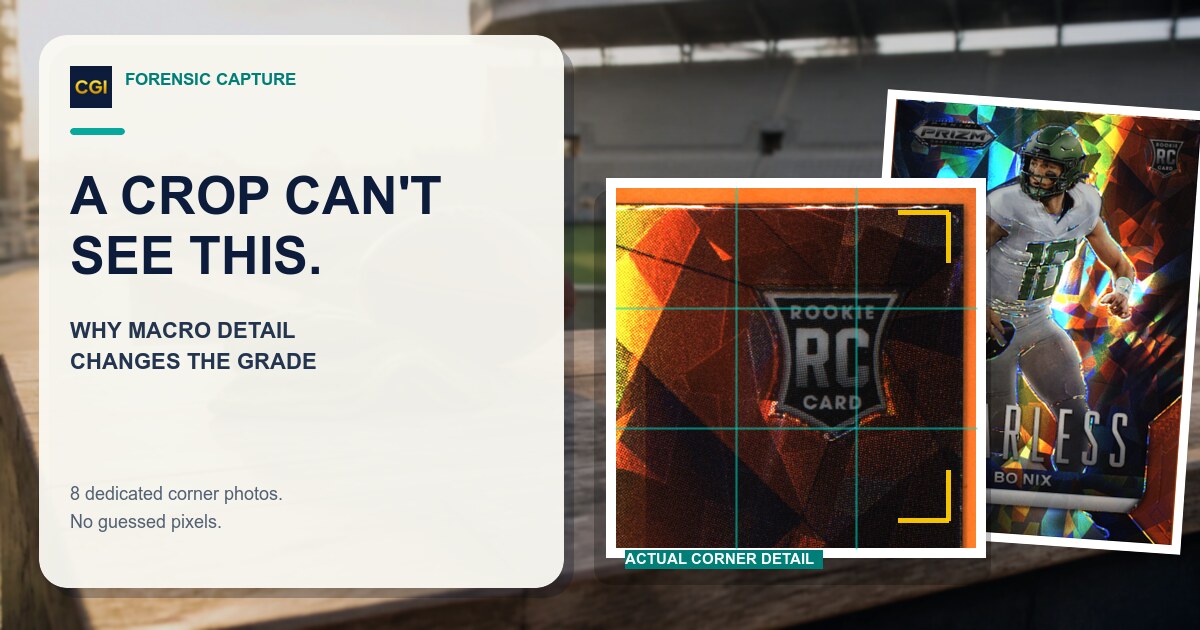
The corners sub-grade evaluates all four corners of your card and reflects the overall corner condition. The report may note specific issues at individual corners.
Common findings:
Sharp corners: All four corners are crisp and well-defined. Top scores.
Minor softness: One or more corners show slight rounding or softness. Typically knocks you from a 10 to a 9.
Visible whitening: The white card stock core is visible at one or more corners. Significant grade impact.
Dings or damage: Physical impact damage at corners. Major grade impact.
What you can do: Corner condition is largely fixed, but you can prevent further damage with proper storage. Place cards in penny sleeves immediately and use semi-rigid holders for cards you plan to grade. Handling by edges only prevents new corner wear.
Edges Sub-Grade
The edges sub-grade assesses all four edges of the card between the corners.
Common findings:
Clean edges: Smooth, consistent edges with no chipping or whitening. Top scores.
Minor chipping: Small chips visible under magnification, especially common on dark-bordered cards. Reduces grade by one or more points.
Edge whitening: White card stock visible along edge, typically from wear or factory cutting. Moderate grade impact.
Rough cut: Factory cutting was inconsistent, leaving an uneven edge. This is a manufacturing issue, not wear.
You can get a detailed edge analysis using CardGrade.io's edge tool.
What you can do: Like corners, edge condition is mostly fixed. Prevent further edge wear by never stacking cards without sleeves and avoiding any lateral friction. Some edge issues (like minor chipping on dark-bordered cards) are common enough that graders account for them, but they still affect the grade.
Surface Sub-Grade
The surface sub-grade is the most complex category, covering everything on the card's front and back surfaces.
Common findings:
Clean surface: No detectable scratches, staining, or print defects. Top scores.
Light scratching: Fine scratches visible under magnification or specific lighting. Common on glossy modern cards. Moderate grade impact.
Print defects: Factory printing issues — ink spots, missing ink, color misregistration. Impact varies by severity.
Surface contamination: Staining, fingerprints, or residue on the surface. Can often be carefully cleaned.
Creasing: Fold lines across the card. Significant grade impact.
Indentation: Pressure marks on the surface. Moderate to significant impact.
Use CardGrade.io's surface tool for a detailed surface analysis.
What you can do: Surface is the one category where you might be able to improve condition. Fingerprints can sometimes be carefully removed. Dust or light surface contamination can be cleaned. However, never attempt to "fix" scratches, creases, or print defects — this constitutes alteration and can result in your card being returned ungraded or marked as altered.
The Confidence Score
Your results include a confidence score that indicates how certain the AI is about its prediction. Understanding this score helps you calibrate your expectations.
High Confidence (90%+)
The AI is very confident in its prediction. The card's attributes clearly place it within a specific grade range. High-confidence predictions are your most reliable results.
Moderate Confidence (75-89%)
The AI is reasonably confident but sees some ambiguity. This often occurs with borderline cards — cards that fall near the boundary between two grades. A moderate-confidence PSA 9 might end up as a PSA 10 or a PSA 8 at the actual grading company.
Lower Confidence (Below 75%)
The AI has identified attributes that make the prediction less certain. This could be due to:
Image quality issues that limit analysis accuracy
The card type being underrepresented in training data
Conflicting signals (e.g., perfect centering but unclear surface condition)
Borderline attributes in multiple categories
When confidence is lower, treat the predicted grade as approximate and consider providing better photos or using the individual tools for targeted analysis.
What to Do Next: Decision Framework
Now that you understand your results, here is a framework for deciding what to do with each card.
Predicted PSA 10 / BGS 9.5+ (High Confidence)
Action: Strong submission candidate.
This card is likely to receive a top grade from a professional company. Calculate whether the graded value justifies the submission cost:
Look up the card's PSA 10 / BGS 9.5 market value
Subtract grading fees, shipping, and insurance
Compare the profit to the card's raw value
If the net gain is positive, submit
Predicted PSA 9 / BGS 9 (High Confidence)
Action: Submit if the value justifies it.
A PSA 9 or BGS 9 adds value for many cards, but the premium is smaller than a 10. Do the math:
PSA 9 values are typically 1.5-3x raw value for popular cards
For common cards, the PSA 9 premium may not cover grading costs
For valuable cards, a PSA 9 slab still provides significant value and liquidity
Predicted PSA 8 or Below (Any Confidence)
Action: Generally hold unless the card has high raw value.
For most modern cards, a PSA 8 or lower does not add enough value to justify grading fees. Exceptions include:
High-value vintage cards where even a PSA 5 carries a significant premium
Rare cards where authentication value (proving the card is genuine) matters regardless of grade
Personal collection cards you want encapsulated for protection
Low Confidence on Any Grade
Action: Investigate further.
When the confidence score is low:
Check your photo quality — retake if lighting or focus was poor
Physically inspect the card with a loupe, paying special attention to the categories where the AI noted issues
Consider running the card through AI grading again with a better photo
Comparing Your Results Across Companies
One of CardGrade.io's most powerful features is showing predicted grades across PSA, BGS, and CGC simultaneously. Use this to make strategic submission decisions:
When PSA Score Is Higher
If the AI predicts a PSA 10 but a BGS 9.5 for the same card, the issue is likely centering. PSA allows wider centering tolerances for a 10 than BGS does. Submitting to PSA gives you the best chance at the top grade.
When BGS Score Is Higher
If the AI predicts a BGS 9.5 but a PSA 9, the card likely has an attribute where BGS's half-point scale works in your favor. A card that is solidly between a 9 and 10 gets a 9.5 at BGS but must round down to 9 at PSA.
When Scores Are Equal
If all three predictions are the same, choose based on other factors: market liquidity (PSA usually wins), turnaround time, cost, and personal preference.
Over time, your CardGrade.io account builds a history of all cards you have graded. This history is valuable for:
Tracking collection condition: See how your collection's overall condition breaks down
Identifying trends: Notice if certain card types or sets consistently grade higher or lower
Insurance documentation: Maintain a condition record for insurance purposes
Buy/sell decisions: Reference past grades when deciding which cards to sell or hold
Improving Your Results
If you are consistently getting lower grades than expected, consider these improvements:
Better Photography
The single biggest factor in AI grade accuracy is photo quality. Invest 5 minutes in learning proper card photography:
Consistent, diffused lighting eliminates shadows and glare
Camera directly overhead avoids perspective distortion
Clean background (dark, non-reflective) helps the AI identify card boundaries
Maximum camera resolution provides more detail for analysis
Better Card Handling
If your cards are getting corner and edge wear between purchase and grading, improve your handling practices:
Always handle cards by the edges with clean, dry hands
Sleeve and top-load cards immediately after opening packs
Store cards in a cool, dry environment
Never stack unsleeved cards
Understanding Your Cards
Different card types have different grading characteristics:
Glossy modern cards show scratches more easily than matte vintage cards
Dark-bordered cards show edge chipping more visibly than light-bordered cards
Foil and holographic cards are more susceptible to surface scratches
Thick card stock (like Pokemon V/VMAX) tends to have better corner durability
Start Grading
Ready to understand your cards better? Sign up for CardGrade.io and get plan credits. Upload a card, explore the detailed grade report, and use this guide to interpret every score and sub-grade.
Whether you are pre-screening before a PSA submission, evaluating a potential purchase, or simply curious about your collection's condition, your AI grade report gives you the data you need to make confident decisions.
Jamie Budesky is the founder of CardGrade and the engineer behind its AI vision grading pipeline. An Army veteran and IT specialist (DoD, since 2017), he writes about card grading, AI/ML grading technology, and collecting strategy — grounded in CardGrade's own grading data.